
Nearly $100 billion of intervention can't stop the yen from heading straight to 160? Yen exchange rate gives back nearly half of its rebound, US-Japan joint intervention effect is fading

The Japanese yen has slightly weakened against the US dollar, approaching a key level, which may trigger market speculation that Japanese authorities will intervene again to support the yen.
According to Zhihui Finance APP, the Japanese yen continued to weaken slightly in forex trading on Tuesday, approaching a very critical level on the USD/JPY upward trajectory (which means further yen depreciation). This could spark speculation that the Japanese Ministry of Finance might intervene once again to support the yen. Even after joint intervention by the U.S. and Japanese governments, the yen is once again approaching 160, with the core logic being that while FX intervention can change short-term capital flows, it cannot alter the fragile fiscal outlook, relative yield gap, and the monetary policy reaction function that fundamentally determine the level of the exchange rate.
On Tuesday, with Tokyo markets closed for a holiday, market volatility was relatively mild, but FX traders are preparing for the yen’s depreciation path to reach 160 yen per U.S. dollar. This key level has previously capped further yen weakness. During London trading hours, the yen briefly fell 0.1% to 159.39 per U.S. dollar.
On Monday, as the U.S. dollar strengthened against most G10 currencies, the yen fell by 1%, marking its worst single-day performance since mid-February. The yen has now given back nearly half the gains it made since July 31, the day Japan and the U.S. implemented their first joint and coordinated intervention since 1998 to strongly support the yen.
Senior strategist Masayuki Nakajima from Japanese banking giant Mizuho wrote in a report: "If the USD/JPY rate clearly breaks past the psychologically significant 160 level, concerns about intervention may intensify in the market."

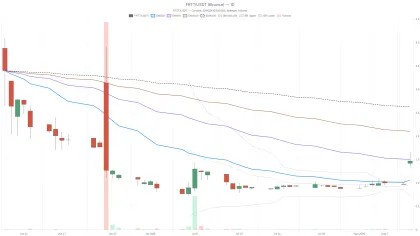
As shown in the figure above, the yen’s decline has triggered discussions about possible further government intervention—the yen has already given back nearly half the gains from the Japan-U.S. joint yen-buying operation in July.
U.S. Treasury Secretary Yellen’s “whatever it takes” commitment to support the yen by the U.S. government essentially masks the very limited firepower for intervention.
This joint intervention helped the yen rebound from around 164 yen per dollar—a nearly 40-year low—at the end of July, rising to as much as 155 yen per dollar earlier this month.
Analysis by financial institutions based on Bank of Japan accounts shows that government authorities, coordinated by the U.S. Treasury, may have used about $34 billion to intervene in foreign exchange markets on July 31 to support the yen. The day before that, authorities coordinated by the U.S. may have already spent $53 billion; if this is officially confirmed, it could mark the largest single-day forex intervention on record.
But as market participants once again turned their attention to fundamental drivers, the yen has gradually weakened again. Even though officials in Tokyo and Washington warn that they are ready to act jointly again if necessary, the substantial interest rate differential between the U.S. and Japan, concerns about Japan’s fiscal and monetary policy outlook, and ongoing geopolitical uncertainty continue to put pressure on the yen.
For the Japanese government, the bigger challenge is that the problem is not purely a monetary policy issue, but rather a “interest rates–fiscal–exchange rate” trilemma. This makes yen intervention reflexive—the more frequent the intervention, the more important policy credibility becomes. Japan must raise rates to truly narrow the U.S.-Japan spread, but higher Japanese rates would also increase financing costs for its massive government debt and the term premium for Japanese government bonds; if the government hesitates on rapid BOJ tightening for this reason, markets will question to what extent policy rates can really rise.
At the same time, if Japan relies on foreign reserves to continuously buy yen, this could involve a global reallocation of bond assets and have spillover effects on already-stressed long-term U.S. yields—this is also a key reason for rare U.S. participation in this round of coordination.
Even nearly $100 billion in intervention couldn't stop 160! The yen’s true “short engine” isn’t speculation, but the U.S.-Japan interest rate gap
The rare joint yen buying by Japan and the U.S. around July 31 temporarily pushed USD/JPY down from around 163.99 to 155.20, but as of August 11, it had already rebounded above 159, giving back about half its gains. The real issue is that the BOJ’s July meeting decided 8:1 to maintain policy rates at 1.0%, with only Hajime Takata favoring a direct hike to 1.25%; by contrast, U.S. policy rates and 10-year (or longer) Treasury yields remain distinctly higher, while the short-end rate gap is still enough to maintain the yield advantage of U.S. dollar assets and the economic basis for yen-funded carry trades.
BOJ Governor Kazuo Ueda’s hawkish signals about possibly accelerating rate hikes did lead the market to view a September rate hike as increasingly likely, but expected hikes are not the same as an actual narrowing of the interest rate gap—as long as Japan’s actual rate increases lag behind traders’ expectations, the fundamental carry structure supporting short-yen positions remains intact.
The surprise miss in U.S. nonfarm payrolls actually proved this: what can truly drive sustained yen appreciation is not “how much the government bought,” but whether the U.S.-Japan rate spread narrows persistently. On July 5, after U.S. nonfarm data unexpectedly showed a drop of 23,000 jobs—far below expectations of an 80,000 gain—U.S. short-term yields plunged, and USD/JPY briefly fell 1.1% to 156.68, a classic case of fundamentals repricing: the market revised Fed tightening expectations downward → U.S. yields dropped → the dollar’s yield advantage narrowed → yen rose. Yet with Middle East geopolitical risks pushing oil prices up and lifting U.S. inflation risk and bond yields, the dollar quickly regained its rate spread support, and the yen was soon sliding back toward 160.
The joint intervention by Japan and the U.S. is more about raising the cost of shorting the yen and injecting two-way risk during disorderly exchange rate moves than fundamentally changing the equilibrium price of USD/JPY. Thus, although short positions shrank sharply after the joint intervention, if the Bank of Japan does not tighten policy further to meet market rate expectations, these short positions may very well be rebuilt.
Disclaimer: The content of this article solely reflects the author's opinion and does not represent the platform in any capacity. This article is not intended to serve as a reference for making investment decisions.
You may also like
3 Altcoins Poised for a Breakout as Key Crypto Catalysts Approach

Strategy cratered 75% over 12 months, analyst sets 350% target price
What Anthropic's $9 Billion Deal With This Data Center Operator Means for the AI Boom -- Barrons.com
Fort Technology Inc. stock breaks out to $1.47 as RSI hits 85.65—rally at risk?
Crypto prices
More


