
Interest Rates Fall but Gold Prices Don't Rise? Unveiling the Core Pricing and Turning Point Logic

Huitong Network, September 21 — Breaking the interest rate pricing misconception! Deconstructing the abnormal gold market—fiscal expectations and economic growth are the core keys for the future.
On Monday (September 21) during the Asia-Europe session, the US 2–30 year Treasury yield fell throughout the day, coupled with a decline in the US Dollar Index. Spot gold eventually showed a dip and rebound pattern, digesting prior high-level long profit-taking pressure, and is currently trading around 4365.
There is a key market question here: with US Treasury yields falling (corresponding to rising Treasury prices), which traditionally benefits gold, why didn't gold surge immediately during the session, but instead first dipped and then gradually rebounded along with the dollar’s decline near the close? The FTPL framework can explain this paradox clearly.
That is, in some situations, when real interest rates fall, gold might also fall together. Under what circumstances does this occur?
Fiscal Theory of the Price Level (FTPL): Rising Holding Costs Can Also Boost Gold Prices
First, let’s introduce a formula previously discussed in FTPL articles: the total US government debt equals the price level X the discounted sum of US government surpluses.
So when the government experiences a debt crisis, the higher the real interest rate, the greater the government’s debt issues and the harder it is to repay. Assuming total debt remains unchanged, the discounted sum of government surpluses shrinks significantly as interest payments increase and discount rates rise. Only a substantial increase in the price level—i.e., a fall in purchasing power—can fill this gap. In such cases, higher rates can actually push up gold prices, as sharply rising prices benefit gold as a universal equivalent.
This theory explains why earlier surges in yields were accompanied by strong gold prices. Conversely, as this narrative eases now, rates are pulling back and gold is also down, for essentially the same reason. We can’t always attribute gold price corrections purely to profit-taking; this time, the logic for gold’s pullback and its earlier rally are complementary.
Divergence Between US and French Treasuries: Differing Risk Premium Pricing
The recent comparison between US Treasuries and French bonds best illustrates how fiscal expectations affect bond yields.
France’s fiscal deficit has remained at 5% of GDP amid great uncertainty before the election. Policy expectations about tax cuts and pension reductions amplify the deficit pressure;
Taxation is already high with little room for further hikes, and with foreign investors holding 57% of the debt, capital flight risks persist.
The market continuously demands a higher risk premium, pushing the French-German bond spread towards the 1% psychological level. There is even market discussion about the ECB’s TPI tool as a “nuclear option.”
Economic resilience grows the tax base. The market believes the US government’s tax revenue can support it, reducing worries about a future US debt explosion and lowering the fiscal risk premium in US bonds.
Capital is not passively buying US Treasuries because of lower rates, but is actively allocating to Treasuries in a high-rate environment, which is sharply contrasted by France’s bond market, where worsened fiscal conditions lead to a soaring risk premium.
It is precisely the marginal improvement in US fiscal expectations that has brought down US nominal yields, also affecting the core logic behind the previous gold rally.
Deconstructing Multiple Factors Driving Recent Gold Price Volatility
Nominal rate ≠ real rate—core contradiction in the short-term market
Gold prices are anchored to real rates, not nominal rates.
This time, nominal US bond yields declined due to market repricing of US sovereign debt risk premiums.
For now, the US economy is strong, inflation remains sticky, and the decline in TIPS real rates is limited. This is why, recently, even with a slight retreat in bond yields, gold did not rally sharply right away.
Only when real rates truly decline does gold’s opportunity cost decrease substantially.
Though oil prices fell sharply today, gold prices did not show a significant rise.
On one hand, easing tensions in the Middle East quickly erased the geopolitical risk premium, dampening gold’s rebound; on the other hand, oil doesn’t have a clear short-term bearish driver and is likely to undergo further upside volatility later.
The Nasdaq and other equity assets continue to rise, with improving corporate earnings expectations, attracting capital toward risk assets.
Gold, as a non-interest-bearing asset, loses allocation appeal in a hot economy where both stocks and bonds are favored. High-level longs take profit, and the gold price enters a consolidation phase.
This is a phase of capital rebalancing, not a long-term trend reversal.
Two Scenario Projections: Gold’s Turning Point Lies in Fiscal Expectations
Market expectations for future US fiscal surpluses remain stable, fiscal risk premiums fall, and US nominal yields trend down. Gold stays in a bottoming consolidation, waiting for catalysts, with a slow upward pace.
High rates mean high interest expenditure, becoming a heavy passive burden on the US government. If tax revenue can’t cover rising interest costs, the present value of future government surpluses shrinks, with debt continuing to pile up. According to FTPL theory, the price level will be repriced and long-term inflation expectations will expand significantly.
If inflation expectations rise faster than nominal rates, real interest rates fall significantly.
At this point, gold will realize two major values simultaneously: hedging against long-term inflation from sovereign fiscal issues and hedging economic downturn risks. The opportunity cost of holding gold drops sharply, and even if nominal rates are high, gold could enter a trend-wise bull market.
Summary & Technical Analysis:
In the short term, robust US economic data restores confidence in US Treasuries, pulling down nominal rates and completing the bottoming process for gold prices.
However, the essence of this round of rate declines is a fall in the fiscal risk premium, not monetary easing. The equity market’s current strength means gold likely remains in a consolidation.
Over a longer period, the ultimate pricing power for gold is not only in the Fed’s rate decisions, but also in market expectations for US long-term fiscal sustainability.
If economic growth disappoints and tax revenue cannot match the interest expense expansion, the FTPL pricing logic will again dominate the market, setting the stage for a trend reversal and new rally in gold.
Technical: Spot gold is suppressed by the lower edge of the trading range, and this rebound has already priced in recent positives. Further moves need new catalysts.
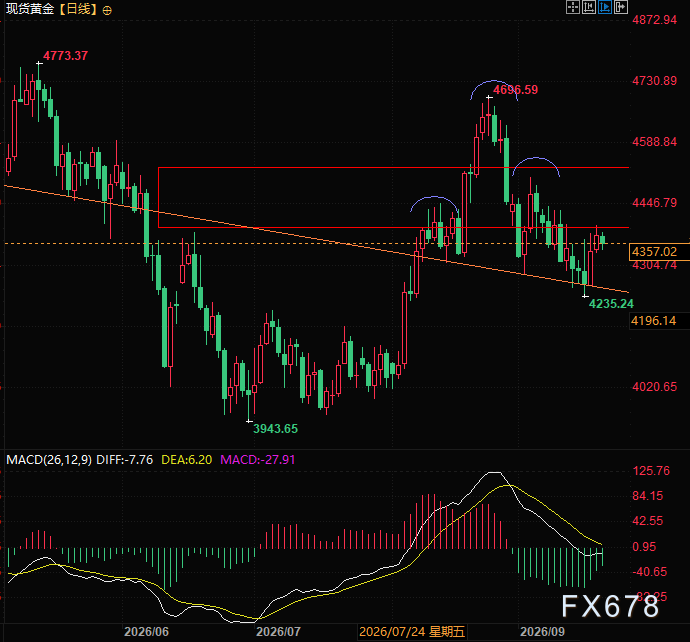
(Spot gold daily chart, source: Yihuitong)
Beijing time 21:04, spot gold was last quoted at $4,357/ounce.
Disclaimer: The content of this article solely reflects the author's opinion and does not represent the platform in any capacity. This article is not intended to serve as a reference for making investment decisions.
You may also like
CLARITY Act fails, but ‘crypto didn’t blow its big moment’ yet
Solana rises 5%, breaks $110 resistance as ZETA token migration fuels rally

AI Computing Power Boom Faces Doubts from Influencers: Rothschild Shorting "AI New Cloud," "Big Bear" Warns of $3 Trillion Off-Balance-Sheet Commitments
From the perspective of data center project economics, the Rothschild research report investigates how much shareholder return remains after GPU rental income covers equipment depreciation, operating expenses, and financing costs.
HP (HPQ.US) Cools Down PC Industry Expectations: Shipments to Decline in 2027, Can "Growth-Driven Revenues" Hold Up?
HP warned in its filing to the SEC that PC shipments will decline by a mid-single digit percentage in 2027, stating that this aligns with third-party forecasts. The stock fell over 5% in pre-market trading.
Crypto prices
More


