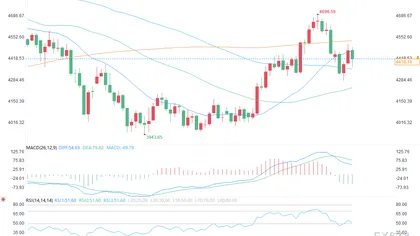
(Kitco NewsWire) - Spot gold and silver prices are lower in late-afternoon U.S. trading Friday, after a stronger-than-expected August employment report lifted Treasury yields, firmed the U.S. dollar and revived expectations that the Federal Reserve could raise rates at its Sept. 15-16 meeting. At the time of writing, spot gold was trading near $4,429.40 an ounce, down 0.96%, while spot silver was trading at $66.040, down 1.21% on the session.
North American equity markets closed lower as the jobs report pushed rate risk back into focus. The S&P 500 fell 29.11 points, or 0.4%, to 7,718.60, the Dow Jones Industrial Average dropped 271.86 points, or 0.5%, to 53,414.25, the Nasdaq Composite lost 77.07 points, or 0.3%, to 26,506.99, and the Russell 2000 rose 7.38 points, or 0.2%, to 2,975.65. European markets finished mixed, with the STOXX Europe 600 up 0.12% to 649.88. London’s FTSE 100 was virtually unchanged at 10,831.09, Germany’s DAX rose 0.17% to 26,046.40, France’s CAC 40 slipped 0.09% to 8,278.77, and Italy’s FTSE MIB fell 0.28% to 52,100.43.
The latest positioning turned back against precious metals after nonfarm payrolls rose by 162,000 in August, well above expectations, while June and July revisions added 55,000 jobs and the unemployment rate held at 4.1%. The two-year Treasury yield rose to about 4.37% to 4.38%, its highest level since January 2025, while the 10-year yield traded near 4.77% to 4.78%. Fed-hike pricing moved back into the 60% to 65% area, up from roughly coin-flip levels before the release. The next policy inputs are next week’s PPI and CPI reports, with CPI due Sept. 11. For gold, the jobs print shifted the market away from Thursday’s Waller-led pause trade and back toward the Warsh view that inflation remains the dominant risk.
Gold and silver sold off with the rates trade, but both finished off their session lows. Gold fell from the $4,490 area to an intraday low near $4,365 before recovering above $4,420, leaving it between the $4,489.87 resistance level and the $4,319.50 to $4,230.51 support zone. Silver tested moving-average support after the jobs surprise, but the selloff did not produce a decisive break below the $65.20 to $65.66 moving-average band. The metals complex remains vulnerable if next week’s inflation data keep the Fed-hike trade intact, while a softer PPI/CPI sequence would give Waller’s pause argument fresh support.
The Strait of Hormuz remains the main geopolitical channel into oil, inflation expectations and defensive demand. Diesel hit a record U.S. average price of $5.85 a gallon as the six-month U.S.-Iran war continued to disrupt global fuel flows, with most tanker traffic still bottlenecked around Hormuz. Brent crude remained above $95 a barrel, and U.S. crude traded near $90 despite easing from this week’s highs. For gold, the setup remains conflicted: Hormuz risk and fuel-market stress support defensive demand, but higher energy costs feed inflation pressure, strengthen the Fed-hike case and raise the opportunity cost of holding non-yielding metals.
The key outside markets see Nymex WTI crude oil prices lower and trading around $89.87 a barrel, while Brent crude was near $94.26. The yield on the benchmark 10-year U.S. Treasury note is trading near 4.77%. The U.S. dollar index is firmer. (Kitco Global Index shows how much of today's gold move is the dollar versus the gold market itself.)
Technically, spot gold bulls' next upside price objective is to push prices back above the $4,489.87 resistance level, with a sustained move targeting $4,534.09 and then $4,538.77. Bears' next near-term downside price objective is a break below $4,319.50, with deeper downside targets at $4,239.55 and then $4,230.51. First resistance is seen at $4,489.87 and then at $4,534.09. First support is seen at $4,319.50 and then at $4,239.55.
Spot silver bulls' next upside price objective is to drive prices back above $67.21, with a move above that level targeting $68.74 and then $70.76. The next downside price objective for the bears is a break below $65.660, with deeper downside targets at $65.200 and then $63.80. First resistance is seen at $67.21 and then at $68.74. Next support is seen at $65.660 and then at $65.200.
See live precious metals prices for gold, silver, platinum and palladium — in USD, CAD and 12 more currencies.