
Gold Weekly Outlook: Fed Uncertainty Limits Upside Potential

FXStreet, Sep.5— Gold managed to rebound after a bearish trend in the first half of the week. Upcoming US August inflation data may help the market determine whether the Federal Reserve will hike rates. The short-term technical outlook shows a slightly bullish but momentum-lacking stance.
After a sharp decline early this week, spot gold fully recovered its losses, reflecting a shift in market pricing for the Federal Reserve’s (Fed) next rate decision. Investors are closely watching US August inflation data, while the short-term technical outlook for precious metals shows sellers remain hesitant.
In the first half of this week, gold remained under pressure as Federal Reserve Chair Kevin Warsh reignited expectations for a September Fed rate hike with his hawkish remarks at the Jackson Hole symposium. Meanwhile, the escalating Middle East crisis further weighed on gold prices, pushing them to their lowest levels since early August, with prices dropping below $4,300 by Wednesday’s early trading.
Last weekend, the US and Iran launched military strikes against each other for the first time in weeks. The US attacked two rocket launch devices on Iran's Larak Island, and in response, Iran targeted US military bases in Jordan and the United Arab Emirates (UAE). During Tuesday's US trading session, news of the US strikes—and Tehran’s claims of civilian casualties—marked another escalation in the military conflict. Following the attacks, US President Donald Trump stated on Truth Social that Iran "will be hit back even harder and stronger, but this won’t be the biggest strike yet; the biggest is still in the making." In response, the Islamic Revolutionary Guard Corps claimed it had attacked two US military bases in the UAE.
On Wednesday afternoon, spot gold gathered rebound momentum and closed higher for the day. US private sector employment data missed expectations, putting pressure on the US dollar, while a sharp drop in USD/JPY suggested possible intervention in the forex market.
On Thursday, the dollar faced renewed selling pressure, allowing spot gold to extend its rebound for a second consecutive session.
Federal Reserve Governor Christopher Waller’s cautious stance on policy tightening made the dollar less attractive. Waller’s key comment—that if August inflation continues to improve, he would lean towards keeping the policy rate unchanged in September; but if the data is hot, he would consider a rate hike—highlighted a finely balanced, data-dependent reaction function, indicating that a rate hike at the next meeting is not a foregone conclusion. He admitted to "finally" seeing signs of inflation easing, while noting that it remains elevated and his tolerance for renewed price pressures is low, further underpinning his cautious attitude toward hikes. Following Waller’s speech, the CME FedWatch Tool showed the probability of a 25-basis-point hike at the upcoming Fed meeting dropping from about 63% a week earlier to 50%. As a result, gold climbed above $4,500 late on Thursday, completely erasing the week’s earlier losses.
OCBC analysts, commenting on gold price action, pointed out that gold "rose over 2%, briefly approaching a high of $4,510 during the session, as Waller’s speech led markets to temper expectations for a September Fed hike, pushing down Treasury yields and the dollar." They said this movement "partially reversed the sharp sell-off earlier in the week—when Warsh’s Jackson Hole comments and rising global yields pressured precious metals." OCBC added, "Geopolitical tensions still provide marginal support for gold, but higher oil prices feeding into inflation expectations and yields present a double-edged risk."
Data released on Friday showed US nonfarm payrolls increased by 162,000 in August, far exceeding the expected gain of 56,000 and causing the dollar to strengthen in response. Other details of the report showed overall June and July employment numbers were revised up by 11,000 and 44,000, respectively, while the unemployment rate remained at 4.1%. After the strong labor market report, gold failed to extend its rally and faced resistance as the weekend approached.
Before the September 15-16 policy meeting, the Fed will enter a blackout period. Therefore, the US Bureau of Labor Statistics (BLS) Consumer Price Index (CPI) data to be released on Friday will serve as the final and perhaps most crucial clue for determining whether the Fed will opt for a rate hike.
Fed Governor Waller noted that "continued progress toward our 2% target" is necessary in order for him to vote to keep policy unchanged, adding that his decision will "be influenced by our understanding of August inflation." Although Waller’s 2% target refers to the annual core Personal Consumption Expenditure (PCE) Price Index, a monthly core CPI reading below July's 0.2% could still be viewed as confirmation of "progress," possibly triggering immediate dollar selling. In this scenario, spot gold is likely to build bullish momentum ahead of the Fed meeting. Conversely, if the monthly core CPI reading equals or exceeds 0.2%, it may reinforce rate hike expectations and put significant pressure on gold.
In summary, given that after strong August employment data, markets currently see about a 60% chance of a rate hike, gold faces two-sided risks ahead of Friday’s US inflation report.
Strategists at TD Securities believe gold’s backdrop has become more favorable. The firm emphasized, "Given improved precious metals prospects under a new dollar depreciation theme, and with Fed hikes still far from certain, we do not see substantial downside for gold." A weakening dollar narrative combined with ongoing policy uncertainty at the Fed is seen as helping anchor gold prices amid recent market volatility.
Gold Technical Analysis: Bullish Bias Remains, But Lacks Momentum
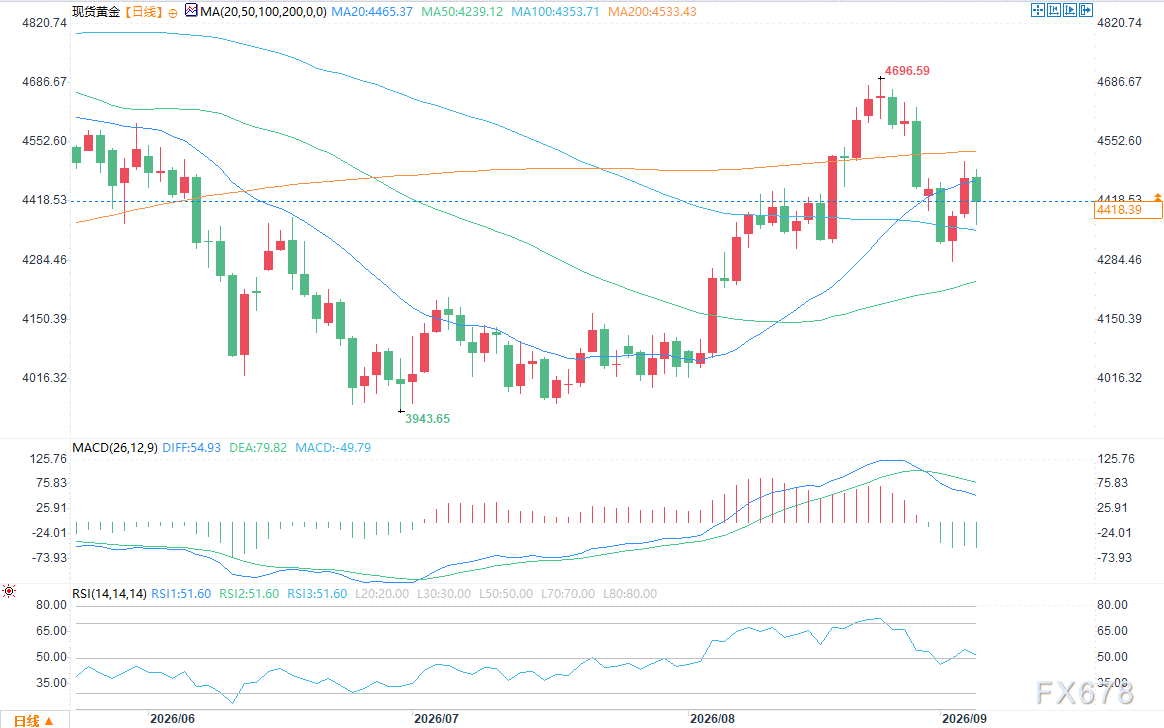
(Spot Gold Daily Chart Source: FXStreet)
The daily Relative Strength Index (RSI) dipped below the neutral 50 line early in the week but has since recovered above that level, now reading around 51.6. In addition, despite previously closing below it, gold has reclaimed the 100-day Simple Moving Average (SMA), currently around $4,354. However, the daily RSI remains flat above 50, and gold has yet to break decisively above the 200-day SMA at around $4,533, indicating buyers are still reluctant to bet on a sustainable upward trend.
On the upside, $4,510–$4,535 (the 38.2% Fibonacci retracement of the March-August downtrend, 200-day SMA) forms a key resistance area. If gold stabilizes above and confirms this zone as support, the next bullish target could be $4,675–$4,700 (50% Fibonacci retracement, round number), followed by $4,850 (61.8% Fibonacci retracement).
On the downside, the first important support is around $4,354 (100-day SMA), followed by $4,300–$4,295 (static level, 23.6% Fibonacci retracement) and around $4,239 (50-day SMA).
Disclaimer: The content of this article solely reflects the author's opinion and does not represent the platform in any capacity. This article is not intended to serve as a reference for making investment decisions.
You may also like
Digital Asset Investor outlines 101 XRP reasons, cites BIS focus and Senate vote
Bitcoin rises 998,000% in 15 years, annualized return near 85%
4 dormant Bitcoin wallets move $15.73 million, oldest since 2011, Galaxy Research reports
CASHCAT drops 16% – But THIS metric flashes hope for bulls
Crypto prices
More


