
Global Energy Roundup: Market Talk
 Dow Jones2026/09/02 10:23
The latest Market Talks covering Energy markets. Published exclusively on Dow Jones Newswires throughout the day.
1023 GMT - Treasury yields continue to rise, with the 10-year yield hitting near three-year high, while the dollar reaches its highest in nearly three weeks as rising oil prices add to expectations for higher U.S. interest rates. "Federal Reserve Governor Michael Barr stated that he would support an interest-rate hike should inflation fail to moderate," Exness' Christopher Tahir says in a note. More comments like this from other Fed officials could further bolster yields and the currency, the strategist says. Middle East tensions add to this narrative, reviving inflation concerns, he says. The DXY dollar index rises to a high of 99.847. The 10-year Treasury yield reaches 4.818%, according to LSEG. (emese.bartha@wsj.com)
1022 GMT - Palm oil ended lower, tracking weakness in the soybean oil market, according to David Ng, a trader at Kuala Lumpur-based Iceberg X. Recent weakness in export performance also weighs on the vegetable oil's price, he says. Ng sees prices for palm oil supported above 4,900 ringgit a ton and resistance at 5,050 ringgit a ton. The Bursa Malaysia Derivatives contract for November delivery falls 13 ringgit to 4,970 ringgit a ton. (tracy.qu@wsj.com)
0902 GMT - BP's permanent appointment of interim chairman Ian Tyler isn't a surprise but might be seen as too conservative, AJ Bell's Dan Coatsworth says. "Tyler is more of a known quantity than his predecessor Albert Manifold, having joined BP's board nearly 18 months ago and sat in the chair's seat since Manifold's acrimonious departure in May," AJ Bell says. The appointment may be seen as too cautious, as Manifold's hiring as an outsider was to shake up the oil major. "The initial market reaction suggests Tyler's appointment hasn't sparked much in the way of excitement or disquiet, and CEO Meg O'Neill will hope it gives her the space and time to make the changes she wants at the business," Coatsworth adds. Shares are down 0.8%. (michael.hennessey@wsj.com)
0849 GMT - The oil market is increasingly pricing the cost of an unresolved war, Phillip Nova'a Priyanka Sachdeva says in a note. The latest disruption is no longer limited to military escalation, as reports of attacks on vessels passing through the Strait of Hormuz bring the risk directly into the physical oil supply chain, the analyst notes. The most feasible outcome now looks like stretched negotiations and prolonged trouble for oil flows, rather than a quick resolution, she says. The longer the disruption continues, the greater the risk that higher crude prices become embedded into inflation expectations and eventually into monetary policy decisions, Sachdeva adds. (sherry.qin@wsj.com)
0828 GMT - Diesel markets remain tight globally, particularly in the Atlantic Basin, says June Goh of Sparta Commodities. India and Northeast Asian countries are sending more fuel west to help ease shortages, but those shipments might not be enough to close the gap. Meanwhile, other refined products also remain elevated. With U.S. plants already running near full capacity, there is little spare capacity to replace lost production, leaving the market particularly exposed to disruptions. "The threat of any unplanned shutdowns including hurricanes has the potential to increase refined product cracks further," the senior oil analyst says. (giulia.petroni@wsj.com)
0809 GMT - The euro weakens to its lowest in two weeks against a broadly stronger dollar as renewed Middle East hostilities increase energy prices. Rising oil and gas prices, in addition to increased expectations that the Federal Reserve could raise interest rates soon--potentially as early as this month--leave the euro vulnerable to further declines, ING's Chris Turner says in a note. The euro could extend its drop to $1.1520, while $1.1500 "looks an appropriate target for month-end," he says. The euro falls to a low of $1.1565, LSEG data show. (jessica.fleetham@wsj.com)
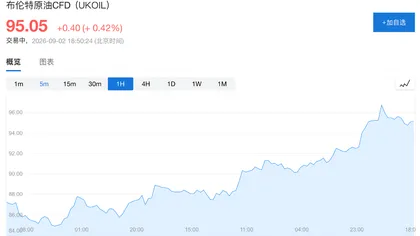
0752 GMT - Oil prices hold onto Tuesday's gains after the U.S. and Iran exchanged strikes overnight, clouding prospects for a near-term deal to reopen the Strait of Hormuz. "These latest developments have underscored the lack of a realistic path towards normalizing maritime traffic through the Strait," says Ricardo Evangelista from brokerage ActivTrades. "The absence of a credible timeline is increasing investor anxiety." In early European trading, Brent crude is up 0.3% to $94.91 a barrel, while WTI futures are flat at $90.19 a barrel. Escalating tensions are also keeping refined-product markets, especially diesel, extremely tight. Disruptions to Middle Eastern and Russian exports are pushing diesel refining margins to record levels, with strong seasonal demand and limited spare refining capacity likely to keep prices elevated and volatile, according to analysts. (giulia.petroni@wsj.com)
0734 GMT - The Middle East conflict, which has lifted oil prices back up to $95 in recent days, seems stuck in a phase where the tussle for control of Hormuz leads to recurring hostilities, nourishing the risk premium in oil prices, says Norbert Rucker, head of economics at Julius Baer. "While the conflict is enduring and is feeding energy markets with geopolitical uncertainties, oil and natural gas supplies proved surprisingly resilient so far," he says in a note. The Middle East is still supplying oil, except for Iran, he says. Overall, the oil market's fundamentals call for lower oil prices, he says. Julius Baer retains its cautious view and sees oil prices dropping into the $70s this year and into the $60s next year. (monica.gupta@wsj.com)
0728 GMT - European natural-gas prices surged to their highest level since the end of 2022 as escalating hostilities between the U.S. and Iran fuel worries about prolonged disruptions to energy flows. Dutch front-month futures--Europe's benchmark--rise 2.3% to 73.85 euros a megawatt-hour in early European trading, and are up 25% on the month. Increasing tensions in the Persian Gulf are clouding prospects for a recovery in regional LNG exports, adding to concerns over Europe's gas supply as storage levels trail seasonal norms. Europe is currently a more profitable destination for LNG cargoes than Asia once shipping costs are taken into account, according to analysts at ING. But as the winter approaches, "competition between the two regions is likely to pick up, particularly if Qatari LNG remains largely absent from the market through year-end." (giulia.petroni@wsj.com)
0712 GMT - Yields on U.K. government bonds, or gilts, rise further, with 10-year yields hitting their highest since 2007. The rise reflects concerns about the long-term U.K. fiscal outlook and inflation fears from high global energy prices, Manulife Investment Management's Hugo Belanger says in a note. Gilt yields climb in line with other developed-market government-bond yields, mainly due to inflation worries amid high energy costs. Gilt yields could stay high and volatile near term, Belanger says. "Risks are skewed to the upside if energy prices stay high, U.S. yields continue to rise, or the [U.K.] budget signals materially higher borrowing," he says. Ten-year gilt yields rise more than 5 basis points to 5.268%, LSEG data show. (miriam.mukuru@wsj.com)
0652 GMT - Eurozone bond yields rise in line with global bonds, as oil price and inflation worries dent market sentiment, pushing the 10-year German Bund yield to another 15-year high. "The 'highest since' narrative on global bond markets yesterday simply continued," KBC Bank analysts say in a note. "This time it was again mostly a further rise in energy prices due to a new intensification of the Iran conflict that served as the 'explanation' for the daily price action," they say. However, other factors, such as fiscal risk premia, abundant supply on bond markets, still play in the background, they say. The 10-year Bund yield rises to 3.381%, the highest level since 2011, according to LSEG data. (emese.bartha@wsj.com)
0556 GMT - Some form of a deal between the U.S. and Iran is still likely before the U.S. midterm elections in November, Jefferies' Mohit Kumar says in a note. "We are still optimistic that we would have some sort of a deal before the mid-terms," the global economist says. From Iran's perspective, President Trump is likely to be ready to give more concessions before the midterms, while from Trump's perspective, if he can secure a deal before the midterms, "it could potentially help in the odds for the Senate which is currently looking too close to call," Kumar says. (emese.bartha@wsj.com)
(END) Dow Jones Newswires
September 02, 2026 06:23 ET (10:23 GMT)
Disclaimer: The content of this article solely reflects the author's opinion and does not represent the platform in any capacity. This article is not intended to serve as a reference for making investment decisions.
You may also like
Gold declines as US-Iran escalation drives Oil prices, global bond yields higher
Anthropic is expected to surpass SpaceX to become the top IPO, but needs to turn AI growth into Microsoft-level profit margins
Anthropic is expected to surpass SpaceX (SPCX.US) with the largest stock offering in history, but PitchBook analysts warn that this AI giant may need to achieve a gross margin level of about 70% similar to Microsoft (MSFT.US).

Modi Urges Public to Stop Buying Gold, Analysts Say It's Actually a Buy Signal

Crypto prices
More


