
Japan's core CPI accelerated for the second consecutive month in July, with the market betting an 80% chance that the Bank of Japan will raise interest rates in September

A key inflation indicator in Japan has accelerated for the second consecutive month, increasing the likelihood that the Bank of Japan may raise interest rates again soon. Meanwhile, the market is speculating that the central bank could take action as early as September.
Jitong Finance APP notes that Japan's key inflation indicators accelerated for a second consecutive month. With speculation rising that an interest rate hike could come as early as September, this keeps the Bank of Japan on track for another near-term increase. On Friday, Japan’s Ministry of Internal Affairs reported that July’s consumer price index (CPI), excluding fresh food, rose 1.8% year-on-year, up from 1.6% in the previous month. This figure matches the median forecast of economists.
The index excluding fresh food and energy rose 1.9% year-on-year. This indicator is closely watched by the Bank of Japan to gauge underlying inflation levels. Overall CPI also increased by 1.9%.

The acceleration in inflation was partly due to energy. Energy costs rose 0.6% year-on-year, reversing a slight decline in June. As has been the case for some time, overall figures have been affected in part by government measures to mitigate the impact of rising energy costs. The Ministry of Internal Affairs stated that gasoline tax cuts slowed overall price gains by 0.22 percentage points.
This outcome gives strong support for a Bank of Japan rate hike. Just a few weeks ago, Bank of Japan Governor Kazuo Ueda indicated authorities might begin moving toward policy normalization at a faster pace. Investors are increasingly convinced the central bank will act next month, since even after a rare joint intervention in the currency market late July by officials from Japan and the US, the weakening yen still poses an upward risk for prices.
Economist Taro Kimura said: “Japan's July CPI report reinforces the rationale for the Bank of Japan to stay alert to inflation overshooting. With oil prices surging from March to June and the weaker yen raising input costs, inflation has picked up. The low base caused by last year’s energy subsidies also contributed to this acceleration.”
The Bank of Japan has said it expects the CPI excluding fresh food to see "significantly above" 2% year-on-year increases starting in the second half of the current fiscal year. Economists at Mitsui Sumitomo Nikko Securities project this figure will reach 2.8% at some point during the last three months of this year. Overnight Index Swap (OIS) markets are pricing in around an 80% chance of a rate hike when the Bank of Japan announces its next decision on September 18.
Processed food prices rose 3%, which is quite fast by recent decades' standards; however, since that pace slowed from 3.1% the previous month, it dragged down the overall index. After last year's staggering 91% surge (when rice became a major driver of overall inflation), rice prices declined nearly 12%.
Service prices, a key indicator of persistent inflation, rose 1.2%, slightly accelerating compared to June.
Alongside higher labor costs driven by a tight job market, high oil prices and increased raw material expenses stemming from Middle East tensions have shifted Japanese companies’ pricing behaviors. Businesses are increasingly passing higher costs onto consumers rather than absorbing them. Data from Teikoku Databank shows the number of food and beverage products with price increases this month is up 83% from a year ago.
Disclaimer: The content of this article solely reflects the author's opinion and does not represent the platform in any capacity. This article is not intended to serve as a reference for making investment decisions.
You may also like
The surge of alternative assets: Don’t listen to what they say, watch what they do.
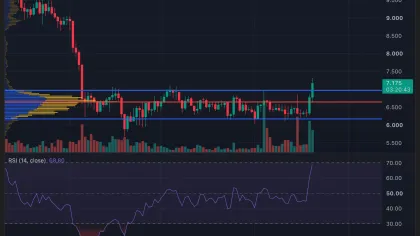
Avalanche crypto breaks $7 as tokenized asset value tops $3B
Implantica wins FDA approval for RefluxStop GERD implant in US
Japan's Inflation Data Support BOJ Rate Hike in September -- Market Talk
Crypto prices
More


