
Risk appetite improves, but hidden risks in the bond market pose a dilemma for the Federal Reserve

Huitong Network, August 17 News—— With the equity and gold markets heating up, long-term bond yields remain stubbornly high. The Federal Reserve is mired in a dilemma between inflation and economic growth.
Recently, risk appetite in US equity and gold markets has notably recovered. Driven by AI-related earnings, US stock indices continue to approach record highs, with market breadth improving as well. The equal-weight S&P 500 Index has outperformed the market-cap-weighted benchmark, indicating that the rally is no longer solely dependent on a handful of tech giants.
However, amid the strong performance of equities and gold, the bond market has issued warning signals, reflecting a highly bifurcated market structure: on one hand, long-end US Treasury yields have continued to climb, with the 30-year Treasury auction yield hitting a 25-year high. At the same time, Trump has once again issued threats, stating that if Oman obstructs the US, the US will bomb Oman.
On the other hand, gold and equities have benefited from the sharply declining expectations of US rate hikes. Along with the latest inflation and livelihood data, it’s clear that the bond market’s concerns are not unfounded and have pushed the Federal Reserve into a policy dilemma.
Trump Says US Will Bomb Oman If It Obstructs the US
In interviews, Trump commented extensively on the situation in several parts of the Middle East. Regarding Iran, he said he was “not in a hurry,” revealed the existence of secret communication channels between the US and Iran's Islamic Revolutionary Guard Corps, and stated that Iran should surrender by raising the white flag, calling Iranians excellent poker players. He also threatened that if Oman obstructs the US, the US will bomb Oman.
Additionally, Trump said he may support a particular candidate in the Israeli election.
The Surface and Reality of Inflation: Marginal Easing in CPI, Energy-driven Sticky Inflation Persists
On the inflation front, US July CPI was up just 0.1% month-on-month, or 3.4% year-on-year, showing a modest easing in overall inflation, which also led markets to downgrade the probability of further rate hikes by the Federal Reserve.
However, the underlying structural problems of inflation have not disappeared. Due to disruptions in the Hormuz Strait from US-Iran tensions, Brent crude prices are approaching $90/barrel, gasoline and diesel prices remain elevated, year-on-year inflation in the Northeast region is still as high as 4.3%, and food categories such as fruits and vegetables are seeing inflation at 5.1%.
Energy supply shocks have caused headline CPI to fall back, but consumers still feel significant pricing pressures. For example, in Connecticut, gasoline prices are nearly $1 higher than a year ago, diesel is up 46% year-on-year, and these costs continue to be passed down the supply chain to consumer goods. As the winter heating oil contract season approaches, energy-related inflation risks remain unresolved.
America’s elderly and low-income groups are feeling the brunt of rising prices. The Social Security cost-of-living adjustment is projected to reach 3.6% by 2027, suggesting that pensions need to rise by 3.6% just to keep pace with prices, underscoring that the real cost of living has not cooled in tandem with the statistical CPI's 3.4%.
This marginal easing in measured inflation, coupled with persistent energy-driven sticky inflation, is a major underlying reason for the sustained high yields of long-term US Treasuries.
Fiscal Supply Combined with Inflation Fears: High Long-term Yields Coexist with a Weak Economy
Another core variable driving up long-term yields comes from fiscal debt pressures.
US federal debt is about to surpass $40 trillion. The persistently expanding fiscal deficit results in vast Treasury supply, and bond investors require higher term premiums to compensate for inflation and fiscal risk, leading to a substantial rise in the 30-year Treasury yield.
It is noteworthy that rising long-term yields do not fully correspond to strong economic performance: the latest data reveal US job losses, sharp declines in retail sales, and a significant drop in consumer confidence, indicating that the fundamentals of the real economy are already weakening.
This has resulted in a contradictory market picture: the real economy is weakening, equities are buoyed by AI-driven risk appetite, gold and silver are also supported, but long-end Treasury yields remain high due to inflation fears and fiscal supply pressures. High risk-free rates, in turn, suppress stock valuations and the holding cost of gold and precious metals, thus planting the seeds for potential reversal in the current rally.
The Fed Caught in a Policy Dilemma: Silent Communication Amplifies Market Uncertainty
This complex situation is a direct test of new Fed Chair Kevin Walsh’s policy framework. The Fed has abandoned traditional forward guidance in favor of “silent” communication, no longer providing explicit rate paths and instead leaving the market to interpret policy signals from economic data, thereby amplifying market uncertainty.
This has left the Federal Reserve with no easy choices: if it opts for further rate hikes, it could curb inflation risks, but the already weakening jobs and consumption sectors will be hit harder, increasing the risk of real economic downturn. High long-term rates, combined with policy hikes, would also further increase the federal government’s interest burden, amplifying negative fiscal feedback.
If the Fed holds rates steady or even turns dovish, current energy-driven inflation risks are not fully resolved. Should monetary conditions ease, inflation expectations may surge again, prompting the bond market to continue selling long-term bonds and driving yields even higher, thus failing to allay market concerns.
This contradiction is echoed in market trades: the probability of a September rate hike has dropped sharply, which the equity market interprets as positive and risk appetite rises;
However, the bond market does not fully buy in, as long-end yields have not declined following the drop in rate hike expectations. Bonds are pricing long-term inflation and fiscal risks, not just short-term rate moves. While the stock market expects some relief in the monetary environment, the bond market continues to price in long-term risks—a tug of war between the two forces.
Tail Risks Converge, Real Rates Become Key to Asset Pricing
The core tail risk facing markets today has shifted from “whether or not to raise rates” to “the complex evolution of real interest rates.”
A particularly concerning scenario is if recent job market data continues to deteriorate, drastically limiting the Fed’s room for rate hikes, or even forcing it to keep rates unchanged.
In this situation, a contradictory picture may emerge: on one hand, further spikes in energy prices due to Middle East tensions would push up inflation expectations; on the other hand, weak economic data would make the Fed hesitant to tighten policy, causing nominal rates to stay at current levels or lower.
This would result in “rising inflation expectations but unchanged nominal rates," leading to a passive decline in real interest rates (nominal rates minus inflation expectations). In such a scenario, gold stands to benefit more than equities.
Markets are holding their breath for the Jackson Hole Global Central Bank Symposium at the end of August, seeking policy signals from new Fed Chair Kevin Walsh’s keynote speech.
Additionally, the minutes from September’s FOMC meeting will be key, as markets will be watching how officials weigh bond market signals, sticky inflation, and weakening real economic data. This will determine whether the stock-bond contradiction can be temporarily resolved and dictate the ultimate trajectory of real rates.
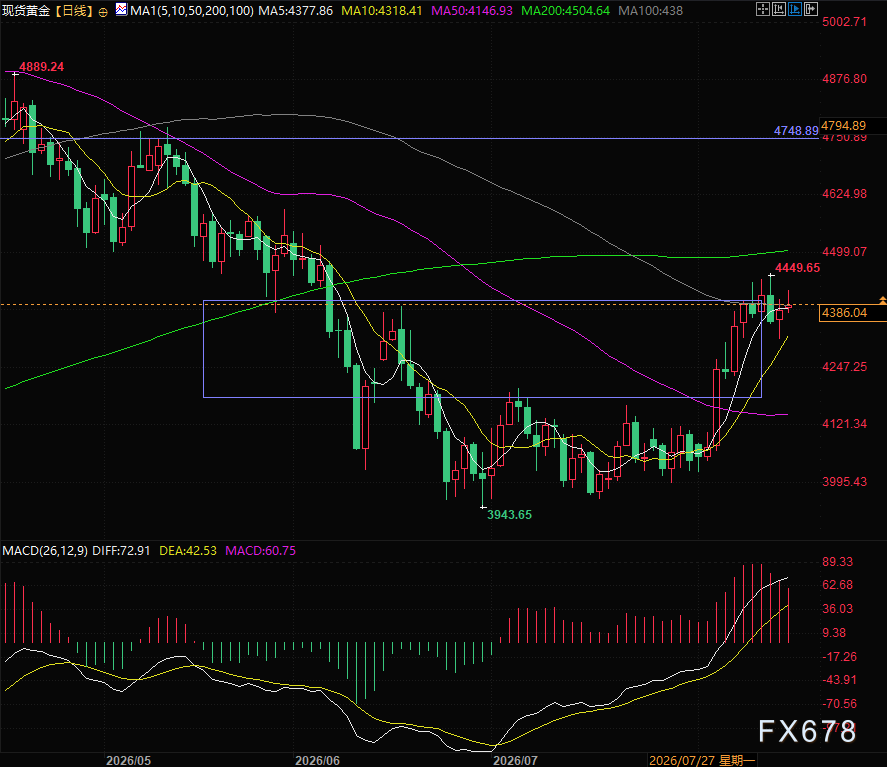
(Spot gold daily chart, source: Easy Huitong)
As of 21:02 Beijing time, spot gold is reported at $4,383 per ounce.
Disclaimer: The content of this article solely reflects the author's opinion and does not represent the platform in any capacity. This article is not intended to serve as a reference for making investment decisions.
You may also like
Hedera gains traction as UK FX pilot boosts institutional adoption, HBAR eyes $1 target
Ripple White House Meeting Draws XRP Focus

XRP Price Holds to Near Two-Year Streak, But Charts Flash a Warning Sign

ZEC Breaks $500 as 4.3% Daily Gain Puts XMR Further Behind
Crypto prices
More


