
Lumentum Q4 Earnings Preview: Orders Booked Through 2028 — Can Growth Deliver Amid Capacity Shortages and the Optical Module Ban?
 2026/08/11 06:16
1. Investment Highlights Overview
Lumentum (LITE.US) will report its fiscal 2026 fourth-quarter and full-year results after the U.S. market close on August 11. Wall Street consensus expects Q4 revenue of approximately $988 million (+105.5% YoY) and GAAP EPS of about $2.35 (-20.7% YoY). The company’s prior guidance calls for revenue of $960 million–$1.01 billion and non-GAAP EPS of $2.85–$3.05. What the market is truly focused on is not a single earnings metric, but order visibility, gross margin trends, the ramp of new products, and management’s comments on the potential “China optical module ban.”
2. Four Key Focus Areas
Focus 1: 1.6T Optical Module and CPO Ramp Progress
The company has confirmed that 1.6T optical modules will enter volume production this quarter, with CPO-related products scheduled to begin volume shipments to customers including NVIDIA in the second half of 2026. Investors will closely watch the actual revenue contribution, gross margin profile, and smoothness of the production ramp. Progress at or above expectations would reinforce the company’s long-term growth narrative in AI high-speed interconnects.
Focus 2: OCS Business Volume Ramp and Order Fulfillment
Optical Circuit Switch (OCS) is viewed as a key long-term growth driver. Order backlog has surpassed $400 million, and the company targets $100 million in quarterly revenue by the end of 2026. Attention will center on delivery progress, new customer wins, and whether supply-chain constraints continue to limit shipment pace.
Focus 3: Capacity Shortage and Indium Phosphide Supply Reality
Management previously stated that orders are already booked through 2028, with current supply shortfalls for EML lasers, pump lasers, and related products exceeding 30%. Indium phosphide-based lasers remain the most constrained link in the supply chain. The production timeline for the new North Carolina factory and the role of long-term contracts in supporting capital expenditure will be key topics on the earnings call. Whether capacity can keep pace with demand will directly determine the upper limit of growth elasticity.
Focus 4: Optical Module Ban Narrative and Management Commentary
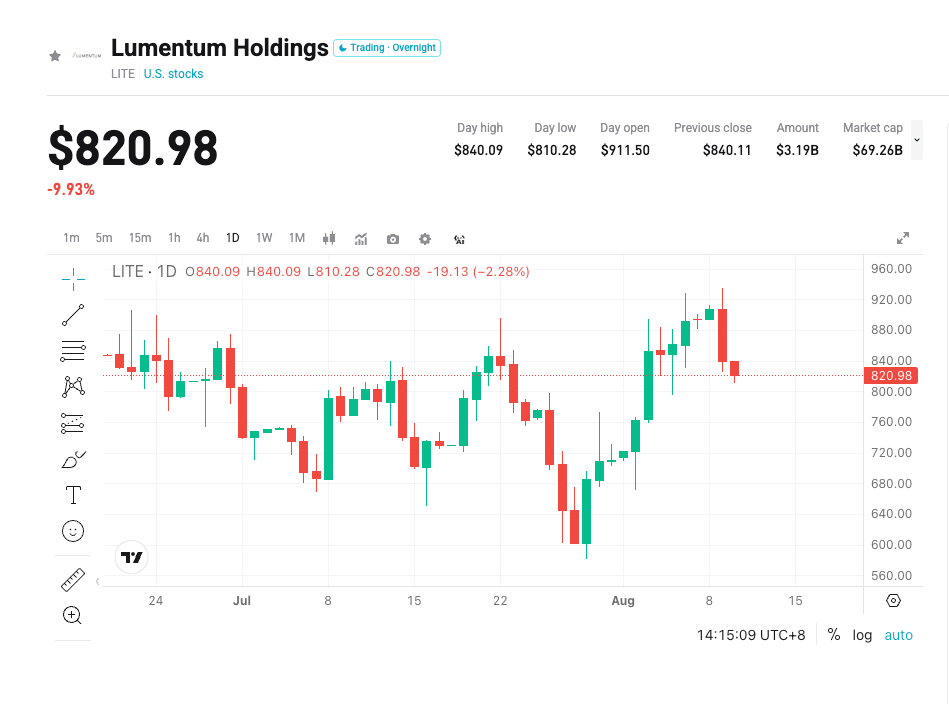
Following the August 4 Reuters report that the Trump administration was drafting a ban on imports of certain Chinese optical modules, the stock surged nearly 9% as the market priced in a potential share shift from Chinese to U.S. suppliers. However, Chinese manufacturers still account for more than 60% of global high-speed optical module capacity, and Lumentum itself remains partially dependent on China for indium phosphide raw materials. If management only highlights improved near-term demand visibility while reiterating capacity and supply constraints, the positive impact may be limited. Clearer comments on customer qualification windows and long-term industry restructuring could amplify the narrative.
3. Risks and Opportunities
Upside Catalysts:
- Revenue lands at the high end of guidance or exceeds expectations, accompanied by constructive commentary on the next quarter or full-year outlook.
- 1.6T/CPO shipments ramp faster than expected and OCS deliveries accelerate, validating new product elasticity.
- Management offers an optimistic assessment of the ban’s impact, combined with a clear capacity-expansion timeline, reinforcing the “beneficiary” narrative.
Downside Risks:
- Revenue only meets the midpoint of guidance or falls slightly short, with signs of margin or expense pressure that raise questions about the quality of expansion.
- Capacity bottlenecks remain unresolved, new-product ramps lag expectations, or raw-material constraints are re-emphasized.
- The ban is ultimately framed as highly uncertain (possible exemptions, modifications, or delays), leading to a unwind of previously priced-in benefits.
4. Trading Strategy Considerations
Bull Case: If core revenue and non-GAAP profitability clearly beat consensus, new-product contributions exceed expectations, and management provides constructive guidance along with confidence in capacity expansion, the company’s position as an AI optical “picks-and-shovels” play could be reinforced, supporting valuation recovery. Bear Case: If results merely meet or slightly miss expectations, capacity and supply-chain constraints are repeatedly highlighted, or ban-related commentary turns cautious, profit-taking could follow—especially given that policy expectations have already been largely priced in.
Key Metrics to Watch:
- Total revenue and whether it reaches the upper end of guidance
- Non-GAAP gross margin and operating margin trends
- Specific contribution or guidance for 1.6T/CPO and OCS businesses
- Whether full-year or next-quarter revenue/profit outlook is raised
- Commentary on capacity shortage and new factory timeline
Trading Notes: If results beat and guidance is constructive, consider opportunities on any pullback. If data is in-line or management tone is cautious, be mindful of near-term volatility and avoid chasing. Position sizing and stop-loss levels should be adjusted according to individual risk tolerance.
Stock Limited-time Offer:August new user gift: Buy U.S. stocks and get free NVIDIA stock.Trade Now for Better Deals
Disclaimer: The above is for informational purposes only and does not constitute investment advice.
Disclaimer: The content of this article solely reflects the author's opinion and does not represent the platform in any capacity. This article is not intended to serve as a reference for making investment decisions.
You may also like
Goldman Sachs: The Next Main AI Trend Shifts from Computing Power to Humanoid Robots
Goldman Sachs believes that labor shortages and the demand for automation are providing long-term growth drivers for the humanoid robot industry. The valuations of the humanoid robot and automation sectors in Asia remain lower than those of similar assets in the United States, and capital is gradually rotating into core components and the automation industry chain. However, the industry as a whole is still in the early stages of commercialization. The scarcity of real-world data, insufficient general autonomous AI capabilities, and high costs remain the main bottlenecks restricting the large-scale implementation of humanoid robots.
SHIB Price Stays Under Pressure Despite 83M Token Burn

Tariff "boomerang" deals a heavy blow to finances! CBO confirms: Trump tariffs cause a $200 billion gap, US deficit to soar to $2.1 trillion in 2026
The U.S. federal government had originally relied on tariff revenue as a source of increased income, but this windfall is fading at a much faster rate than expected. The Congressional Budget Office (CBO) has admitted that the sharp decline in tariff income has created a $200 billion budget gap for this fiscal year.

Micron forecasts a decade of "Physical AI" opportunities: Humanoid robots will drive DRAM demand, memory chip supply shortage may continue until after 2027
Sumit Sadana, Executive Vice President and Chief Business Officer of Micron Technology, stated that due to the ongoing surge in demand driven by the AI wave and the industry's inability to expand capacity fast enough, the tight supply situation in the memory chip market is expected to persist beyond 2027.

Crypto prices
More


