
Institution: Gold and silver pullback does not mean the end of the bull market, long-term allocation logic remains

FXStreet, August 11 - Sprott executive Maria Smirnova believes that the recent pullback in gold and silver is a cyclical correction within a bull market, not a trend reversal. Sovereign debt, central bank gold purchases, and geopolitical factors continue to support gold prices, while silver benefits from demand in the new energy industry. Although mining stocks followed gold prices downward, mining companies remain fundamentally sound, and the long-term logic for allocating gold and silver persists despite market volatility.
After a strong upward surge earlier, gold and silver saw a significant price correction in 2026, raising concerns among many market participants that the long-term bull run in precious metals had ended.
However, Maria Smirnova, Managing Partner at Sprott Inc. and Senior Portfolio Manager and Chief Investment Officer at Sprott Asset Management, put forward a different perspective in her latest report.
Cyclical Correction Does Not Alter Precious Metals' Fundamental Base
Reviewing the past two years, gold and silver posted impressive gains in 2025, with spot gold rising by over 64.58% for the year and spot silver by 147.95%. Large-scale gold purchases by central banks, inflation risks, sovereign debt expansion, and geopolitical risks all drove this rally. At the end of January 2026, both metals hit new all-time highs.
Smirnova notes that after peaking in January, gold and silver entered a correction, with prices dropping sharply in the second quarter: gold oscillated between $4,000 and $4,100 per ounce, while silver fell back to the $55-$60 per ounce range. Even with the decline, both remained higher than a year prior. As safe-haven sentiment in the Middle East intensified, prices recently started to rebound. This correction is mainly due to short-term liquidity, a strong dollar, and other cyclical factors, not a deterioration of fundamentals.
Sovereign debt continues to balloon, fiscal deficits remain high, and many central banks are diversifying reserve assets; a fragmented global geopolitical landscape continues to offer robust support for gold. As for silver, the photovoltaic sector, power grid construction, AI infrastructure, and high-end electronics create ongoing industrial demand, while mine supply growth is sluggish, leaving the market in a supply-demand deficit for years.
She adds,
Breaking Down Gold's Three Phases in 2026 and the Mining Stock Landscape
The report splits the 2026 gold trend into three phases: At the start of the year, debt risks and central bank buying drove prices to new highs; in March, geopolitical events triggered a tightening of global liquidity, leveraged funds sold off to cash out, pressuring gold prices, and together with the dollar's strength and tighter policy expectations, gold weakened further in Q2. By early summer, selling pressure gradually eased as physical demand and ongoing central bank purchases established support. Official sector buying was the key force preventing a deeper decline in gold prices.
Precious metals mining stocks declined in step with gold as funds flowed en masse into the technology and AI sectors, diverting capital from cyclical industries. Smirnova notes that while share prices were weak, top gold miners remained fundamentally healthy, with strong free cash flow and sound balance sheets, rewarding shareholders with dividends and buybacks, and ongoing industry consolidation. However, sector valuations remain low compared to previous bull markets.
Silver’s Unique Supply-Demand Structure
Unlike gold, which is mainly a monetary safe haven, silver possesses both monetary and industrial attributes. The silver market is smaller, has a higher proportion of leveraged trading, and typically sees greater volatility than gold.
As the industrial sector cooled in Q2 and speculative positions exited, silver’s decline was magnified. Long-term, however, the expansion of new energy and electrification industries drives a rigid demand, while mine supply struggles to keep up, causing inventories to be continuously depleted. As prices rebounded above $60 per ounce, the market once again focused on silver’s structural supply and demand opportunities.
Conclusion
Overall, the shocks from short-term rates and a strong dollar are largely reflected in current gold and silver prices. Sharp swings in the precious metals market are normal during a long-term bull market; corrections actually improve the medium- and long-term risk-reward ratio.
As long as structural conditions such as high debt, central bank de-dollarization, and geopolitical fragmentation persist, the logic for investing in gold and silver will not fundamentally change. Investors should distinguish between short-term cyclical fluctuations and the longer-term trend.
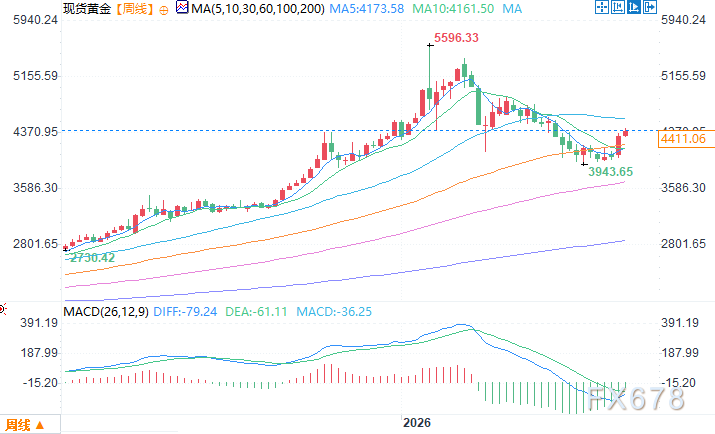
Spot gold weekly chart Source: Yihuitong
East 8 Zone August 11, 11:06 Spot gold reported at $4413.26 per ounce
Disclaimer: The content of this article solely reflects the author's opinion and does not represent the platform in any capacity. This article is not intended to serve as a reference for making investment decisions.
You may also like

Apple (AAPL.US) All-Glass 20th Anniversary iPhone "Rashomon": Jefferies just said it was canceled, insiders quickly refute and say it is still proceeding as planned
It is reported that Apple's 20th anniversary edition iPhone, featuring glass as the core material, is still scheduled to be released in 2027.

ETH Continues to Respect Its Long-Term Macro Fractal, Looks at $10,000 – $16,000 as ATH Targets

Crypto prices
More


