
Is the rebound in software stocks not over yet?


👆Click the blue text to follow us
Software Stocks
Has AI's disruption of software come to an end? I don't think so, but there are indeed signs it's slowing down. AI hasn't brought universal benefits to the entire software industry, but the list of winners and losers is becoming more and more clear.
According to the latest report by Goldman Sachs analysts Gabriela Borges and Callie Valenti, the just-concluded second quarter is likely to be a turning point. Based on financial data, Goldman Sachs is marginally upgrading its view on Snowflake and Palo Alto Networks, but is slightly downgrading Adobe, Intuit, and Workday, while remaining optimistic about Microsoft, Shopify, Cloudflare, and Twilio, believing these companies may be at the beginning of a multi-quarter fundamental improvement.
The logic behind this list of software stocks can be broken down into three layers. The first is whether a company can become the infrastructure for AI agents—this is the most important. The second is whether AI traffic can be converted into consumption, i.e., usage-based billing rather than the previous seat-based or per-user model. The third is what constitutes corporate budgets: are these new budgets, or is existing software spending being shifted toward AI? The first two determine who can capture incremental value, while the third decides who will be the winners or losers.
First, let's look at the direct beneficiaries: platform companies like Cloudflare. Cloudflare is a provider of network acceleration, security, and edge computing services. Goldman Sachs believes the company's machine internet traffic is rising rapidly, about 18 months ahead of management's original expectations. Nearly 2 million new developers joined in Q2, surpassing the annual target of 1.5 million for all of 2025. Much of the strong performance was driven by pooled-commitment contracts, where customers pre-purchase credits and then use different products as needed. If usage suddenly accelerates, revenue for the quarter could significantly exceed previous forecasts.
Next is Microsoft. Microsoft's Azure also benefits from GitHub Copilot's usage-based billing. Goldman Sachs’ client cases show that some companies saw their Q2 GitHub bills double year-over-year, and a few software companies saw them triple, clearly reflecting the acceleration brought by pay-per-use pricing.
Then there's Twilio. Twilio is a cloud communications platform that provides voice, SMS, email, and other services via API to businesses. It recorded accelerated growth for two consecutive quarters and raised its full-year revenue, profit, and free cash flow guidance. Goldman Sachs believes this shows that AI voice demand is no longer just in pilot or trial phases—at least some is transitioning into sustainable commercial use.
Next is Shopify. Shopify enables businesses to set up online stores and unify the management of payments, orders, and offline sales on one platform, representing another kind of winner. In the past, e-commerce traffic depended heavily on search rankings and advertising, but consumers are increasingly likely to ask AI directly what to buy and what’s good. Tools provided by Shopify can organize product attributes into parameters readable and comparable by AI agents, allowing niche and long-tail brands to get AI-recommended exposure. Goldman Sachs observed that this kind of exposure benefit will start to emerge in the second half of 2025, and will accelerate significantly in Q2 2026, indicating the new business model has been validated.
Finally, there is cybersecurity software. Since July, the industry has been discussing new risks posed by cutting-edge AI models breaking out of sandboxes. Short-term earnings may be volatile, but as AI agents gain more permissions, new attack surfaces emerge in identity, models, endpoints, and runtime processes, making security budgets potentially even more rigid or indispensable.
Therefore, Goldman Sachs is optimistic about three cybersecurity stocks, with Palo Alto Networks as its top pick. It believes there’s still upside for the firewall and Chronosphere business, and the company is already driving acquisitions and integration around AI. Next is CrowdStrike, whose fundamentals may turn around later this year, though current valuations already reflect high expectations. Lastly is Okta; its AI agent identity security products will likely not truly take off until 2027. However, if CrowdStrike and Okta pull back due to short-term expectations, that may offer opportunities to take positions.
Alright, that’s about it for this research report. Although Goldman recommends many software stocks, Jason believes that the wave of software disruption isn’t over—it’s just that, as semiconductors become less leveraged, software looks relatively more attractive, especially for those companies closely involved with AI, rigorous in security audits, and deeply partnered with government and large corporates. For example, cybersecurity, data analytics, and Microsoft’s security audit capabilities, among others.
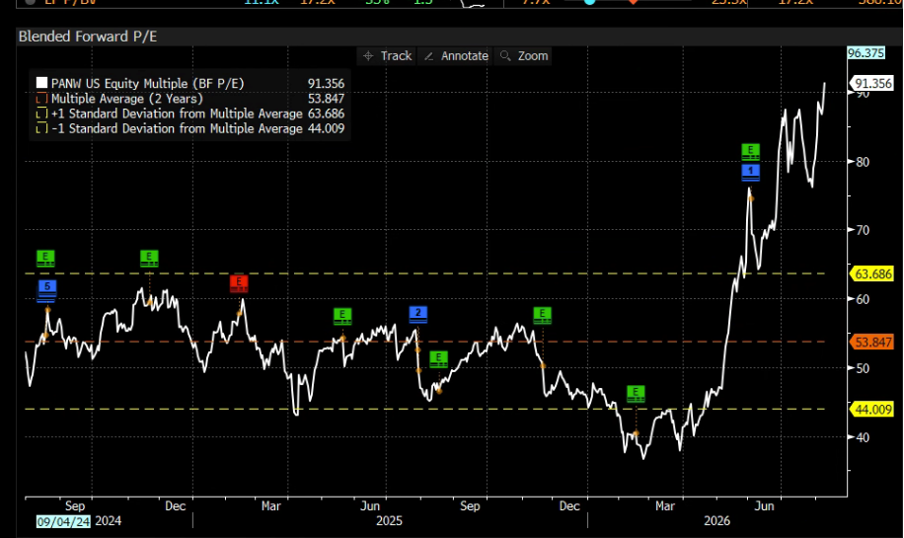
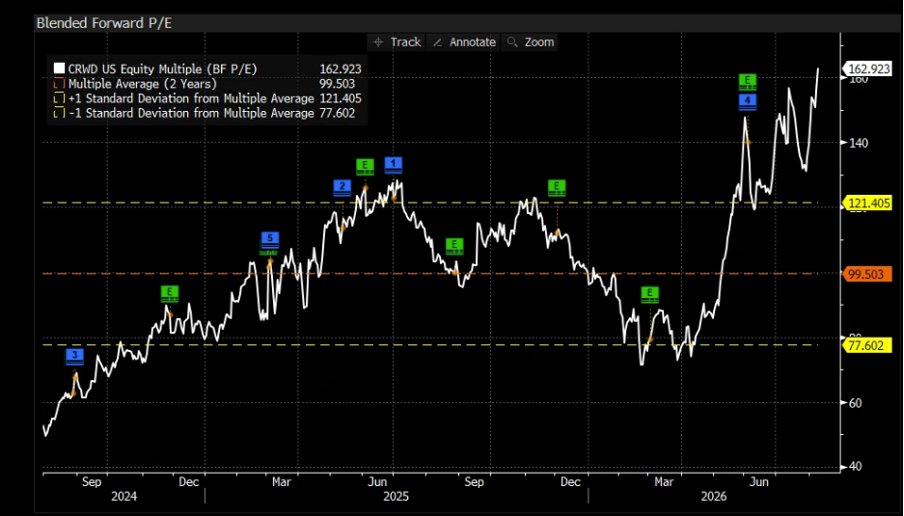
Specifically, for the two cybersecurity stocks (PANW and CRWD), they have already far exceeded their valuation averages, essentially reflecting full bullish expectations. Their earnings reports in two weeks may not necessarily live up to those valuations, so my view is: if you haven’t bought in, it’s okay to wait and observe, or consider entering on significant dips or after performance validation.
[One of the two cybersecurity stocks: PANW]
[One of the two cybersecurity stocks: CRWD]
As for data analytics application stocks like Palantir and Snowflake, there are already detailed analyses in Meitou Pro, so I won't elaborate further here.
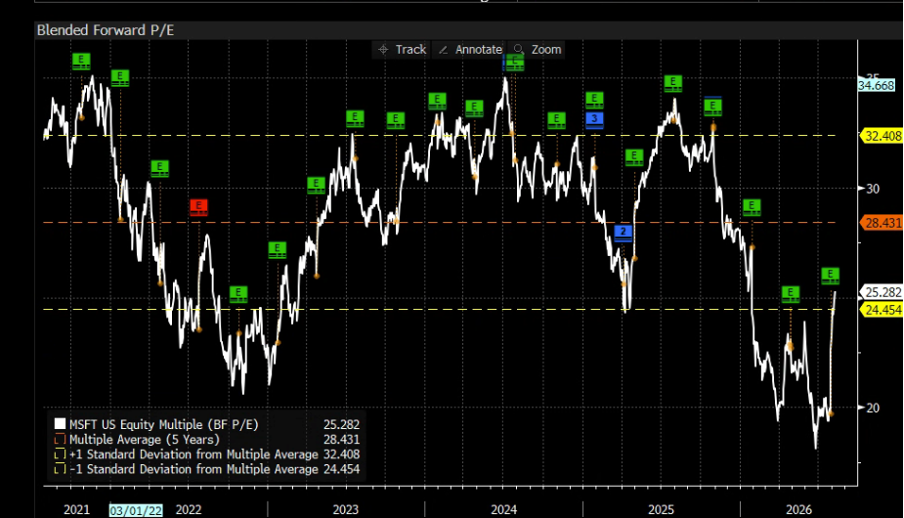
Regarding Microsoft, from what I know, Copilot usage is just starting to roll out in government and large enterprises, so there’s significant room for future conversion. Even though Microsoft has already seen a considerable rally recently, its valuation is still at a discount. Thus, my view is that it's still worth considering buying and holding Microsoft.
[Microsoft]



Disclaimer: The content of this article solely reflects the author's opinion and does not represent the platform in any capacity. This article is not intended to serve as a reference for making investment decisions.
You may also like

Apple (AAPL.US) All-Glass 20th Anniversary iPhone "Rashomon": Jefferies just said it was canceled, insiders quickly refute and say it is still proceeding as planned
It is reported that Apple's 20th anniversary edition iPhone, featuring glass as the core material, is still scheduled to be released in 2027.

ETH Continues to Respect Its Long-Term Macro Fractal, Looks at $10,000 – $16,000 as ATH Targets

Crypto prices
More


