
Gold Approaches Two-Month High; The Key Variable Determining This Week's Volatility Has Arrived

Huitong Finance, August 10—— On Monday, August 10, spot gold entered a consolidation phase at a high level after a strong rebound last week; currently trading near $4,340/ounce, with limited intraday fluctuations. Last week's cumulative increase was over 7%, hitting a near seven-week high last Friday.
On Monday, August 10, spot gold entered a consolidation phase at a high level after a strong rebound last week; currently trading near $4,340/ounce, with limited intraday volatility, last week's cumulative increase was over 7%, and nearly reached a seven-week high last Friday.
Meanwhile, U.S. non-farm payrolls unexpectedly decreased by 23,000 in July, prompting the market to reassess the Federal Reserve's future rate path. The probability of a rate hike in September has dropped to about 44% from previously higher levels. This week, market attention has shifted to the U.S. Consumer Price Index (CPI) and Producer Price Index (PPI), signaling that the current core pricing driver for gold is no longer just a technical rebound, but a new round of rebalancing among employment, inflation, and real interest rates.
Employment Data Alters Rate Pricing, Gold Regains Macro Drivers
The most significant change in this round of gold movement comes from the repricing of interest rate expectations. In July, U.S. non-farm payrolls decreased by 23,000, not only significantly missing the market estimate of an increase of about 80,000, but previous two months’ data were also revised downward. The employment data itself does not directly determine the price of gold, but it influences precious metals valuation through Fed policy expectations, U.S. Treasury yields, and the dollar. The latest market pricing shows the probability of a September rate hike has fallen to around 44%, substantially below the level before the employment report was released.
Gold itself does not generate interest; when risk-free interest rate expectations rise, the opportunity cost of holding gold usually increases; conversely, when the market lowers expectations for further tightening policy, the opportunity cost pressure decreases. Therefore, the recent rise in gold cannot simply be understood as heightened risk aversion sentiment, but more accurately as the result of rate path repricing reducing previous valuation pressure on gold.
The pullback in U.S. Treasury yields also strengthens this logic. The 10-year U.S. Treasury yield is trading near 4.65%, below the recent high of about 4.74%; the dollar index is near a two-month low. The simultaneous movement of both provides gold with a more favorable pricing environment from a financial conditions perspective.
Market Focus Is on U.S. Inflation Data This Week
The employment data has completed the first stage of expectations correction, but this week’s CPI and PPI will be the core variables to test whether this repricing is sustainable. The market is currently not focused on a single inflation figure, but whether inflation can send a consistent signal with the slowing labor market.
Latest market expectations show that before the release of CPI, investors see near-equal probabilities for the Fed to keep policy unchanged or raise rates again at the September meeting. Some institutions expect the overall inflation rate may be around 3.4%. If inflation remains sticky, the market may re-evaluate the previously rapidly falling probability of policy tightening; if price pressures are weaker than expected, the rate repricing triggered by employment data will gain additional macro justification.
Thus, for gold, the biggest variable this week is not any specific technical price level, but whether real interest rate expectations continue to change. The CPI shapes the terminal inflation outlook, while the PPI provides clues to cost pressures; together, these data will determine how the market recalculates the length of time policy rates may remain high.
This is also the biggest distinction between the current gold rally and an ordinary technical rebound. Rising prices, a weaker dollar, and U.S. Treasury yields falling from highs have all happened together, indicating that the recent precious metals movement is already embedding a more complex macro pricing process.
Daily Structure Significantly Improved, But Volatility Expands in Tandem
From a technical perspective, the daily chart shows the middle Bollinger Band near 4,101, the upper band near 4,291, and the lower band near 3,912. The price had long been near or below the mid-band, but in recent trading days has quickly broken out of the consolidation range and moved above the middle band. The recent high reached near 4,371, indicating the market has shifted from low-volatility consolidation to a higher-volatility state.
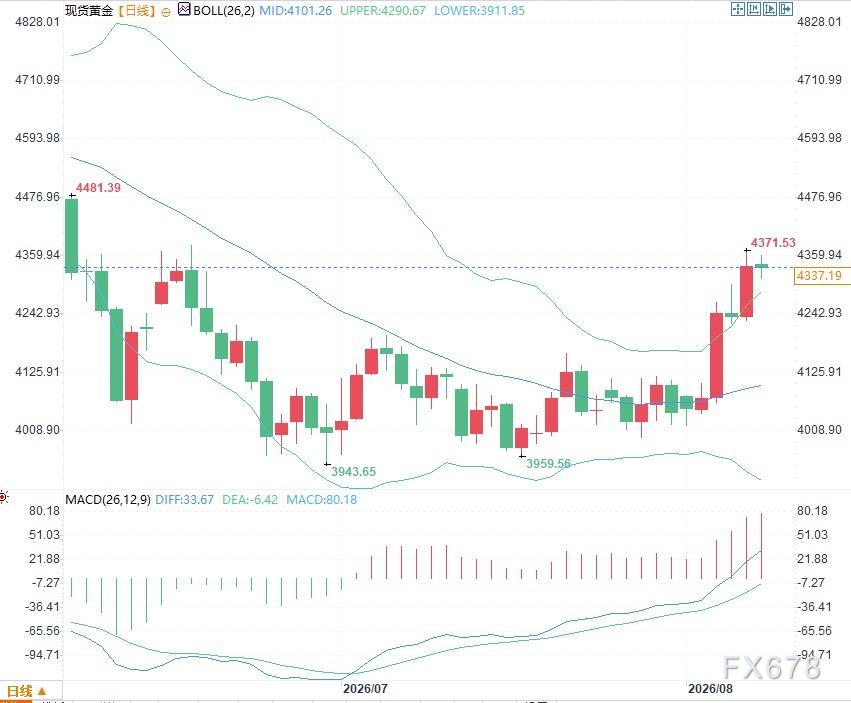
Of particular note is the MACD structure. The DIFF line has climbed to 33.67, DEA is at negative 6.42, and the MACD bars have expanded to around 80.18. This does not simply signal an upward trend, but rather that the speed of recent price change is much faster than during previous consolidation stages, meaning short-term momentum is being rapidly released.
But increased momentum usually comes with heightened volatility risk. The price breaking through the upper Bollinger Band should not be mechanically interpreted as confirmation of a new trend or as being overbought. What the Bollinger Bands truly reflect is the price relative to recent averages and the standard deviation. When a market suddenly escapes a long period of narrow consolidation, and the distance from the mid-band rapidly expands, it itself shows the market is going through a repricing of volatility.
Disclaimer: The content of this article solely reflects the author's opinion and does not represent the platform in any capacity. This article is not intended to serve as a reference for making investment decisions.
You may also like
South Korea launches $3.5 billion fund to develop semiconductor chip supply chain
Pendle brings srUSDat fixed-yield trading to Monad, hits $111M TVL
Boeing Bets on Archer (ACHR.US) with “Asset-for-Equity” Swap, Signaling Transition of the “Low-Altitude Economy” from Cash-Burning Competition to Commercial Realization
Boeing will sell several of its divisions to Archer Aviation in order to focus on its core commercial and defense sectors. Archer will take over Boeing’s Wisk, SkyGrid, and Insitu divisions, which are responsible for designing and building unmanned aircraft and air traffic management systems.

BTC holds $65,281 as institutional premium signals steady demand
Crypto prices
More


