
From the AI Gloom to Advertising Breakthrough, Unity Emerges Strong After Breaking the Cocoon


Hello everyone, I'm Dolphin!
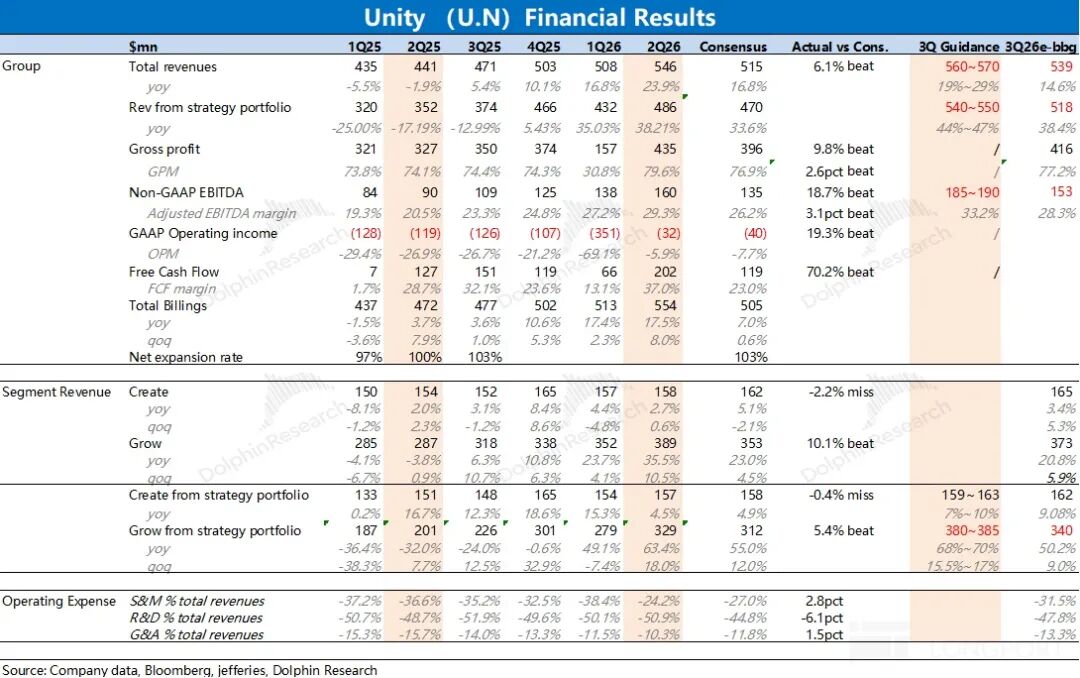
Q2 performance finally brought some relief to Unity, marking one of the rare, clean beats in recent years and proving the inflection-point achievements after business adjustment. Let's get to the details:
1. Grow Outperforms Expectations: How much comes from within, and how much from external factors?
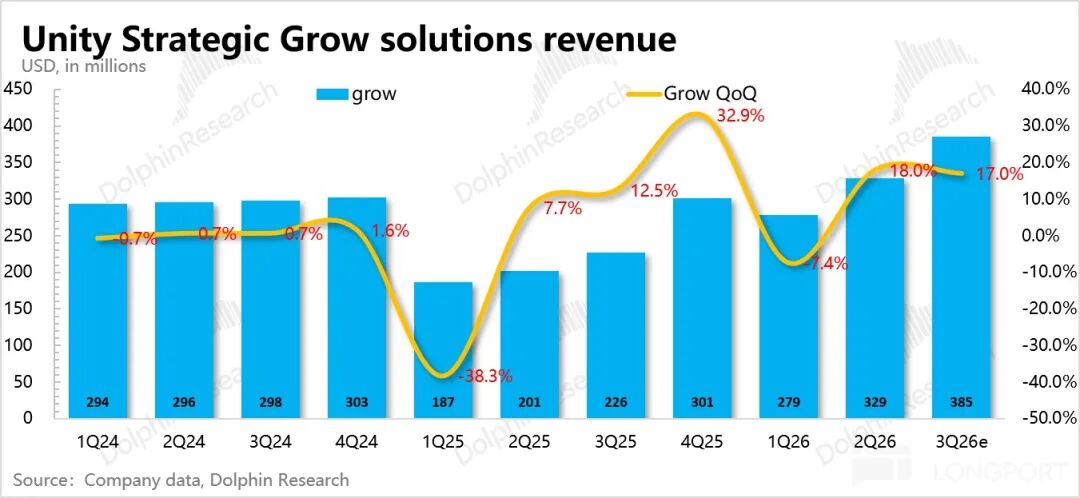
Over the past few quarters, the most crucial indicator determining the quality of Unity's financial reports has been the quarter-over-quarter growth of the Grow business.
Whether last quarter or this quarter, the market expected Vector to grow over 15% quarter-over-quarter, which means that after offsetting some of the impact from the spin-off of IronSource and the lower growth contribution from Supersonic, the rough strategic Grow business Q/Q growth needs to exceed 12% (with Vector revenue accounting for over 80% of strategic Grow business in Q2).
The growth drivers, besides Vector (with the full rollout of D28, marked ROAS improvements, and Runtime data access to 3 billion players by the end of Q2), are also related to the closure of IronSource at the end of April. According to Jefferies' tracking research, after IronSource's exit in Q2, Unity is likely the primary beneficiary of the released market share.

Why is the benchmark set at Q/Q 15% growth? Let’s break this down.
Firstly, the 15% Q/Q growth has been the management’s trend anchor for the last four consecutive quarters, and as such, serves as the market’s minimal psychological baseline. If the growth fails to meet management's stated target, it's considered a clear miss.
Secondly, with Vector delivering 15% Q/Q growth in Q1, if the remaining three quarters of this year slow naturally from 15% to 10% Q/Q, the implied annualized YoY growth is about 60-70%. After factoring in Ironsource and other slow-growth businesses within Grow, the overall rate may be around 40-50%. Calculated at a 30% adjusted EBITDA margin, that could result in an adjusted profit of $600-650 million this year.
Put another way, to support a $15 billion market cap (was $15.5 billion before earnings), Q2 needs to achieve, at minimum, Vector’s 15% Q/Q growth.
In reality, strategic Grow revenue in Q2 grew 18% Q/Q, and the guidance shows a 16% Q/Q increase for Q3, both well above the market’s Q3 “10% Q/Q growth” threshold. For Vector, Q2 and Q3 Q/Q are 23% and 20%, also exceeding the typical “mid-teens growth” guidance.
It’s worth watching management’s views on the growth drivers for ad revenue. Since IronSource closed at the end of April, it’s important to separate how much of Q2’s high ad growth is from released share versus organic growth within Vector.
If Vector’s organic growth contributed more, then the quality of this outperformance is much higher, and Dolphin tends to believe the main growth driver is Vector.
2. Create Remains Mediocre: Potential Short-term Pressure
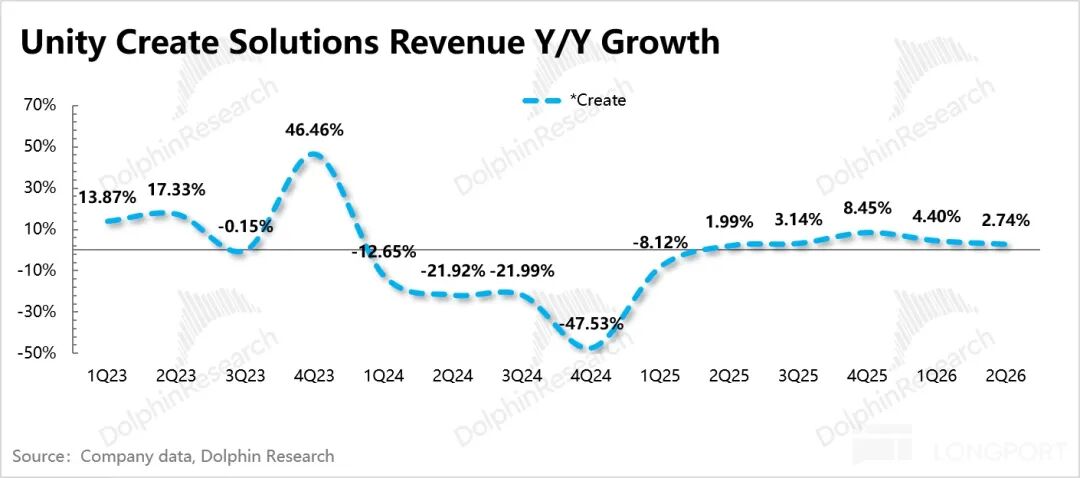
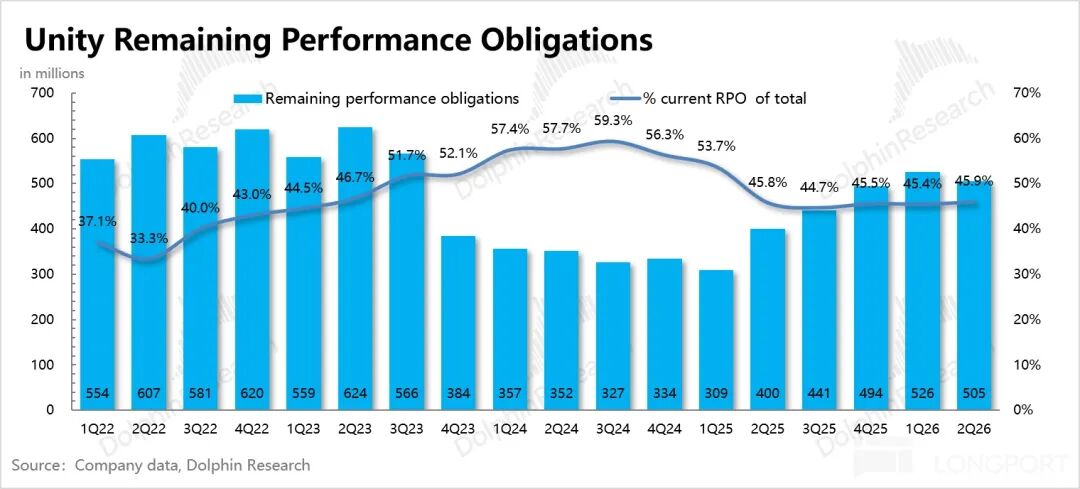
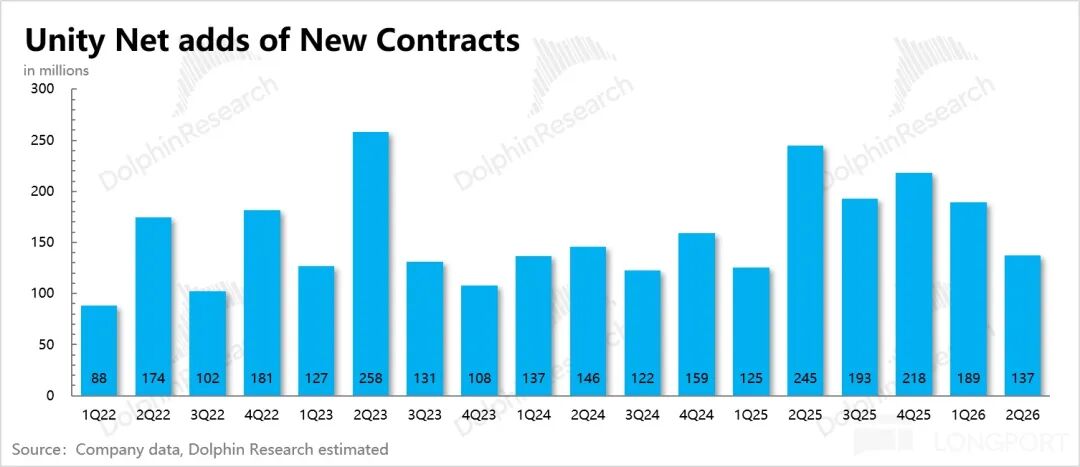
This quarter's Create segment was rather mediocre, and given changes in RPO (remaining performance obligations), short-term growth ahead may also face pressure. In Dolphin's view, there are probably two factors:
(1) The sales cycle for Unity 6’s launch has largely passed; Q2 saw a 4% sequential decline in RPO, and loosely calculated, newly-signed contracts in the period also shrank. While Unity 6’s price was raised by 5% earlier this year, this doesn’t seem to have had a major impact on the scale of new contracts.
(2) There may also be some AI substitution: for example, prototype demo stages can now be low-cost, quickly tested using LLMs. For small and midsize developers making solo hyper-casual games, LLMs can take over more functions, thus reducing costs.
At the end of July, the company released Unity 7, with testing planned for early next year. Unity 7, as an upgrade from Unity 6, introduces Coding Agent for multi-party collaboration and further accelerates all stages of the pipeline via technical upgrades, including the new CoreCLR modern runtime, near-instant code hot reload, and open access to MCP/CLI interfaces, breaking down editor walls. On the graphics side, there's Surface Cache GI real-time global illumination and Neural rendering, allowing full dynamic lighting at 60fps even on mobile.
Beyond the technical upgrades, most importantly, Unity 7 will embed a game store and AI advertising system, extending the engine capabilities downstream, potentially increasing barriers against AI challengers. However, before Unity 7 officially launches, we expect the Create business to stay mostly flat, balancing the benefits from app store fee cuts with the negative impact of AI-driven substitution.
3. Significant Margin Improvement: Mainly Due to Higher Ad Margins
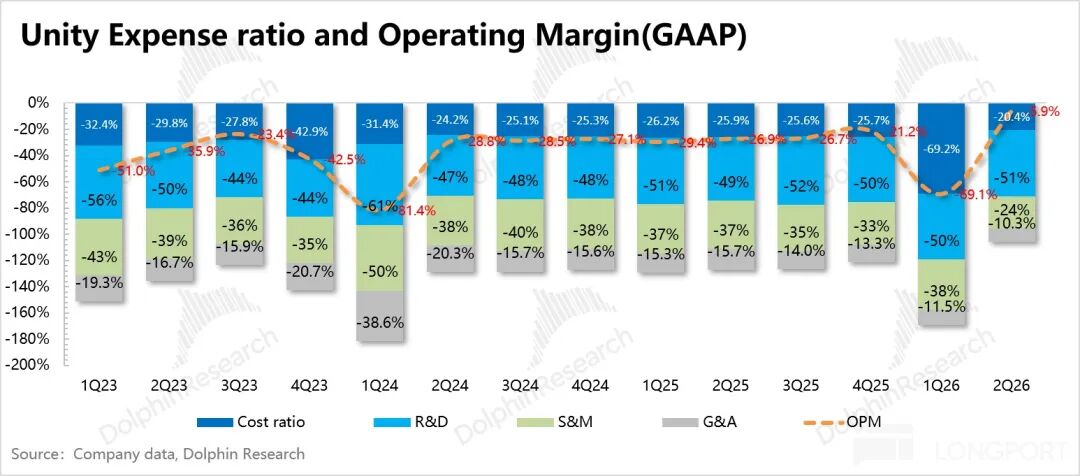
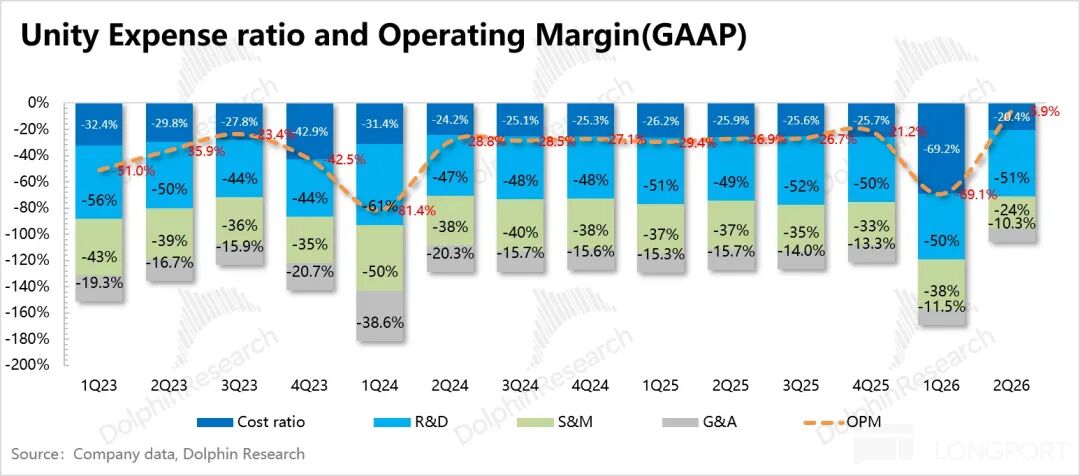
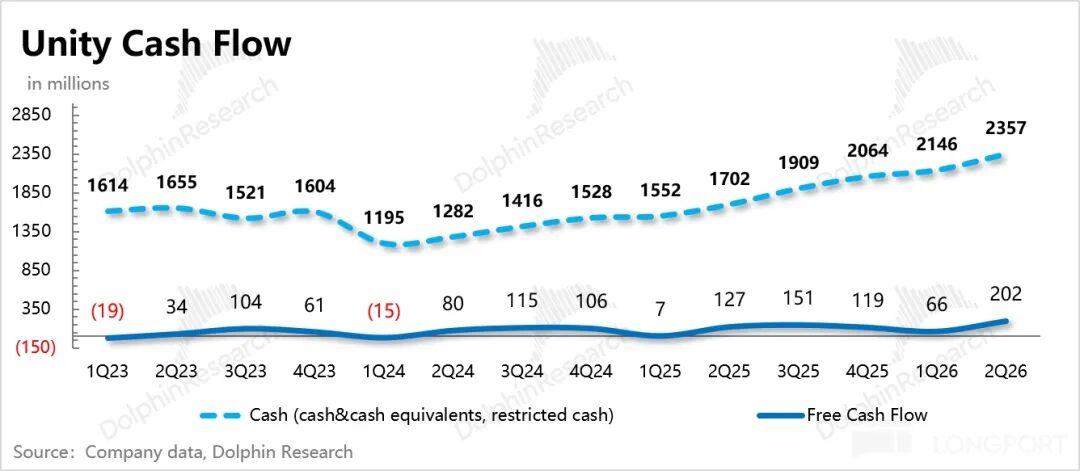
Q2 operating profit and adjusted EBITDA both beat expectations, and Q3 guidance is solid. When broken down, a major driver is the natural improvement in gross margin as ad business grew—Q2 saw a YoY increase of 5.5 percentage points in gross margin.
On the operating expense side, R&D expenses surged 30% YoY—on one hand, Unity's own R&D investment rose 17%, related to ad system recommendation model optimization and new engine development; on the other, there were severance costs during business integration.
Selling and administrative expenses fell slightly YoY, so improvement in margins mainly comes from gross margin increases resulting from business mix changes.
4. Outlook: Short-term Growth Dividend, Medium-Long-term AI Impact Still Not to Be Ignored
In early 2023, AI disruption hype played out through Q1 and hit Unity repeatedly. At the time, the main impact was Google’s Genie world model release. Dolphin commented then, believing that erosion wouldn't be immediate and that market concerns were premature, but not that AI would have zero impact.
As previously noted, LLMs’ substitutional effect in game engines mainly hits hyper-casual single-player games on the product spectrum, and the early R&D greybox prototype stage on the pipeline—allowing companies to cheaply test new game concepts.
But a game isn't just about upstream content creation; the Unity engine offers not just design and development but a full ecosystem solution including built-in store systems, ad matching, cross-platform distribution, etc. This covers not only the creation but also monetization and operations.
So, for consistency and holistic collaboration, unless it's a relatively simple casual single-player game and long-term operation/commercialization is not important, LLMs can do a lot of the work. But for mid-to-large sized games, especially online multiplayer, a mature, established solution is still needed.
Still, the experience of the first half of this year shows that AI changes rapidly, and it's impossible to make a 100% definitive forecast about the future. Dolphin thus believes that the impact of AI on the engine segment will keep popping up for narrative shifts; after short-term upbeat sentiment from Vector’s outperformance is factored in, it’s worth selectively hedging against surprise AI-related downside risks.
Since this is an inflection point, there’s no need to be overly conservative on valuation unless another panic induced by an “AI disruption” narrative erupts shortly.
5. Financial Metrics Overview
6. Note: Unity Main Business Introduction
In Q1 2023, Unity consolidated IronSource operations and adjusted its business segmentation. Under the new disclosure structure, segment reporting changed from three segments (Create, Operate, Strategic) to two (Create, Grow).
The new Create solution bundle includes the main game engine product and also brings in UGS (Unity Game Service)—originally under Operate—which is a full-chain solution for game companies, as well as some “Strategy” income. From 2023 onwards, it’s phasing out Professional Service, Weta, and other offerings;
The Grow solution includes Unity Ads (which has seen performance realized through Vector recommendation system improvements), and, after consolidation, IronSource’s marketing (mainly Aura—Luna closed in 1Q24; IronSource closed at the end of April) and publishing (Supersonic—expected to be divested by early August 2026, sold to Tripledot Studios).
Revenue contributions come from the game engine’s subscription seats, ad platform matching revenue, publishing revenue, etc.
- END -

The article isn't easy to write, please give me a “share” to support me~
Disclaimer: The content of this article solely reflects the author's opinion and does not represent the platform in any capacity. This article is not intended to serve as a reference for making investment decisions.
You may also like
DOGE Down 90% From Its Record High: Is a Major Rebound Possible?

Standard Chartered cuts 2025 ether price target by 60% to $4,000
Global crypto funds' worst-ever weekly outflow streak reaches $6.4 billion: CoinShares
Strategy makes much smaller $10.7 million bitcoin buy as its total holdings near 500,000 BTC
Crypto prices
More


