
Weekend Hot Topic: "Empty Storage, More Light"?

Hard · AI
Author | Kozmon
Editor | Hard AI
On Friday, the US memory and optical communication sectors showed significant divergence.
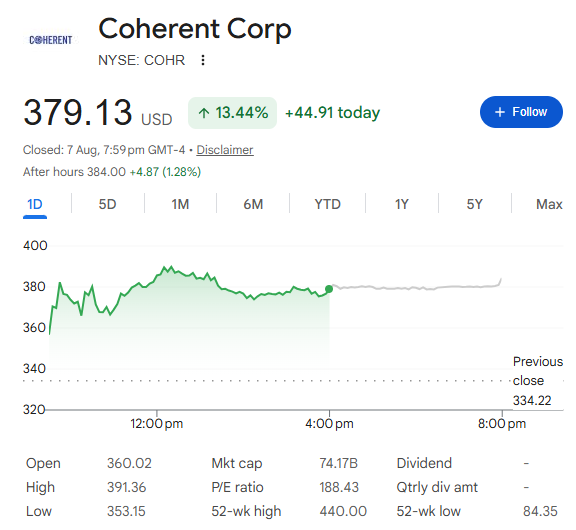
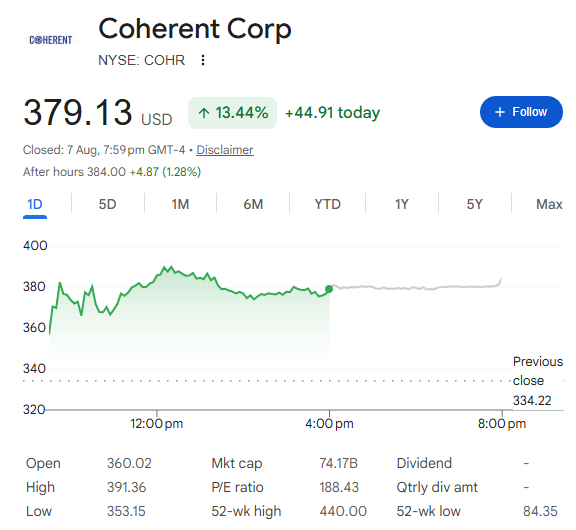
Citi sharply cut Micron's target price, putting broad pressure on storage stocks; whileAAOI’s earnings beat ignited the optical communications sector, with Coherent surging 13% in a single day.
With these two threads converging,the "short memory, long optical" trading strategy sparked heated debate over the weekend.
The one to first propose this framework was the market-recognized memory bull—Citrini analyst Jukan. He stated on the X platform thatsome hedge funds have begun to build positions accordingly.
Soon after, well-known investor "White-haired God of Stocks" Serenity countered, stating that storage fundamentals remain unchanged, with the market merely "rotating between bottlenecks."
01
Citi cuts Micron target price, expectations rise for memory price peak
On Friday, Micron (MU) fell about 1%, SanDisk (SNDK) fell over 2%, and the downward trend extended to Asia—SK hynix dropped more than 4%, with Samsung and Kioxia also declining.
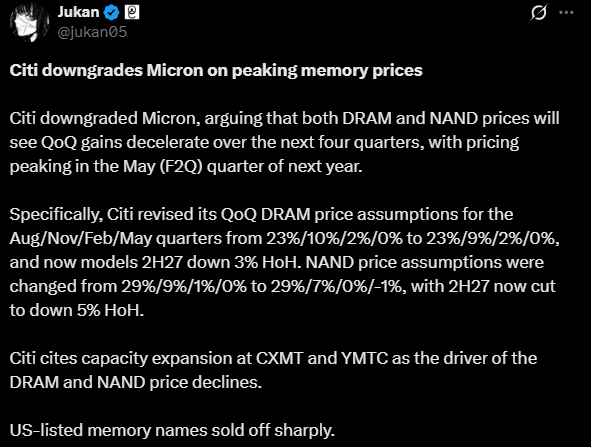
The pressure came from Citi. Analyst Atif Malik maintained a "Buy" rating on Micron, butslashed the target price from $1,400 to $1,150. Citi noted after communicating with storage suppliers and industry participants thatDRAM and NAND price growth will gradually slow over the next four quarters, with prices expected to peak in May next year.
Specifically, Citi set the next four quarters’ expected quarter-over-quarter DRAM price growth at 23%/9%/2%/0%, expecting a 3% sequential drop in the second half of 2027; NAND price expectations were adjusted to 29%/7%/0%/-1%, with the second-half sequential decline widening to 5%.
Citi attributed the price slowdown tocapacity expansion by Chinese memory companies CXMT (Changxin Memory Technologies) and YMTC (Yangtze Memory Technologies).
02
AAOI’s earnings beat ignites the optical communications sector
In sharp contrast to memory, the optical communications sector saw a strong collective rally.
US optical module manufacturer AAOI (Applied Optoelectronics)saw Q2 revenue rise 86% year-over-year to $191.9 million, with data center revenue surpassing the $100 million mark for the first time. Non-GAAP EPS was $0.06, beating the top end of guidance. The company provided Q3 revenue guidance of $255–$290 million and maintains a full-year target of around $1.1 billion. On the same day,Coherent surged 13%, Lumentum rose 6%, Corning was up 5%, and AAOI itself gained 9%.
In terms of product mix, 400G revenue was $48.4 million, a more than fourfold increase year-over-year; even more telling,800G—Q2 revenue reached $12.8 million, a more than tenfold jump year-over-year and doubled sequentially, with management expecting nearly a fivefold quarter-over-quarter increase in Q3. The growth focus is rapidly shifting from 100G and 400G to even higher-speed rates.
The signals on the production side are equally strong. Management revealed thatcurrent customer demand exceeds supply capacity by 20% to 40%, meaning that growth is limited by capacity, not demand. The current monthly capacity for 800G and 1.6T modules is close to 200,000 units, with plans to exceed 650,000 by the end of 2026 and 930,000 by the end of 2027.CEO Dr. Thompson Lin expects Q4 revenue from 1.6T modules to surpass $70 million, stating that "it wouldn't be surprising to see it double again in Q1 next year." However, he also acknowledged that supply of key 1.6T components like DSP and TIA remains tight, and deliveries in Q4 will be constrained more by materials than production capacity itself.
Analysts believe that AAOI’s strong performance bodes well for upcoming earnings reports from Lumentum and Coherent—both companies have Nvidia as a major shareholder and are seen as "picks and shovels" for AI computing power infrastructure by the market.
03
Bull turns? "Short memory, long optical" triggers weekend debate
The spark for weekend debate was the post by renowned storage bull Jukan on social media—in his post on X, he stated that the market might need a "short memory, long optical" strategy in the short term, giving three reasons:
First, after the leveraged ETF market in South Korea functionally failed, relevant investors face redemption pressure, likely causing further selling pressure on memory stocks; second,Nvidia is adjusting its next-generation AI system architecture, with Rubin Ultra possibly reducing HBM configuration per rack, switching to using optical interconnects across racks; third, expectations that memory prices will peak in the next two quarters are strengthening.
Jukan emphasized that he remains constructive on the storage sector in the long term, but is cautious short term. He pointed out thatthe focus of AI infrastructure investment is shifting from HBM capacity to holistic data center architectural efficiency, with high-speed optical interconnects being a key direction.
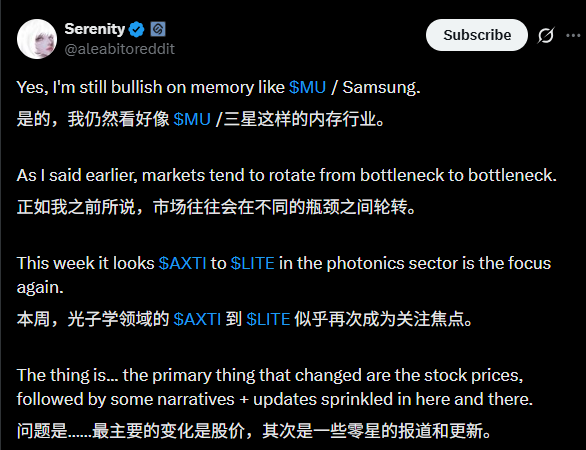
"White-haired God of Stocks" Serenity joined the discussion immediately, taking a clear stance:Still bullish on memory.
Serenity’s core argument is—what changes mainly is stock price, not fundamentals. He pointed out that Coherent and Lumentum’s laser production capacity was sold out for two years even during the July sell-off, AAOI’s demand imbalance was already clear in last quarter’s conference call, and during the crash in July, these companies’ fundamentals did not deteriorate at all—"only prices post-liquidation changed." However, back then, many investors called AAOI a "scam" at $75, but at $140, the narrative turned bullish: "But the bottlenecks for optical transceivers and indium phosphide substrates haven’t changed, and might even be more severe."
As for storage, Serenity noted seeing a massive retail panic sell, "yet just a month ago these same people cheered Micron signing 16 supply agreements and Samsung’s record operating profit." Serenity views Rubin Ultra’s memory optimization as something Nvidia does with each generation,and calls the current operating profit level implied by storage market caps ‘absurd,’ especially as storage demand becomes more structural, and next year’s supply-demand imbalance will only grow more severe.
"AAOI at $140 and $75 is the same company. Samsung at $1.5 trillion and $980 billion market cap is the same company.What changes is just valuation and the storyline—usually just noise—as the market rotates between sectors." Serenity wrote.
Hard · AI

Disclaimer: The content of this article solely reflects the author's opinion and does not represent the platform in any capacity. This article is not intended to serve as a reference for making investment decisions.
You may also like
XRP Ledger payment volume falls 90% from August peak amid price pressure
DOGE Down 90% From Its Record High: Is a Major Rebound Possible?

Standard Chartered cuts 2025 ether price target by 60% to $4,000
Global crypto funds' worst-ever weekly outflow streak reaches $6.4 billion: CoinShares
Crypto prices
More


