
Nonfarm payrolls in July plunge by 23,000! Gold price soars $60, and expectations for a Fed rate hike in September collapse instantly

Forex Live August 7 Report — On Friday (August 7) at 20:30 Eastern Eight District Time, the U.S. Department of Labor released the July Non-Farm Payrolls data. The figures showed that seasonally adjusted non-farm payrolls fell by 23,000 in July, significantly below market expectations for an increase of 80,000. At the same time, the combined data for May and June was revised down by 103,000. The unemployment rate edged down to 4.1%, the lowest since June 2025, while average hourly earnings increased by 3.2% year-on-year, below the expected 3.5%.
On Friday (August 7) at 20:30 Eastern Eight District Time, the U.S. Department of Labor released the July Non-Farm Payrolls data. The results indicated a decrease of 23,000 jobs on a seasonally adjusted basis in July, sharply below market expectations for an increase of 80,000. Additionally, the previous data for May and June was revised down by a total of 103,000. The unemployment rate marginally dropped to 4.1%, the lowest since June 2025, and average hourly earnings grew by 3.2% year-on-year, below the anticipated 3.5%.
Prior to the data release, the market generally anticipated continued moderate employment growth, with Federal Reserve officials primarily focused on inflation risks. Some members hinted that if prices did not improve, rate hikes could be considered. The U.S. Dollar Index oscillated around 99.9, while spot gold had already advanced about $20 to stand above the 4310 level, reflecting some cautious positioning ahead of the data.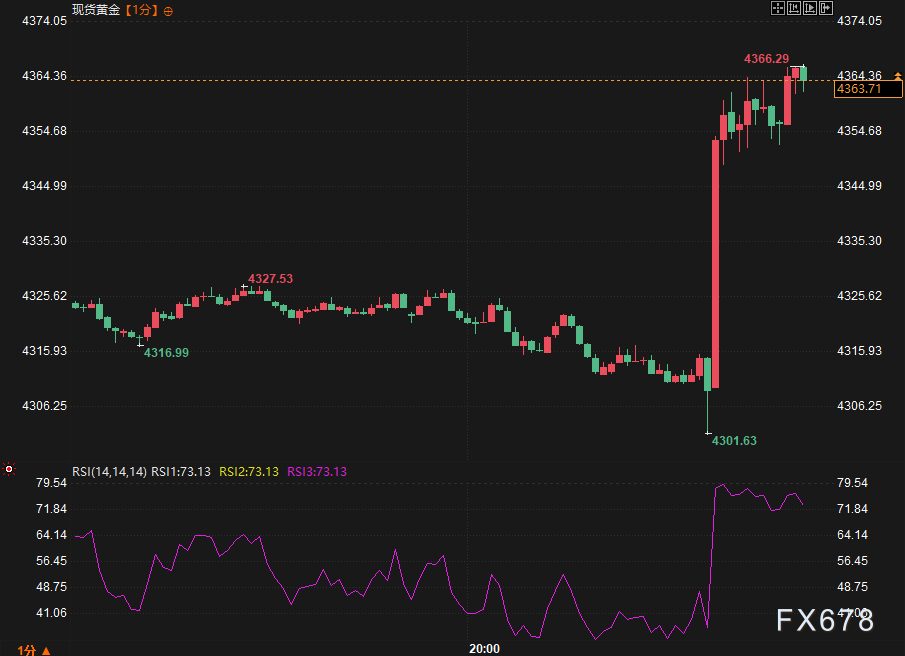
Deep Linkage Analysis
From a fundamental perspective, the unexpected negative employment change combined with significant downward revision of prior values directly undermined perceptions of labor market strength. Although the unemployment rate declined to 4.1% with simultaneous drops in job seekers and those counted as unemployed—pushing the jobless rate to a two-year low—the overall employment contraction and slowing wage growth delivered a double blow. U.S. rate futures indicate the market has quickly lowered the probability of a Fed rate hike in September, with rates now expected to rise only about 28 basis points by year-end, down from 32 basis points before the data release.
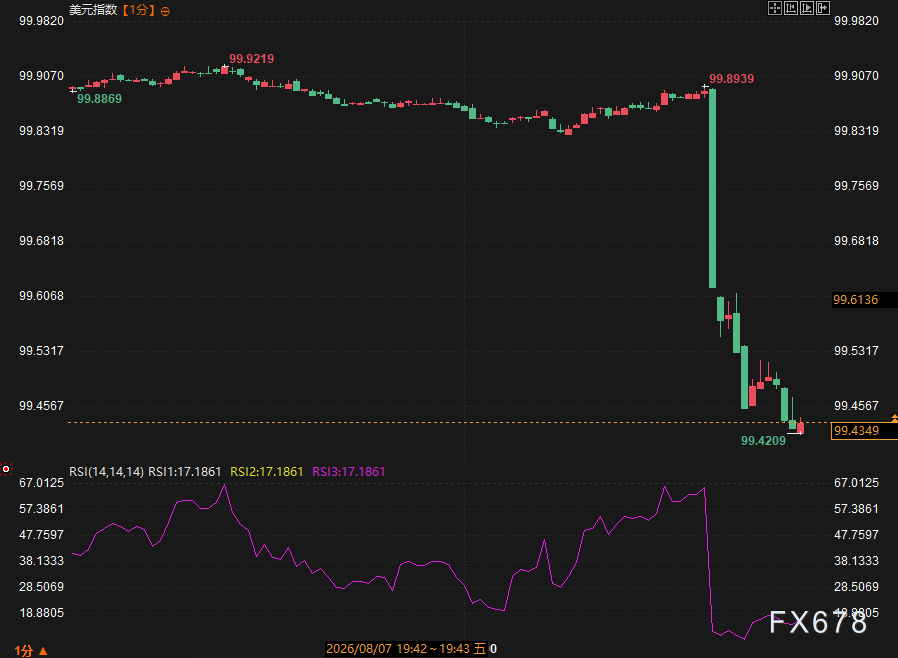
On the technical and real-time market side, the U.S. Dollar Index dropped sharply by about 30 points immediately after the data, reaching a low of 99.61. Spot gold jumped rapidly from around 4310 before the release, briefly retreated to 4301, then surged strongly to reach above 4364, with an intraday gain of nearly 2.8%. The EUR/USD pair rebounded quickly about 38 points from 1.1526 to 1.1564, while USD/JPY fell below 157 and widened its decline to nearly 1%. U.S. Treasury prices rose in tandem, and German two-year bond yields reversed earlier gains.
Before the data, institutional views largely focused on stable employment as a key support for inflation concerns, with well-known institutions and Federal Reserve officials highlighting that labor market improvements could allow room for policy maneuver. Retail investors remained on the sidelines, with some expecting figures to be near consensus. After the release, institutions quickly shifted to emphasize the impact of unexpectedly weak employment on the rate hike path. Fed mouthpiece Nick Timiraos highlighted the drop in the unemployment rate to a two-year low, but pointed out that negative job growth and downward revision were the core issues. Retail sentiment clearly shifted towards rising risk appetite, with discussion centering on gold’s rapid breakout and dollar weakening. The deviation from expectations was especially evident with the much weaker-than-expected job numbers and wage growth.
Historical comparisons show that while employment had stabilized after volatility at the end of 2025, this negative growth combined with significant downward revisions contrasts sharply with the mild spring expansion. In the latest quotes, gold has broken out of its previous consolidation range to test higher levels, while the Dollar Index fell below short-term support. Both long-term and short-term logic remain consistent under the influence of lowered rate expectations.
Trend Outlook
The surprise contraction and revisions in employment, together with slowing wage growth, have eased the urgency for near-term policy tightening. The markets have already repriced the rate trajectory. After gold’s breakout, attention shifts to possible testing of the 4370-4382 range, while the Dollar Index’s behavior below 99.6 will remain driven by rate expectations. The rebound in non-U.S. currencies like the euro may continue to be watched. Follow-up attention should be paid to inflation data and official statements for further confirmation or adjustment of market direction. Current moves mainly reflect immediate repricing from the employment shock.
Frequently Asked Questions
Q: Why did the unemployment rate fall to 4.1% even though non-farm jobs decreased by 23,000 in July?
The unemployment rate is based on an independent household survey, and both the number of job seekers and those counted as unemployed decreased, driving the rate down to 4.1%. Employment figures come from the establishment survey; the two use different samples and methodologies, so short-term divergences can occur.
Q: What does the 103,000 downward revision of previous values mean for the market?
May's figure was revised down from 129,000 to 63,000, and June from 57,000 to 20,000, indicating that spring employment growth was weaker than initial readings. This further enhances the suppressive effect of this data on rate expectations, pushing both U.S. Treasuries and gold higher.
Q: What were the main differences between institutional and retail views before and after the data release?
Before the release, institutions emphasized employment stability and inflation risks, while retail investors expected figures close to the consensus. After the release, institutions focused on the employment shock and rate-hike path adjustments, while retail discussions shifted to gold’s rapid rise and the dollar’s short-term weakness.
Q: What was the logic behind gold’s surge from 4,301 to above 4,364?
Negative job growth and major revisions significantly reduced expectations for rate hikes. Coupled with gold’s earlier gains ahead of the data, the repricing of risk appetite and rate paths jointly drove gold to break out and test higher ranges.
Q: What could happen to the Dollar Index after breaking below 99.6?
Rate futures indicate diminished expectations for year-end rate hikes, weighing on the Dollar Index in the short term. Subsequent trends will depend on whether inflation data and policy statements confirm or modify current pricing, with the recovery in non-U.S. currencies being observed simultaneously.
Disclaimer: The content of this article solely reflects the author's opinion and does not represent the platform in any capacity. This article is not intended to serve as a reference for making investment decisions.
You may also like
Bitcoin’s address boom may be a security warning, not adoption – Here’s how!
Bitcoin rises above $65,170 despite $130 million Coldcard hack and Clarity Act delay
Crypto ETFs see positive inflows for BTC and ETH as of Aug 6
New Zealand Dollar advances as US labor market weakness pressures the USD
Crypto prices
More


