
Goldman Sachs: The Monopoly of Mega-Cap Tech Stocks is Collapsing, Market Concentration Turning Point in 15 Years Has Arrived

The highly concentrated pattern of the US stock market that has lasted for more than fifteen years is starting to unravel.
Goldman Sachs Chief Global Equity Strategist Peter Oppenheimer highlighted in the latest report that the global equity market is undergoing a healthy normalization process, with market returns expanding across both geographic and industry dimensions, and the value of diversification is rising significantly.
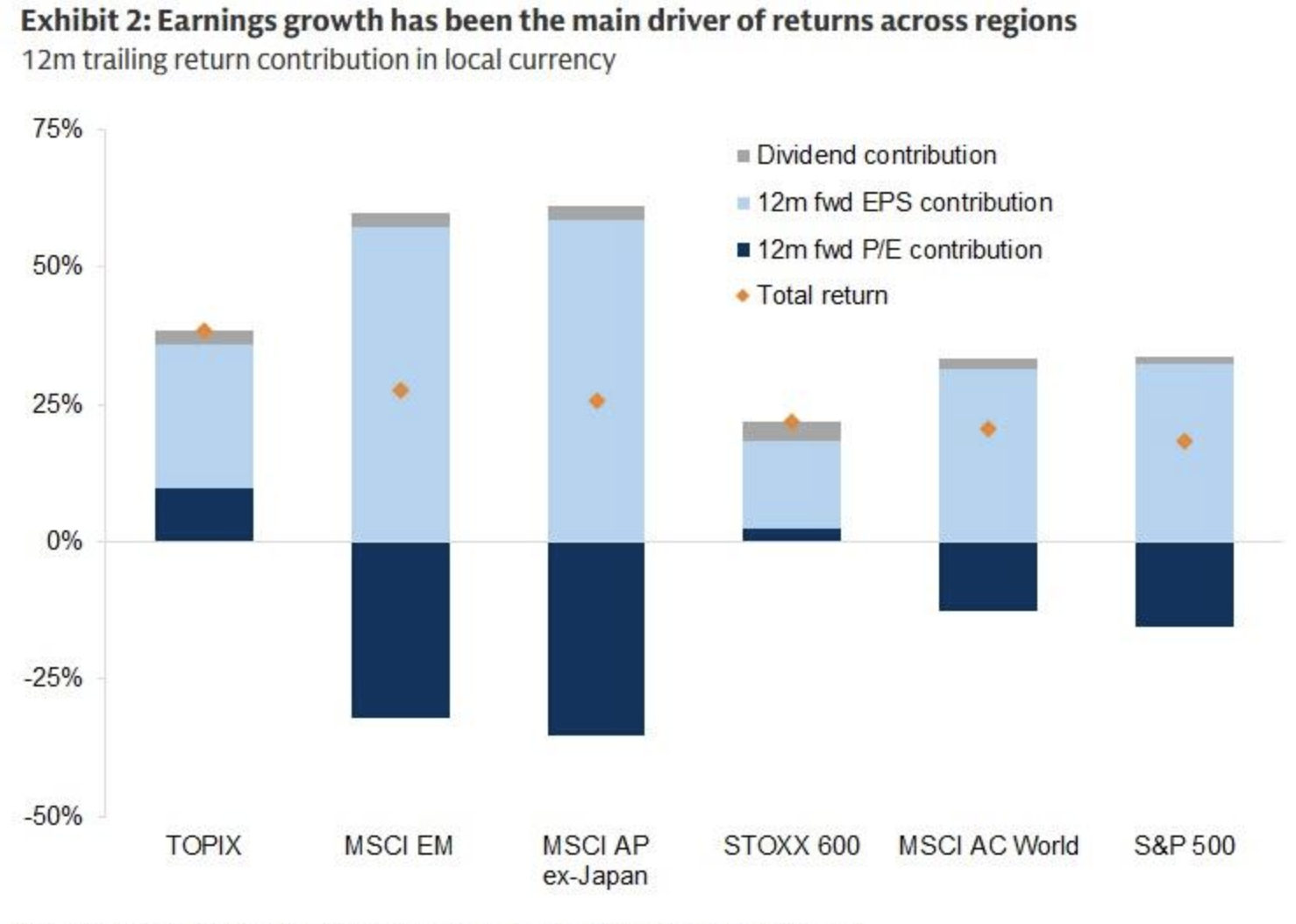
Since the beginning of 2025, this latest wave of "broadening" has accelerated notably. Among major regions, the US stock market has performed the weakest, while Japan, Asia Pacific, and emerging markets have recorded the strongest local-currency gains. At the same time, the massive capital expenditures by hyperscaler technology companies continue to erode their free cash flow yields, driving down tech sector valuations. The spillover effect, meanwhile, has boosted the growth outlook and valuations for traditional industries such as industrials.
In his global strategy report entitled "Momentum, Rotation, and Value in Growth," Oppenheimer emphasized that the driving force behind this round of market rotation comes from earnings fundamentals rather than valuation expansion or falling interest rates. He believes that after more than a decade of extreme concentration in market capitalization and performance, the market is experiencing a structural inflection point, increasing the opportunity for investors to capture returns from genuine diversification.
Tech Sector Valuations Under Pressure, Free Cash Flow Advantage Narrows
In the decade following the financial crisis, the tech sector benefited from asset-light models, booming demand for cloud computing and software, and valuation premiums in a zero-interest-rate environment, achieving sustained increases in profit margins and return on equity (ROE), cementing its position as a core allocation for global capital.
However, the emergence of ChatGPT triggered a capital expenditure arms race among hyperscaler tech companies. Oppenheimer pointed out that this capex super-cycle is fundamentally altering the financial characteristics of the tech sector—huge investments are consistently eroding free cash flow, forcing related companies to turn to debt and equity markets for financing.
Measured by free cash flow yield, the advantage of the US market—dominated by hyperscaler tech stocks—relative to value-oriented markets such as Europe has narrowed substantially. This has provided fundamental support for recent shifts in relative performance. Meanwhile, higher government debt, persistent inflation pressures, and increased bond supply have collectively pushed up the cost of capital, making earnings growth the core driver of equity returns.
Earnings-Driven Rotation, Traditional Industries Revalued
It is noteworthy that this round of market broadening is not the result of valuation bubbles or loose monetary policy, but is rooted in solid earnings growth. Oppenheimer stressed that not only have earnings themselves been strong, but the direction of earnings estimate revisions is also persistently upward, providing dual validation of the fundamental support for equities.
The large capital expenditures by hyperscaler tech and semiconductor companies, combined with increased government fiscal spending on energy security, key infrastructure, and defense, have together sparked a new capex super-cycle. The spillover effect of this cycle is re-energizing long-neglected traditional industries, with improved growth outlook and valuations for sectors such as industrials.
At the national level, ROE remains elevated across regions, and individual stock correlations are declining. As market-leading sectors continue to rotate, alpha opportunities are on the rise. Oppenheimer believes that although overall US stock P/E ratios have dropped due to tech sector drag, from a ROE perspective, the US remains the most attractive market globally.
Inflection Point in Concentration, Diversification Value Returns
Goldman Sachs believes that the decline in equity correlations and the rapid unraveling of recent momentum strategies are accelerating leadership changes in the market, creating a more favorable environment for investors to identify value within growth segments.
Oppenheimer’s core judgment is that, after more than a decade of extreme concentration in market cap and earnings, global equity markets are undergoing a healthy normalization and diversified allocations are once again generating real returns. He expects this trend to continue evolving.
For investors, this means that strategies focused solely on US hyperscaler tech stocks are becoming less cost-effective, while balanced allocations across regions and industries are regaining logical prominence.
Disclaimer: The content of this article solely reflects the author's opinion and does not represent the platform in any capacity. This article is not intended to serve as a reference for making investment decisions.
You may also like
After South Korea's strict leverage regulation, local retail investors flock to US 3x ETFs
After South Korea tightened regulations on single-stock leveraged ETFs, the trading volume of 16 domestically listed single-stock leveraged and inverse ETFs dropped by nearly 90%. Meanwhile, the net purchase of US stocks by South Korea soared from $630 million to $4.64 billion in July, with triple-leverage products like SOXL and TQQQ becoming new favorites, resulting in an actual increase in risk exposure rather than a decrease. The "balloon effect" of South Korean regulation has emerged, and academia directly questions the effectiveness of the policy.
FOMO sentiment reignites as investors rush to bet on further gains in the S&P 500; call option trading volume hits record high
The trading volume of S&P 500 call options surpassed 4 million contracts on Tuesday, setting a new all-time high, with the call/put ratio reaching its third highest level in nearly 15 years. FOMO sentiment is dominating the market, and a single aggressive $40 million bet brought in more than $23 million in unrealized profits overnight. Earnings season continues to exceed expectations, and the equal-weighted index repeatedly hitting new highs indicates that the bull market is spreading beyond AI. UBS has set a year-end target of 8,100 points, stating that “profit growth is not yet fully reflected in valuations.”
Trump and Walsh's "frequent calls" draw attention; White House: The president respects the independence of the Federal Reserve but also has the right to express his views
Recent reports indicate that since taking office less than three months ago, Walsh has had frequent phone calls with Trump, seeking his views on the Iran situation, AI development, and its economic impact. Although it is not yet clear whether the two have discussed monetary policy, the reports suggest this is the latest sign of Trump's attempt to exert greater influence over the Federal Reserve.
Circuit and DaLand enable direct Bitcoin access for credit unions
Crypto prices
More


