- Circle (CRCL) is trading near $69.30, up more than 7% in 24 hours.
- The company received final OCC approval to launch Circle National Trust, a federally chartered trust bank.
- The new entity will provide institutional digital asset custody services under U.S. regulation.
- The approval further strengthens USDC's position as a leading regulated stablecoin.
Circle has just achieved something that very few crypto-native companies have managed: formal, federally chartered banking approval in the United States. The OCC’s decision to grant Circle a national trust bank charter is not a regulatory checkbox — it is a structural transformation in how Circle can position itself to institutional clients, banks, and asset managers who require federally regulated counterparties.
$CRCL at a Glance — July 10, 2026
Circle Internet Group ($CRCL) is trading at $69.30, up +6.99% in the last hour and +7.34% in the past 24 hours following major regulatory news.
 $CRCL Price on July 10 2026/Source: Source: Coinmarketcap
The Announcement — OCC Approval for First National Digital Currency Bank
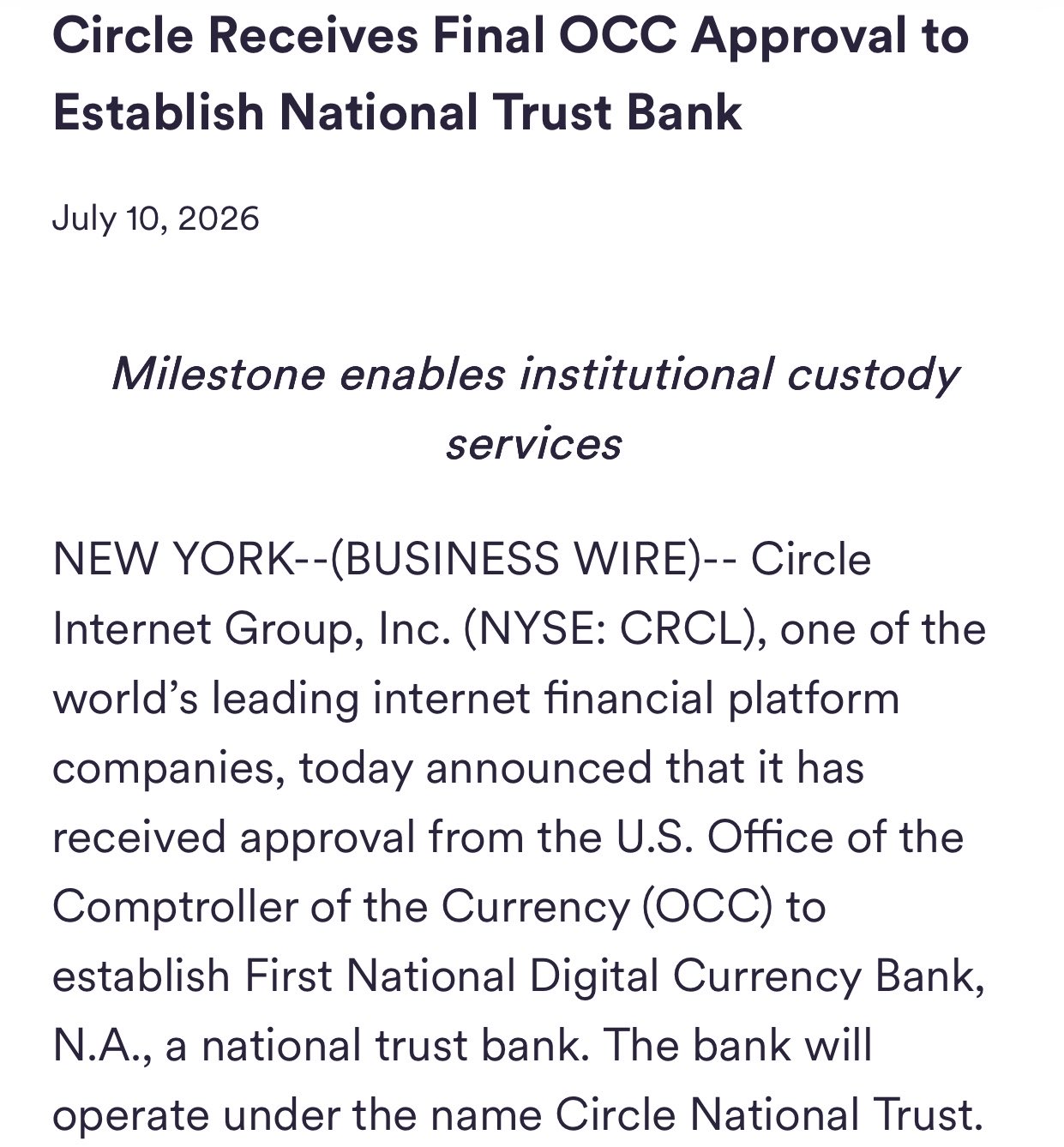
On July 10, 2026, Circle announced it has received final approval from the US Office of the Comptroller of the Currency (OCC) — the primary federal regulator of national banks — to establish First National Digital Currency Bank, N.A.
The institution will operate under the brand name Circle National Trust — sitting alongside Circle’s existing internet financial platform as a formally chartered, federally regulated banking entity specifically designed for digital asset operations.
Why OCC approval specifically matters:
The OCC is not a state regulator or a secondary oversight body — it is the federal authority that charters and supervises national banks in the United States. A national trust bank charter from the OCC carries the same federal standing as any traditional national bank — meaning Circle National Trust operates under the same rigorous regulatory framework that governs the largest financial institutions in the country.
This is materially different from state-level money transmitter licenses or BitLicense-style state registrations that most crypto companies have historically relied on. A nationally chartered trust bank is a fundamentally higher tier of regulatory standing — and one that opens doors with institutional counterparties that specifically require federally chartered banking relationships.
 Circle Receives Final OCC Approval to Establish National Trust Bank/Source: circle.com
What This Enables — Three Concrete Capabilities
Institutional-Grade Digital Asset Custody
The most immediate practical capability the national trust bank approval unlocks is custody services for institutional clients. Pension funds, asset managers, family offices, and other institutional investors managing digital assets typically require a federally regulated custodian — the same standard they apply to traditional asset custodians.
Until now, Circle’s institutional custody options were constrained by the absence of a federally chartered banking entity. Circle National Trust removes that constraint — allowing Circle to compete directly for institutional custody mandates that were previously inaccessible.
A Stronger Federal Regulatory Framework
Operating as a nationally chartered trust bank gives Circle a federally regulated, nationally consistent framework — as opposed to navigating a patchwork of state-by-state licensing requirements. This regulatory consistency is particularly valuable for institutional clients operating across multiple US states who need a single, nationally authorised counterparty rather than managing complex multi-state compliance questions.
Broader USDC Institutional Integration
Circle is already the issuer of USDC — one of the world’s most widely used dollar-backed stablecoins. Circle National Trust now creates a federally regulated infrastructure layer underneath USDC’s institutional distribution — giving banks, asset managers, and corporate treasuries a cleaner path to integrating USDC into their operations through a nationally chartered banking counterparty rather than a non-bank entity.
This is the USDC institutional adoption pathway that Circle has been building toward — and the OCC approval is its most important structural enabler yet.
Market Reaction — Why $CRCL Is Up 7%
The immediate +7.34% move in $CRCL shares reflects the market pricing in several forward-looking implications simultaneously:
Expanded addressable market — A nationally chartered trust bank can serve client segments — particularly regulated institutional investors — that were effectively outside Circle’s reach without this approval. A larger addressable market typically translates to higher revenue potential over time.
Competitive differentiation — Very few crypto-native companies have achieved OCC national bank charter approval. This creates a meaningful regulatory moat — regulatory standing of this calibre takes years to build and is not easily replicated by competitors.
USDC credibility reinforcement — Every layer of federal regulatory validation Circle achieves strengthens USDC’s position relative to competing stablecoins. Institutional adoption of stablecoins tends to concentrate around the most regulated options — and Circle National Trust makes USDC the most institutionally credible option available.
De-risking the regulatory narrative — In a year where stablecoin and crypto regulation has been a dominant market theme, successful navigation of one of the US’s most rigorous regulatory processes sends a strong signal that Circle is positioned to thrive in a regulated environment rather than facing headwinds from it.
What This Means for the Broader Crypto Market
Circle’s OCC approval is significant beyond $CRCL itself — it is a data point in the broader narrative of crypto-native companies achieving mainstream financial regulatory standing in the United States.
The approval demonstrates that the US regulatory framework — when navigated successfully — can accommodate crypto-native businesses operating at institutional scale. For the stablecoin sector specifically, a federally chartered USDC issuer with trust bank capabilities changes the calculus for institutional adoption: the question of “is USDC safe enough for our regulated institution” now has a materially stronger answer than it did yesterday.
Bottom Line
Circle’s OCC approval for First National Digital Currency Bank is one of the most significant regulatory milestones achieved by any crypto-native company in the United States. The establishment of Circle National Trust — a nationally chartered trust bank under federal oversight — gives Circle a federally regulated infrastructure layer for institutional custody, a competitive moat that few competitors can quickly replicate, and a structurally stronger foundation for USDC’s continued institutional adoption.
$CRCL’s +7% move today is the market’s immediate assessment of what those capabilities are worth. Whether the stock sustains and builds on this move will depend on how quickly Circle can translate the approval into actual institutional client mandates and expanded USDC distribution through Circle National Trust.
Frequently Asked Questions
What exactly did Circle receive approval for?
Circle received final OCC approval to establish First National Digital Currency Bank, N.A. — a nationally chartered trust bank that will operate under the name Circle National Trust.
What is the OCC and why does its approval matter?
The Office of the Comptroller of the Currency is the primary federal regulator of national banks in the US. An OCC national trust bank charter carries the same federal standing as any traditional national bank — a significantly higher regulatory tier than state-level licensing.
What can Circle National Trust do that Circle couldn’t before?
Offer institutional-grade digital asset custody services to regulated institutional clients — including pension funds, asset managers, and family offices — who require federally chartered banking counterparties.
How does this affect USDC?
It creates a federally regulated infrastructure layer underneath USDC’s institutional distribution — giving banks and asset managers a cleaner, nationally authorised path to integrating USDC into their operations through Circle National Trust.