
Has storage "peaked"?

Morgan Stanley believes that the global memory chip industry is approaching the "peak rate of change," but this does not mean the end of the cycle.
According to Wind Chaser Trading Desk, in a research report on July 6th, Morgan Stanley Asia Pacific technology analysts Shawn Kim and Ryan Kim stated that the current storage chip market has three core controversies:Has the price surge peaked, why haven't long-term agreements (LTAs) triggered a valuation repricing, and is this the cycle's peak or just a bull market consolidation?The core conclusion of the report can be summarized in one sentence:The rate of change in price increases is peaking, but the cycle itself is not yet over.
Morgan Stanley believes that as the largest AI compute buyers are rumored to be starting to sell idle compute capacity, and as enterprises increasingly push for "token minimization," the upward momentum in the storage sector is waning.
This means that ahead of the upcoming earnings season, related stocks will face short-term price weakness and high volatility. The market is currently extremely crowded, and funds are preparing to rotate into lagging sectors. Morgan Stanley's baseline recommendation is:Long-term outlook remains bullish (profits projected to grow 35-40% by 2027), but caution is needed for a short-term pullback.

Three Core Controversies: What Is the Market Debating?
Morgan Stanley points out that three core controversies have repeatedly arisen in investor conversations over the past week, and these are key frameworks for understanding the current trends of the storage sector.
Controversy 1: Is computing power really in excess?
There is an unverified rumor circulating in the market—that one of the AI sector's largest capital spenders supposedly has excess compute capacity available for sale. The bearish interpretation is: if hyperscale cloud providers have excess compute, the whole AI infrastructure buildout may be oversupplied. However, Morgan Stanley offers another view: this is simply enterprises optimizing capital returns and monetizing idle infrastructure, not true surplus computing.
The real moment of validation will be the Q2 2026 earnings season—if hyperscalers maintain or raise their capital expenditure guidance, it will be a good buying opportunity for storage stocks; if they cut, the oversupply narrative will intensify.
Controversy 2: The tug-of-war between 'Token Maximization' and 'Token Minimization'
As AI applications roll out, a new phenomenon has emerged: many enterprises once encouraged employees to use as many AI-generated tokens as possible (“token maxing”), but this led to IT budget overruns, and companies are now looking for cheaper alternatives.
Specific manifestations include:
The firm’s conclusion: Q2 2026 (June quarter) poses little problem for the AI supply chain, but the market is increasingly focused on the impact of cheaper tokens on H2 guidance.
Controversy 3: Why haven't stock prices repriced after LTA signings?
The signing of long-term agreements (LTAs) should have served as a catalyst for the repricing of storage stocks, but market response has been muted. Morgan Stanley's explanation is:The market still remembers well—past LTAs were either renegotiated, or ultimately forced customers to take on unnecessary inventory (analogous to semiconductor companies’ experiences during COVID).
Of course, some believe that current storage LTAs are structurally meaningful (rather than cyclical), provided that AI demand remains strong. Butwhether earnings expectations can continue to be revised upward remains the greatest uncertainty for investors—especially regarding when and by how much storage prices may further exceed expectations, boosting 2028 EPS. The timeline here is very unclear.

Rate of Change Peaks: Three Dimensions Peaking Simultaneously
Morgan Stanley makes it clear that the storage industry is nearing its "peak rate of change," reflected in three dimensions:
Year-on-year (YoY) pricing growth: DRAM YoY price increases have dropped significantly from Q1 highs, and are expected to continue narrowing in coming quarters;
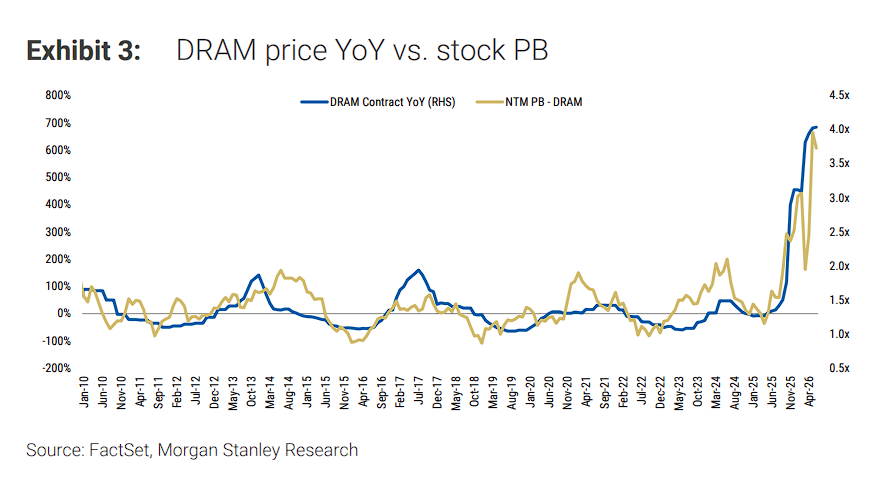
Inventory change: Inventory cycle improvement is stabilizing;
EPS revision breadth: The profitability expectation revision breadth for DRAM has reached a historical high (currently about 89%), leaving little further upside.
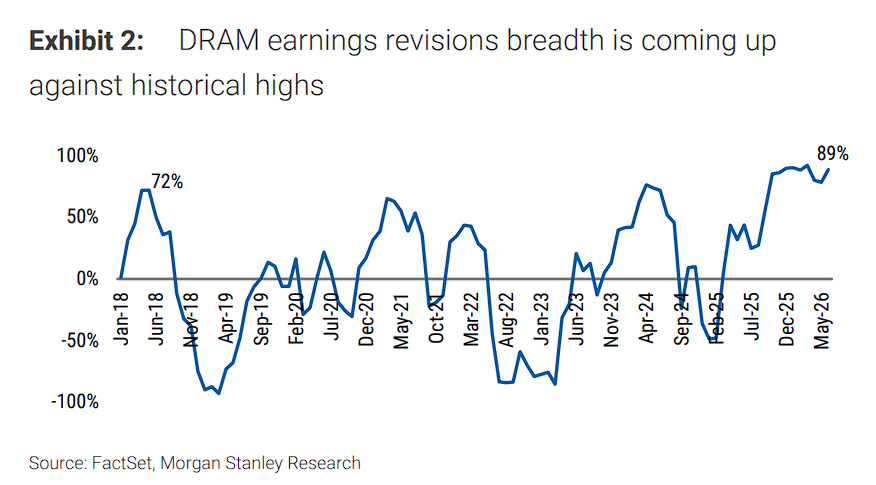
This signal of a "peak rate of change" is the core reason why storage stocks need a phase of consolidation.
It is worth noting that since the generative AI wave started in November 2022, the storage sector has already experienced three cyclical pullbacks (corresponding to the US-Iran conflict: -15%, profit-taking after sharp rallies: -32%, the so-called “reciprocal tariff day”: -20%, and currently around -17%). Morgan Stanley characterizes these asnormal corrections within a structural bull market, not the start of a bear market.
At the same time, Morgan Stanley notes that the most direct pressure now facing the storage sector comes from thepositioning level, not from a collapse in fundamentals.
Storage stocks are among the most crowded trades in the market.Recently higher volatility is making it increasingly difficult to maintain historically high net long positions—even with both spot price rises and increased volatility, this dynamic is becoming more pronounced. Over the past week, several investors told Morgan Stanley they are acutely aware of this dynamic, and are very interested in expanding into ‘broadening laggard opportunities’.
The recent weakness in hyperscaler stocks may be a leading sign that storage stocks (as core beneficiaries of AI spending) are about to underperform the broader market.From a seasonality perspective, this current window is also a relatively tough phase for the market overall.
Finally, Morgan Stanley makes it clear thatat this stage, hyperscaler statements in earnings are more influential on share price trends than storage companies' management commentary—because at this point in the cycle, management teams at storage companies are likely to remain bullish.
For AI spenders, the “token maximization” effect may support Q2 2026 performance, butwhether Q3 2026 guidance comes in below market expectations will be the next big controversy—with token usage optimization, competition from low-cost open-source LLMs, and "chipflation" squeezing profit margins all being key downside risks.
~~~~~~~~~~~~~~~~~~~~~~~~

Disclaimer: The content of this article solely reflects the author's opinion and does not represent the platform in any capacity. This article is not intended to serve as a reference for making investment decisions.
You may also like
Analysts highlight $1,000 long-term target as Solana tests $82 resistance
How Japanese seasoning maker Ajinomoto turned AI hype into 56% 2026 gain
US ETF assets projected to exceed $20T by 2030, but less than $700M lives onchain
Grayscale Recent Action Shocks XRP Army. Here’s What Happened
Crypto prices
More


