
SemiAnalysis: The Fire and Ice of NVIDIA Rubin Platform

Hard·AI
Author | Li Jia
Editor | Hard AI
SemiAnalysis, a semiconductor research organization, has released two consecutive analyses, outlining the “two sides of the coin” for Nvidia’s outlook, with both opportunities and challenges ahead.
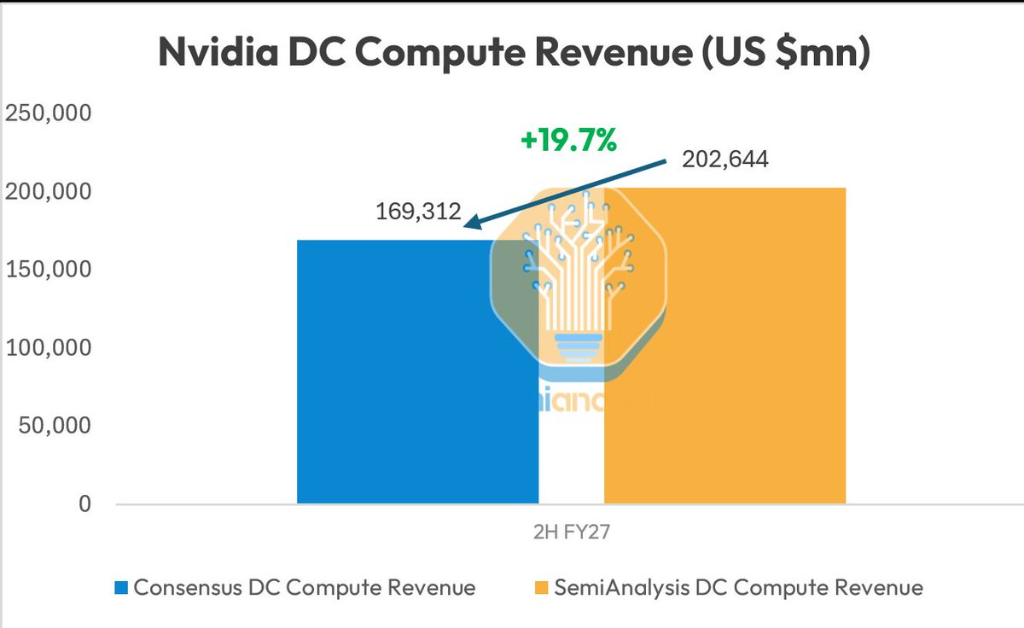
The latest forecast released by SemiAnalysis on the X platform on June 30 shows that Nvidia’s data center computing business revenue in the second half of fiscal year 2027 will exceed Wall Street's consensus estimates by about 20%. The core reason for this optimistic outlook is that the HBM4 memory supply problem, which previously constrained large-scale shipments of the Rubin platform, has now been resolved, and front-end wafer capacity has been sufficiently reserved, clearing substantial obstacles for a performance surge in the second half.
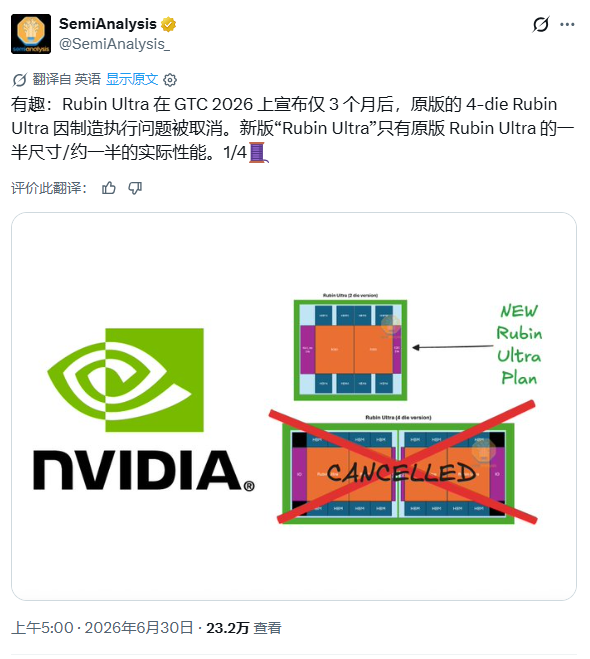
However, earlier the same day, SemiAnalysis released another piece of negative news: The original four-chip Rubin Ultra was canceled about three months after being launched at GTC 2026. The new “Rubin Ultra” has its physical size halved, with its actual performance also halved as a result.
On one hand, the removal of supply bottlenecks brings an optimistic revenue revision, but on the other, the shrinkage of the flagship product leads to a pessimistic technical reassessment—these two sharply contrasting perspectives from SemiAnalysis respectively anchor Nvidia at two narrative axes: execution strength and the depth of its technology moat.
01
HBM4 bottleneck resolved, Rubin platform poised for volume growth in the second half
SemiAnalysis employs its Accelerator Model for the latest projection, predicting Nvidia will experience a large-scale surge in the second half of this year.
The firm expects that with the robust growth of the Rubin platform, Nvidia's data center computing business income in the second half of fiscal year 2027 will be about 20% above current market consensus. The HBM4 issue that once affected Rubin’s progress has now been resolved, while front-end wafer supply has been stocked in advance, which means the previously delayed Rubin platform is now set for rapid ramp-up.
SemiAnalysis also notes that its forecast methodology is significantly different from traditional sell-side analysts. Most Wall Street firms prefer to build relatively conservative profit estimates to leave room for “outperformance” later; SemiAnalysis, however, bases their conclusions mainly on first-hand supply chain research to more closely reflect real market dynamics.
Its Accelerator Model establishes a cross-verification system across the entire information chain, with data sources covering material suppliers, wafer manufacturing, key components, server OEMs, and incorporates real procurement and deployment patterns from hyperscale cloud providers and top AI labs, enabling multidimensional checks on supply and demand relationships.
Notably, the model not only focuses on Nvidia but also includes coverage of other AI chip manufacturers such as Broadcom, AMD, MediaTek, and Marvell, and combines the HBM Model to continually track the evolution of the AI compute supply chain as a whole.
02
CUDA's moat eroded, Rubin Ultra shrinkage highlights custom ASIC rise
However, SemiAnalysis’s earlier comments regarding Rubin Ultra have sparked widespread discussion in the market.
The organization notes that Nvidia’s original plan for a four-chip Rubin Ultra design was changed about three months after its unveiling at this year’s GTC, with the new version being notably smaller, mainly due to the challenges of advanced packaging.
SemiAnalysis believes that the main point is not merely the reduction of Rubin Ultra, but what this incident reflects about the changing competitive landscape in the industry. The firm points out that over the past year, Nvidia’s biggest competition is no longer just traditional GPU vendors like AMD, but also hyperscale cloud providers and AI model companies building their own custom ASICs, targeting dedicated chip systems for training and inference scenarios.
For example, Anthropic now employs a heterogeneous compute architecture with Google TPU, Amazon Trainium, and Nvidia GPUs. A large portion of Claude model training runs on TPU, Claude Code inference increasingly occurs on Trainium, while Nvidia’s GPUs serve broader research and general compute tasks. SemiAnalysis notes that a year ago, it was hard to imagine TPU and Trainium reaching this scale; now, CUDA’s moat is being gradually worn away.
Hard·AI

Disclaimer: The content of this article solely reflects the author's opinion and does not represent the platform in any capacity. This article is not intended to serve as a reference for making investment decisions.
You may also like
3 Altcoins That Could Reach All-Time Highs This Weekend, July 11-12
Solana Ecosystem Metrics Support Recovery Setup

Ethena’s USDe deposits surge to $324M on Morpho in four weeks

Crypto prices
More


