
Bullish on continued CPU boom! UBS raises AMD and ARM target prices, Bank of America bullish on TSMC and ASE Group

Hard·AI
Author | Li Jia
Editor | Hard AI
As the AI industry moves from the training phase into the era of inference and Agentic AI, CPUs, once overshadowed by GPUs, are regaining market attention.
UBS's latest report points out that Agentic AI will drive server CPU demand to significantly exceed traditional cycles. In this trend,AMD continues to expand its share in the server market with strong product competitiveness, while ARM architecture is favored by cloud providers and AI infrastructure companies for its energy efficiency advantages. Meanwhile, according to Bank of America, expansion in CPU demand will drive synchronous growth in advanced process nodes and advanced packaging, benefiting manufacturing leaders such as TSMC and ASE.
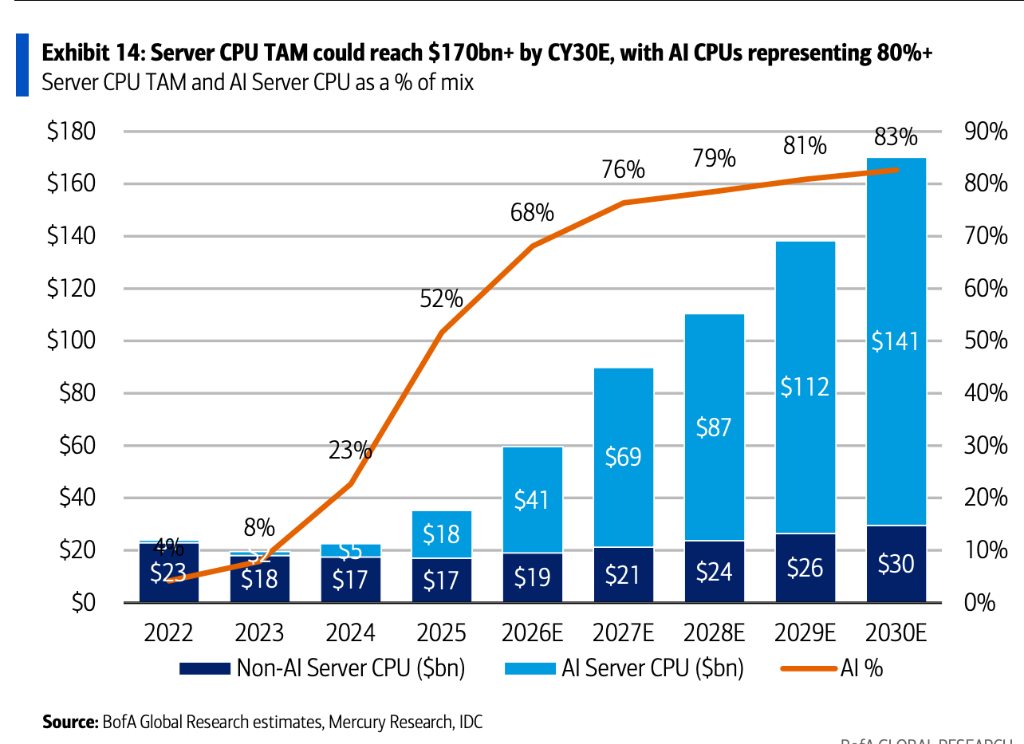
The common foundation of both institutions' assessments is that AI infrastructure is transitioning from simply pursuing computing power to building more comprehensive computing systems. GPUs are still responsible for core training and inference tasks,but the role of the CPU in data management, Agent execution, multi-model collaboration, and system scheduling is becoming increasingly crucial. Bank of America forecasts that the global server CPU market size will grow to more than $170 billion by 2030.
As AMD and ARM continue to expand their market share, more high-end CPU orders will flow to advanced process suppliers like TSMC, and the widespread adoption and increasing complexity of Chiplet architecture will drive growth for advanced packaging companies such as ASE.
01
The Rise of Agentic AI: CPUs Return to the Core
In recent years, the construction of AI infrastructure has mainly revolved around GPUs, and CPUs have assumed more of an auxiliary role for tasks such as data scheduling, storage management, and task coordination.As AI applications gradually shift from training to inference, and further evolve towards Agentic AI, the importance of CPUs is rising rapidly.
In Agentic AI scenarios, models need to plan tasks, invoke tools, access databases, manage states, and execute complex workflows. These jobs do not rely entirely on matrix computation, but involve a large number of sequential, low-latency, and high-I/O tasks, which are more suitable for CPUs.
The CPU is upgrading from a traditional "host processor" to the "central command" of AI systems. If the CPU cannot complete data scheduling, memory management, and task coordination in time, even with powerful GPUs, there may still be declining utilization issues.
Based on this trend, it is expected that the global server CPU market will enter a new round of growth, with market size exceeding $170 billion by 2030, a near fivefold increase over about $35 billion in 2025.
02
The Standalone AI Server Market Points to x86, AMD Takes the Lead
Against the backdrop of explosive CPU demand, UBS is even more optimistic about AMD's long-term growth prospects.
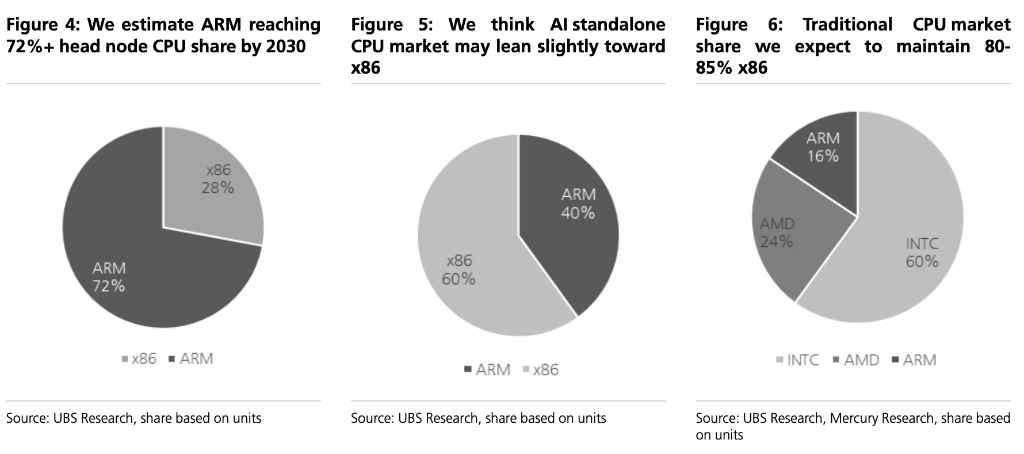
The institution believes thatstandalone Agentic AI servers are rapidly emerging, and these applications place greater importance on core count and multi-thread performance—areas where AMD excels. UBS's latest estimates show that, in the standalone AI server market, the future market shares of x86 and ARM architectures will reach 60% and 40%, respectively,with AMD poised to capture most of the incremental x86 demand.
Based on expectations of higher market share, UBS raised its AMD server CPU revenue forecast for 2027 from $21 billion to $23 billion, for 2028 from $27 billion to $29 billion, and expects server CPU revenue to reach $50 billion in 2030, up from the previous forecast of $41 billion.
Accordingly, UBS raised AMD's target price significantly from $455 to $670.
03
Aiming for 70% of Head Node Share, ARM Ecosystem Accelerates Expansion
Besides AMD, ARM is also a key focus for UBS.
The report indicates that future AI infrastructure will gradually take shape around two types of CPU architectures: one is the Head Node CPU connected to GPUs, emphasizing low latency and high energy efficiency; the other is standalone Agentic AI servers, which emphasize core count and throughput.
UBS believes that ARM architecture has obvious advantages in the former market. NVIDIA Grace, Vera, Google Axion, AWS Graviton, and other products are all expanding rapidly. The institution forecasts thatby 2030 ARM architecture is expected to capture about 70% of the Head Node CPU market and nearly 50% of total server CPU revenue.
Based on its optimistic outlook for AI CPUs, UBS raised ARM's target price from $260 to $470.
04
TSMC and ASE Welcome a New Expansion Cycle
The surge in CPU demand is becoming a new growth engine for the semiconductor industry following GPUs. According to Bank of America,this trend not only benefits chip design companies, but will also directly boost the manufacturing and packaging/testing segments.
Bank of America's estimates suggest that the global semiconductor manufacturing market related to server CPUs is expected to expand from $15 billion in 2025 to $49 billion in 2028. Outsourced production will rise from 52% to 71%, reflecting the continued strengthening of pure foundries such as TSMC in the high-end CPU domain.
The scarcity of advanced process capacity, coupled with simultaneous multi-client and multi-architecture volume ramping, makes the foundry segment the most certain beneficiary in this cycle's uptrend.
Meanwhile, demand for Chiplet heterogeneous integration, CoWoS advanced packaging, and system-level testing in AI CPUs continues to rise, leading to rapid expansion in the backend packaging and testing market.Bank of America expects the server CPU-related packaging and testing market size to grow from $1.9 billion in 2025 to $9.6 billion in 2028, with advanced packaging's share rising from 11% to 24%.
The packaging value chain's upgrade not only increases the packaging value of a single chip but also extends the processing time for backend steps like testing, creating opportunities for leading packaging and testing providers in both volume and price.
Based on the above supply-demand outlook,Bank of America has simultaneously raised valuation expectations for supply chain leaders such as TSMC and ASE, believing that advanced nodes and packaging remain the most defensible links in the industry chain. In the new wave of architectural change driven by Agentic AI, the trend of parallel development between CPUs and GPUs has become increasingly clear. Foundry and packaging/testing providers, with technological leadership and scale effects, are expected to continue benefiting from customer diversification and increased single-chip value throughout this cycle.
Hard·AI

Disclaimer: The content of this article solely reflects the author's opinion and does not represent the platform in any capacity. This article is not intended to serve as a reference for making investment decisions.
You may also like
Why former Bank of America strategist sees an Ethereum ‘tactical bottom’
SWIFT Just Named 30+ Ripple (XRP) Connected Banks. Here’s why
Solana News: Santiment Flags Record Bearish Sentiment, Analyst Eyes $127
3 Altcoins That Could Reach All-Time Highs This Weekend, July 11-12
Crypto prices
More


