
Finally ends 9 consecutive declines! Oracle has fallen in 18 out of the past 22 trading days

Oracle's stock price finally halted its longest losing streak since 2021, but the depth and duration of this downturn still caught the market's attention.
Overnight, Oracle's stock closed up 2.49% at $143.76, ending a nine-day losing streak, marking its largest single-day gain since June 15. During the session, the stock briefly touched $145.62, up 3.8% from the previous close.
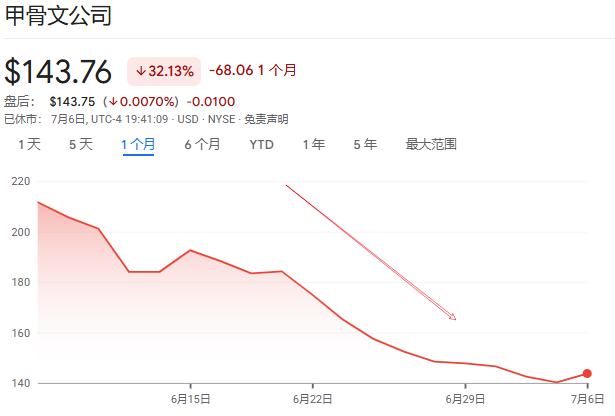
However, this rebound does little to conceal the deeper malaise. Since reaching its 2026 closing high of $248.15 on June 1, Oracle has logged declines in 18 out of the past 22 trading days, accumulating a total drop of 26.2%.
Meanwhile, Wall Street analysts’ bullish sentiment toward the stock has reached its highest level in nearly 20 years, with the average target price suggesting over 80% upside from the current share price—a stark contrast.
The Depth of the Pullback: A 56% Gap and a “True Plunge”
The severity of this decline is quite rare in Oracle’s recent history. During the nine-day losing streak, the stock fell a cumulative 24%, registering its longest streak since December 2021. Broadening the time frame, since hitting its all-time closing high of $324.33 on September 10, 2025, Oracle’s share price has tumbled 56.2%; its decline over the past 52 weeks is 38.1%.
According to Barron's, what’s even more notable is that Oracle’s selloff diverged from a broader rally in the software sector. The iShares Expanded Tech-Software ETF posted five consecutive days of gains exceeding 10% as of last Thursday, while Oracle moved lower over the same period. This divergence suggests that Oracle’s woes are not due to industry-wide pressures, but rather company-specific factors.
Capital expenditure and debt concerns are the main risks hanging over Oracle’s head, and are widely regarded as key reasons for its stock’s continued underperformance.
Analysts believe Oracle needs external financing to sustain its capital expenditure plans, listing “financing challenges” as a core risk factor. The company’s expanding spending and accumulating debt load are currently the most pressing concerns for investors.
Analysts Remain Supportive: 84% Buy Ratings, Target Price Implies 82% Upside
Despite continued stock pressure, Wall Street’s confidence in Oracle is at a historical high. According to FactSet, among analysts covering Oracle, 84% give it a Buy rating—surpassed only briefly in May 2011 over the past 20 years. The average analyst target price stands at $254.84, implying about 82% upside from last Thursday’s close.
Mizuho Securities analyst Siti Panigrahi is the most optimistic, with a target price as high as $320; Oracle is also a key recommendation at Mizuho. In a research report last Thursday, Panigrahi stated, “Oracle’s end-to-end AI technology stack spanning database, infrastructure, and application layers makes it a core long-term winner in the AI adoption wave.”
Last month, KeyBanc analysts also raised their profit forecasts for Oracle, citing growing confidence that operating expense growth will remain moderate, and maintained their Overweight rating and a $300 target price, reasoning “future upside comes directly from this.”
As the AI infrastructure arms race heats up, whether Oracle can maintain financial discipline while delivering on growth promises will be the key variable determining if its stock price can approach analysts’ targets.
Disclaimer: The content of this article solely reflects the author's opinion and does not represent the platform in any capacity. This article is not intended to serve as a reference for making investment decisions.
You may also like
Why former Bank of America strategist sees an Ethereum ‘tactical bottom’
SWIFT Just Named 30+ Ripple (XRP) Connected Banks. Here’s why
Solana News: Santiment Flags Record Bearish Sentiment, Analyst Eyes $127
3 Altcoins That Could Reach All-Time Highs This Weekend, July 11-12
Crypto prices
More


