
Musk Buys "Light Beam," Prompting Action from Silicon Valley Giants

Optical modules are becoming the “new favorite” for Silicon Valley tech giants to invest in.
On June 27, local US time, foreign media reported that Elon Musk's acquisition map has added a new piece.
This time, his sights are set on an optical communications startup, Mesh Optical Technologies.
According to documents from the US Federal Trade Commission (FTC), the antitrust review of this acquisition has already been completed through the fast-track process, eliminating regulatory obstacles.
The focus of Musk’s acquisition is on the toughest problem facing AI computing infrastructure: as AI compute clusters grow larger, traditional copper cabling for data transmission is hitting physical limits—higher speeds lead to signal attenuation, greater distances push power consumption through the roof. Optical interconnects are seen as the inevitable way to bypass this barrier.
Thus, Musk's acquisition of Mesh is primarily to lay the underlying “pipeline” for his compute empire. The optical module track he’s targeting is quietly becoming one of the hottest fields in the entire tech industry.
If we lay out the acquisition lists of major Silicon Valley companies over the past year, we’ll find a subtle but clear trend: they’re all beginning to set up in the optical module space.
Besides SpaceX, Nvidia, Marvell, AMD, Broadcom, and others—from chip giants to rocket makers—are all betting in the same “optical” direction.
According to estimates by organizations such as Reuters, Futurum, and Goldman Sachs, by 2026, capital expenditures by large cloud vendors and AI infrastructure will approach, or even exceed, $700 billion. Within AI clusters, network interconnects are also becoming a key cost item after GPUs.
As tens of billions in CAPEX surge in and interconnect costs occupy an increasing proportion of the data center bill, optical modules are transitioning from supporting roles to center stage—a consensus that’s growing across the industry.
Musk Becomes a “Chaser of Light”
Let’s first discuss the logic and “ambition” behind SpaceX’s layout in optical modules.
The acquired company, Mesh, also shares substantial ties with Musk.
Founded in 2025, Mesh was co-founded by three former SpaceX engineers: Travis Brashears, Cameron Ramos, and Serena Grown-Haeberli.
Before launching the startup, the three worked on SpaceX’s Starlink satellite laser communication links. It was this system that enabled thousands of Starlink satellites to interconnect in space. Now, they’ve brought space-honed optical communications technologies down to Earth, aiming at the AI data center market.
Mesh’s core product is an optical transceiver called Alpha C1, supporting 1.6T and 800G rates. According to the company, its power consumption is only one-third that of similar modules.
The product’s key lies in the manufacturing method for its optical engine, using flip-chip mounting—similar to the technology used in packing modern processor chips. The company is also building capabilities for scalable, high-speed optical interconnect production, spanning optical engine packaging, optical transceiver manufacturing, and automated testing.
Mesh believes the current production of optical systems is far too inefficient: most US-made optics are still assembled by hand like lab instruments, leading to high costs and low output—nowhere near enough to meet the AI clusters’ demand for millions of optical connections.
What Mesh wants to do is make large-scale manufacturing of optical systems a reality.
In February this year, Mesh came out of “stealth mode” and announced the completion of an over $50 million Series A round, led by Thrive Capital.
Now, with Musk’s move, it is beginning to be integrated into a larger AI compute and space communications ecosystem.
The FTC filing specifically lists Musk as the acquirer, rather than SpaceX or xAI. However, it is widely believed externally that cross-selling and personnel transfers between Musk’s companies is typical. After the acquisition, Mesh’s technology and team will likely serve the full spectrum of Musk’s compute needs.
AI Data Centers Enter the Era of “Light Speed Competition”
The core significance of acquiring Mesh lies in improving the efficiency of SpaceX’s data centers.
SpaceX recently completed the largest IPO in history, and its business territory is expanding from rocket launches and satellite internet to AI computing power.
According to the plan, it may eventually launch up to one million data center satellites into Earth orbit—a project recently dubbed “Starmind.”
These satellites do not operate in isolation. Like servers within ground-based data centers, they need to transfer data at high speed between themselves—the difference is, the link is not copper cables or fiber, but laser communications. This is precisely where the Mesh founding team excels: back during Starlink, one of their core competencies was enabling inter-satellite laser communication.
At the same time, SpaceX is accelerating its AI efforts on the ground. Its xAI unit is building massive data centers in Tennessee and Mississippi, currently operating compute clusters of about 1 gigawatt, centered around Colossus and Colossus II training systems. Colossus II is set for further expansion, with over 400 megawatts more compute power and more than 220,000 Nvidia GB300 chips.
Musk is clearly pushing ahead on two tracks: building ultra-large AI data centers on Earth, and exploring “satellite data centers” in space. In both arenas, high-speed optical communications form the foundational layer for expanding AI computing power.
Currently, SpaceX has signed compute supply agreements with Anthropic, Google, and open-source AI developer Reflection AI, offering these firms access to its chips and data centers. Such agreements bring SpaceX significant revenue and place it in direct competition with major cloud providers like Amazon Web Services (AWS), Microsoft Azure, and Google Cloud.
Looking forward, when SpaceX’s space-based data centers enter true orbital operation, inter-satellite laser communications will greatly increase in demand. The experience of the Mesh team with Starlink’s laser links, along with the optical transceiver technology they’re now developing, will be useful both in space and on the ground.
Moreover, this acquisition is part of a series of Musk's recent moves.
Previously, SpaceX already acquired the AI programming startup Cursor, to enhance xAI’s code generation and engineering development capabilities. At the same time, Musk is pushing ahead with turning X into a payment platform.
On June 26, he expanded access to the X Money payment tool for some US paid subscribers on the social platform X, in an attempt to further transform X from a social network into a “super app.”
Looking at all these moves, the direction is clear: Musk’s series of recent actions points toward connecting SpaceX, xAI, and X more closely—to create a tighter loop between computing power, software capabilities, payment entry points, and user networks.
The New Battlefield for Silicon Valley Giants
In the optical interconnect field, the last year witnessed an acceleration of intensive M&A and investments by major semiconductor firms and tech giants.
In December 2025, Marvell announced it would acquire optical interconnect company Celestial AI for $3.25 billion in cash and stock. If Celestial AI hits its revenue milestones, the total deal may reach $5.5 billion.
Celestial AI's “Photonics Fabric” tech enables high-bandwidth, low-latency optical connectivity directly into the GPU package, rather than traditional rack-to-rack network connections.
If we only look at this new wave of AI data center-driven optical interconnect M&A, this is the largest deal so far in the current AI cycle, making Marvell one of the most high-profile names amid the optical interconnect boom.
At Computex Taipei on June 1, Jensen Huang called Marvell “the next trillion-dollar company,” boosting Marvell's share price by over 25% that day.
From acquisition premiums to surging stock prices, optical interconnects are being re-valued by the capital markets as a key AI infrastructure track.
AWS vice president Dave Brown commented at the time that this acquisition would “further accelerate optical interconnect innovation for next-generation AI deployments.” Marvell expects Celestial AI to reach $500 million in annualized revenue by fiscal 2028, and $1 billion by 2029.
As the biggest beneficiary of the AI boom, Nvidia's moves carry even more weight.
In March 2026, Nvidia announced direct strategic investments of $2 billion each in Lumentum and Coherent, two optics companies, along with several billion dollars in procurement agreements.
Additionally, Nvidia participated in the $500 million Series E round of photonics startup Ayar Labs, which specializes in optical I/O chiplet technology targeting chip-to-chip optical interconnects.
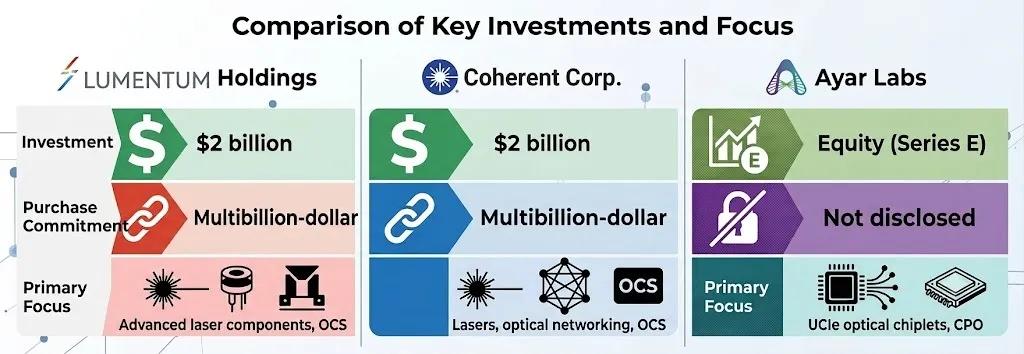
Nvidia invested $2 billion each in Lumentum and Coherent with multi-billion dollar procurement deals, and took a stake in Ayar Labs, staking out the optical interconnect field in advance
The first two partnerships are non-exclusive, while Ayar Labs is a strategic investment—meaning Nvidia, while securing laser sources and optical component capacity, still maintains a competitive supply landscape.
With these investments, Nvidia is extending its reach from GPUs and network switches further down into optical components, entering an even more fundamental layer of compute infrastructure.
Broadcom is also a pioneer in co-packaged optics (CPO). Its “Bailly” CPO switch, based on Tomahawk 5, has shipped to hyperscale clients since 2024, and is being deployed by cloud providers like Meta at scale.
In October 2025, Broadcom released Tomahawk 6 “Davisson,” the industry’s first 102.4 Tbps Ethernet switch with co-packaged optics, using 16 6.4T optical engines built with TSMC COUPE process. The optical interconnect power is reduced by 70% compared to traditional pluggable solutions. Broadcom’s path is to integrate optical engines downward from the switch chip, achieving vertical integration.
AMD has also joined the fray, acquiring optical I/O company Enosemi for chiplet-to-chiplet interconnect. Astera Labs acquired aiXscale Photonics, moving from the electrical signal retimer market into optics.
It's not just about corporate acquisitions—the entire industry is also working to unify standards.
In March 2026, AMD, Broadcom, Nvidia, OpenAI, Meta, and Microsoft co-founded the Optical Compute Interconnect Multi-Source Agreement (OCI MSA), aiming to define open connectivity standards for AI data center optical interconnects.
The alliance membership covers nearly all mainstream vendors developing their own AI accelerators. The OCI MSA plans to support optical physical layer solutions from 200G to 3.2 Tb/s, covering pluggable modules, onboard optics, and co-packaged optical chips across different tech routes.
Taken together, the conclusion is clear: optical interconnects have evolved from an optional technological exploration into the core component of competitive AI infrastructure.
Whether Musk is acquiring Mesh or Nvidia, Marvell, and Broadcom are staking out their territory, they’re all betting on the same trend. After all, copper cabling is reaching its physical limit, and for AI compute to move forward, electron must yield to photon.
Source: Tencent Technology
Disclaimer: The content of this article solely reflects the author's opinion and does not represent the platform in any capacity. This article is not intended to serve as a reference for making investment decisions.
You may also like
Security Flaw in Coldcard Seed Phrase Puts Thousands of Bitcoin Wallets at Risk » CoinEagle
Johnson & Johnson Stock Holds Bullish Trend, But MACD Signals Fading Momentum
Analyst warns XRP will underperform Bitcoin for rest of year after breakdown
Remitly Global, Inc. stock hits record $115M EBITDA, then reverses hard
Crypto prices
More


