Rocket Lab Q2 2026 Earnings Highlights: Record Revenue of $234 Million, Up 62% YoY; Backlog Reaches Record $2.36 Billion; Strong Q3 Guidance
Core View
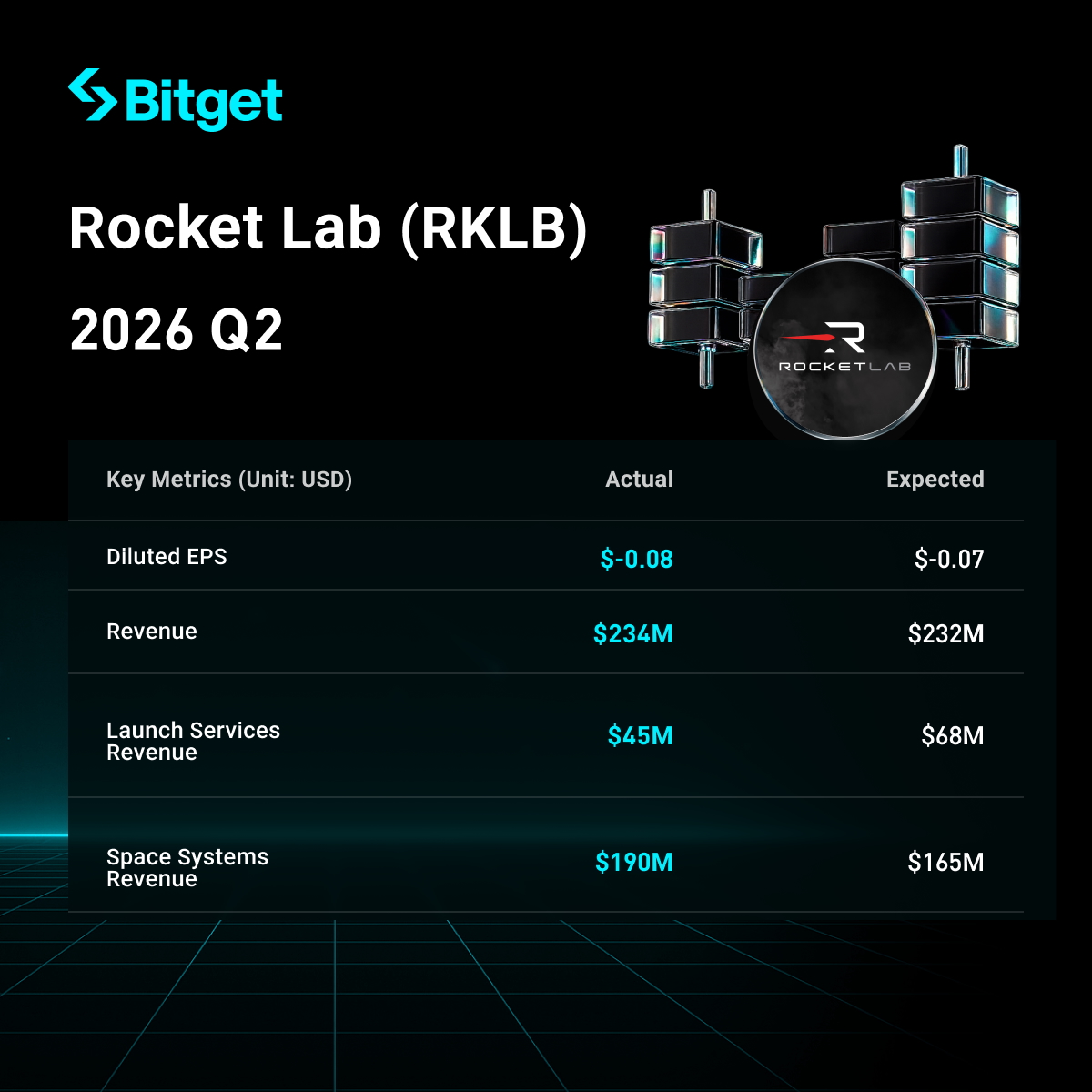
Rocket Lab (RKLB) reported its second-quarter 2026 results, with revenue reaching a record $234 million, up 62% year-over-year and beating market expectations. Net loss narrowed to approximately $49.26 million, or a diluted loss per share of $0.08. Backlog hit a record $2.36 billion, up 137% year-over-year. Growth was primarily driven by the Space Systems segment (accounting for about 81% of revenue), while Launch Services revenue fluctuated due to revenue recognition timing. The company guided Q3 revenue of $250–265 million (above Wall Street estimates), but gross margin guidance came in below expectations, reflecting margin pressure from the expansion of lower-margin satellite platforms. Shares declined after the report.
Detailed Breakdown
- Overall Revenue and Profit Performance
- Quarterly revenue of $234 million (approximately $234.066 million), up 62% year-over-year (from $144.5 million), and up about 16.8% sequentially, exceeding the prior quarter’s record by $34 million and beating analyst estimates (around $231.4–232 million).
- Net loss of approximately $49.26 million, narrowed from $66.41 million in the year-ago period; diluted loss per share of $0.08 (versus $0.13 a year earlier), slightly wider than some estimates of a $0.06–0.07 loss.
- Product revenue approximately $181.3 million; service revenue approximately $52.7 million. Overall gross margin around 36%, improved year-over-year.
- First-half 2026 revenue of $434.4 million, up about 63% year-over-year; first-half net loss of approximately $94.28 million, improved from the prior year.
- Space Systems Performance
- Revenue of $189.5 million, up approximately 94% year-over-year and 38.6% sequentially, representing the largest revenue contributor (about 81% of Q2 total revenue).
- Growth driven primarily by expansion in satellite manufacturing and initial contribution from the Mynaric acquisition.
- Key contracts secured: approximately $397 million award to deliver multiple Flatellite spacecraft for the U.S. Space Force’s SB-AMTI program (to be launched on Neutron); more than $160 million across two contracts to build three geostationary satellites, including a prime contract with the U.S. Space Force’s Space Systems Command to build and operate two space domain awareness satellites.
- Formally established Rocket Lab Germany GmbH to support scaling of satellite and component manufacturing in Germany and to provide commercial and sovereign space capabilities to European customers.
- Launch Services and Other Business Performance
- Launch Services revenue of $44.6 million, down approximately 4% year-over-year and 30% sequentially (despite a similar number of launches), primarily due to the mix of point-in-time Electron revenue recognition versus over-time HASTE recognition.
- More than $437 million in new launch contracts secured across Electron, HASTE, and Neutron during Q2 and post-quarter, expanding the total launch backlog to a record of more than 90 missions.
- Overall backlog of $2.36 billion (roughly 40% Launch Services / 60% Space Systems), up 137% year-over-year.
- Introduced the GHOST globally deployable launch system; first site (Launch Complex 4) at the Pacific Spaceport Complex in Kodiak, Alaska, with planned suborbital debut in 2027.
- Future Plans and Strategic Initiatives
- Neutron medium-lift reusable rocket: Progress on assembly, integration, and first-flight hardware testing; Stage 1 tank production remains on track for delivery to the launch pad in Q4 2026 (with some adjustment to earlier inaugural flight expectations).
- Closed the acquisitions of Mynaric and Motiv; announced a landmark agreement to acquire Iridium Communications Inc. to create a fully vertically integrated space company capable of designing, building, launching, and operating its own satellite constellations.
- Continued investment in launch infrastructure, production capacity, and Neutron development; additional Neutron launch contracts signed (including with Kepler Communications).
- Q3 2026 Guidance
- Revenue: $250 million to $265 million (midpoint approximately $257.5 million, above Wall Street estimates of around $238.5 million).
- GAAP gross margin: 29% to 31% (below analyst average estimate of approximately 37.6%); non-GAAP gross margin: 35% to 37%.
- GAAP operating expenses: $143 million to $149 million; non-GAAP operating expenses: $121 million to $127 million.
- Net interest income: $21 million.
- Adjusted EBITDA loss: $17 million to $23 million.
- Basic weighted-average shares outstanding: approximately 641 million (including about 41 million Series A convertible preferred shares).
- The company noted that more than $1 billion in new launch and space systems contracts have already been signed in Q3 to date, supporting the strong growth outlook.
- Market Context and Investor Concerns
- The core tension is strong top-line growth and record backlog (driven by surging demand) versus near-term margin pressure: the rising mix of lower-margin satellite platforms is weighing on profitability, leading to Q3 gross margin guidance below expectations.
- Investor attention is also focused on Neutron development progress and the adjusted timeline for first flight, alongside ongoing high spending on R&D and infrastructure.
- Market reaction: Shares closed down approximately 3.37%, with further pressure in after-hours trading (reports of declines exceeding 7–8%), reflecting caution on short-term profitability.
- Positive factors include growing defense and government contracts, the vertical integration strategy via the proposed Iridium transaction, and expansion of the launch backlog, which support longer-term competitive differentiation.
Stock Limited-time Offer:August new user gift: Buy U.S. stocks and get free NVIDIA stock.Trade Now for Better Deals
Disclaimer This content is for reference only and does not constitute any investment advice.






