Why Is the U.S. Dollar Index Weakening? $40 Trillion in Debt, Surging Long-Term Yields, and the “Currency Debasement Trade” Are Reshaping FX Markets
The U.S. Dollar Index (DXY) recently fell to around 98.80, near a three-month low, with its weekly decline widening to approximately 0.9%. Notably, this bout of dollar weakness has not been driven by falling U.S. interest rates. On the contrary, U.S. 10-year and 30-year Treasury yields have climbed to multi-year highs, with the 30-year yield at one point reaching 5.337%.
Under normal circumstances, rising Treasury yields tend to support the U.S. dollar, as higher returns attract overseas capital into dollar-denominated assets. However, the market narrative is changing. Investors are not primarily concerned about a healthy rise in rates caused by an overheating economy; instead, they are focused on rising risk premiums associated with U.S. debt, fiscal deficits, inflation, and policy intervention.
In other words, higher yields do not necessarily make the dollar more attractive. If yields are rising because confidence in U.S. fiscal conditions is deteriorating, the dollar may come under selling pressure instead.
$40 Trillion in Treasury Debt: The Dollar’s Core Pressure Point
U.S. government debt has surpassed $40 trillion, becoming one of the key macroeconomic backdrops behind the dollar’s recent weakness. Although the fiscal deficit as a share of GDP has improved somewhat, it remains elevated. Combined with tax cuts, military expenditure, social welfare spending, and rising interest costs, the U.S. government’s financing pressure continues to build.
For the foreign exchange market, the impact of the debt issue can be viewed from three angles:
1. Continued growth in Treasury supply
As the government issues more debt, the market requires higher yields to absorb the additional supply, pushing up long-term interest rates.
2. Interest expenses reduce fiscal flexibility
When debt levels and interest rates rise simultaneously, the U.S. government’s interest burden can increase rapidly. In the future, policymakers may need to respond through higher taxes, spending cuts, continued borrowing, or looser financial conditions.
3. Rising risk premiums on dollar assets
If investors begin to question U.S. fiscal discipline, they may demand higher yield compensation or reduce their long-term exposure to dollar-denominated assets.
This helps explain an unusual recent market dynamic: Treasury yields are climbing, but the U.S. dollar is not strengthening in tandem. Instead, gold, certain crypto assets, and other hard assets are attracting capital.
Treasury Buybacks: A Short-Term Market Stabilizer, Not a Structural Solution
In response to selling pressure in long-dated Treasuries, the U.S. Treasury announced that it would increase the scale of its long-term government debt buybacks from $2 billion to at least $4 billion. The move briefly lifted long-term bond prices and pushed yields lower. However, subsequent market behavior suggested that investors still viewed the measure as short-term liquidity management rather than a fundamental solution to fiscal concerns.
The concern is that if the government relies on more financial operations to suppress long-term yields without presenting a credible plan to reduce deficits, investors may interpret the policy as an attempt to “manage market pricing” rather than improve debt fundamentals.
Under this scenario, the dollar could face pressure from two directions:
-
Concerns over fiscal risks in the long-term Treasury market remain unresolved;
-
The market may worry that policymakers will tolerate higher inflation or use forms of financial repression to reduce the real burden of debt.
When investors stop simply chasing higher U.S. yields and instead focus on the dollar’s long-term purchasing power and fiscal credibility, the “currency debasement trade” may gain momentum.
Oil, Diesel, and Mortgage Rates: Inflation Pressure Is Returning to the U.S. Economy
Beyond fiscal concerns, rising energy costs are another important factor weighing on the dollar.
Based on the market scenario, U.S. gasoline prices have risen above $4 per gallon, while diesel prices have moved above $5 per gallon. This reflects elevated Middle East supply risks and higher transportation costs. If energy prices remain high, they may feed through into broader inflation via logistics, manufacturing, food, and services.
This is not a straightforward bullish factor for the dollar.
Normally, rising inflation could lead markets to expect a more hawkish Federal Reserve, supporting the dollar. But if inflation is mainly driven by energy supply shocks while economic growth is simultaneously slowing, markets may begin to worry about a stagflation-like environment of high inflation and weak growth.
Against this backdrop, the 30-year mortgage rate has risen to 6.65%, indicating that high borrowing costs are further constraining housing demand and household consumption. Housing is a major lever in the U.S. economy. Higher mortgage rates not only affect home purchases but can also reduce household disposable income and consumer confidence.
If energy, mortgage, and food costs rise together, pressure on U.S. consumers is likely to intensify, which may weaken the dollar’s medium-term fundamentals.
GDP Growth Falls Short of Expectations, Leaving the Dollar With Less Growth Support
The U.S. economy is still expanding, but if GDP growth falls short of policy targets, markets may reassess the dollar’s growth premium.
Based on the data provided, U.S. GDP grew by around 2.1% last year, while second-quarter growth this year was approximately 1.5% on an annualized basis—below earlier, more optimistic expectations. While AI infrastructure investment, capital expenditure by major technology companies, and resilient consumer spending continue to provide support, high interest rates, elevated energy costs, and heavy debt burdens are increasing downside risks to growth.
A sustainably strong dollar generally requires several conditions: high real interest rates, stronger growth relative to other major economies, stable capital markets, and credible fiscal and monetary policies. The United States still benefits from deep capital markets and relatively high interest rates, but fiscal risks and concerns over slowing growth are eroding these advantages.
DXY Technical Outlook: The 98 Area Is a Key Near-Term Level
From a market-structure perspective, DXY has fallen back toward 98.80, close to a three-month low, suggesting that bearish momentum has not fully faded.
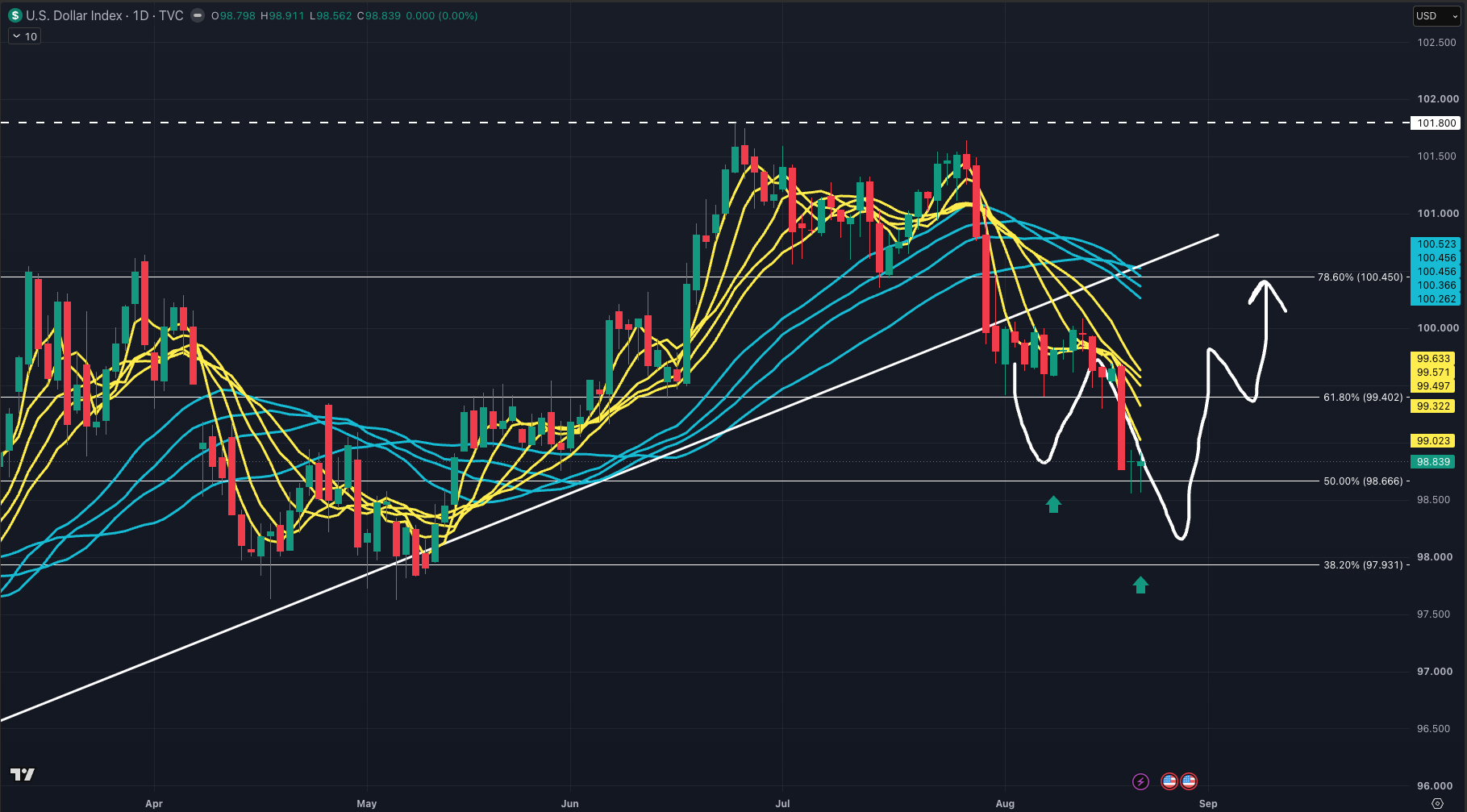
Short-term traders may monitor the following factors:
-
Whether support near 98 holds: A sustained break below this key level could trigger further technical selling pressure.
-
U.S. 10-year and 30-year Treasury yield movements: If yields rise again while the dollar fails to rebound, it would suggest that markets still view higher rates as a sign of fiscal risk rather than a positive catalyst for the dollar.
-
Jackson Hole and Federal Reserve signals: If the Fed reinforces its commitment to fighting inflation, the dollar could receive short-term support. However, if markets believe the Fed is constrained by growth concerns, financial market conditions, or government financing pressure, the dollar’s rebound potential may remain limited.
-
Oil prices and geopolitical developments: Further oil-price gains may intensify inflation concerns, but they could also undermine consumption and economic growth. FX market reactions will depend on which force dominates market sentiment.
Which Currency Pair Opportunities Could Traders Watch?
In an environment of a softer dollar and elevated market volatility, traders do not need to focus exclusively on the Dollar Index. Major currency pairs can also offer insight into capital flows:
-
EUR/USD: If U.S. fiscal concerns persist, the euro may benefit against the dollar. However, traders should still monitor differences in European economic conditions and ECB policy.
-
GBP/USD: The British pound is typically sensitive to interest-rate expectations and risk sentiment, which may result in greater volatility.
-
USD/JPY: The U.S.-Japan yield differential remains a key driver. However, if safe-haven demand rises or U.S. Treasury yields decline, the yen could rebound more quickly.
-
AUD/USD and NZD/USD: These pairs are more closely linked to risk sentiment and commodity prices. Energy markets, raw materials, and global growth expectations are key factors to watch.
-
USD/CHF: If fiscal concerns or geopolitical risks intensify, the Swiss franc’s safe-haven characteristics may draw greater market attention.
Conclusion: Dollar Weakness Is Not Just an Interest-Rate Story—It Is a Confidence Story
The core driver behind recent dollar weakness is not simply an expectation of a Federal Reserve policy shift. More importantly, investors are reassessing U.S. fiscal, debt, and inflation risks.
When long-term Treasury yields rise without lifting the dollar, it suggests that the market’s pricing framework for U.S. assets is changing. A $40 trillion debt burden, high mortgage rates, rising energy costs, and government efforts to stabilize the long-end of the bond market through buybacks may all lead investors to place greater emphasis on the dollar’s long-term purchasing power and policy credibility.
In the short term, the dollar may still rebound in response to Fed rhetoric, economic data, and safe-haven demand. However, if fiscal deficits and long-term Treasury market pressures do not improve materially, the dollar may remain volatile and biased to the downside over the medium term.
Looking to capture trading opportunities from dollar volatility, interest-rate expectations, and global macro events? Trade currency pairs via Bitget CFD and follow key markets such as EUR/USD, GBP/USD, and USD/JPY to respond flexibly to both bullish and bearish conditions.


- $40 Trillion in Treasury Debt: The Dollar’s Core Pressure Point
- Treasury Buybacks: A Short-Term Market Stabilizer, Not a Structural Solution
- Oil, Diesel, and Mortgage Rates: Inflation Pressure Is Returning to the U.S. Economy
- GDP Growth Falls Short of Expectations, Leaving the Dollar With Less Growth Support
- DXY Technical Outlook: The 98 Area Is a Key Near-Term Level
- Which Currency Pair Opportunities Could Traders Watch?
- Conclusion: Dollar Weakness Is Not Just an Interest-Rate Story—It Is a Confidence Story
 Bitget TradFi Perps: When Markets Move, Access Matters2026-10-09 | 5m