
PCE Price Index Takes Center Stage: A Triple Test for Inflation, Economic Growth, and Fed Policy Expectations
Ahead of the Jackson Hole Economic Symposium, markets will be closely watching the upcoming release of the U.S. July Personal Consumption Expenditures (PCE) Price Index and economic growth data. These two reports are not only key indicators of the resilience of the U.S. economy, but could also directly reshape expectations for the Federal Reserve’s future interest rate policy.
For financial markets, the combined impact of PCE data, GDP figures, and comments from Fed officials is often quickly reflected in movements across the U.S. dollar, Treasury yields, gold, technology stocks, and equity indices. For CFD traders, macroeconomic data-heavy weeks such as this typically bring greater volatility, along with more trading opportunities that require strict risk management.
Why Is the PCE Price Index So Important?
The PCE Price Index is the Federal Reserve’s preferred measure of inflation. Compared with the Consumer Price Index (CPI), which receives more frequent market attention, PCE data offer greater flexibility in statistical coverage and weighting adjustments, allowing it to better capture how consumers substitute between different goods and services.
Markets pay particular attention to Core PCE, which excludes food and energy prices. Since food and energy prices tend to be more volatile, Core PCE is generally considered a clearer indicator of medium- to long-term inflation trends. It is also an important reference for the Fed when assessing whether monetary policy should remain restrictive, pause adjustments, or shift toward easing.
When PCE data come in above market expectations, it typically suggests that inflationary pressures have not fully subsided. Markets may then raise expectations for the Fed to keep interest rates elevated or even tighten policy further. Conversely, a significant cooling in PCE inflation could increase expectations for future rate cuts.
Sticky Inflation Could Push Rate Expectations Higher Again
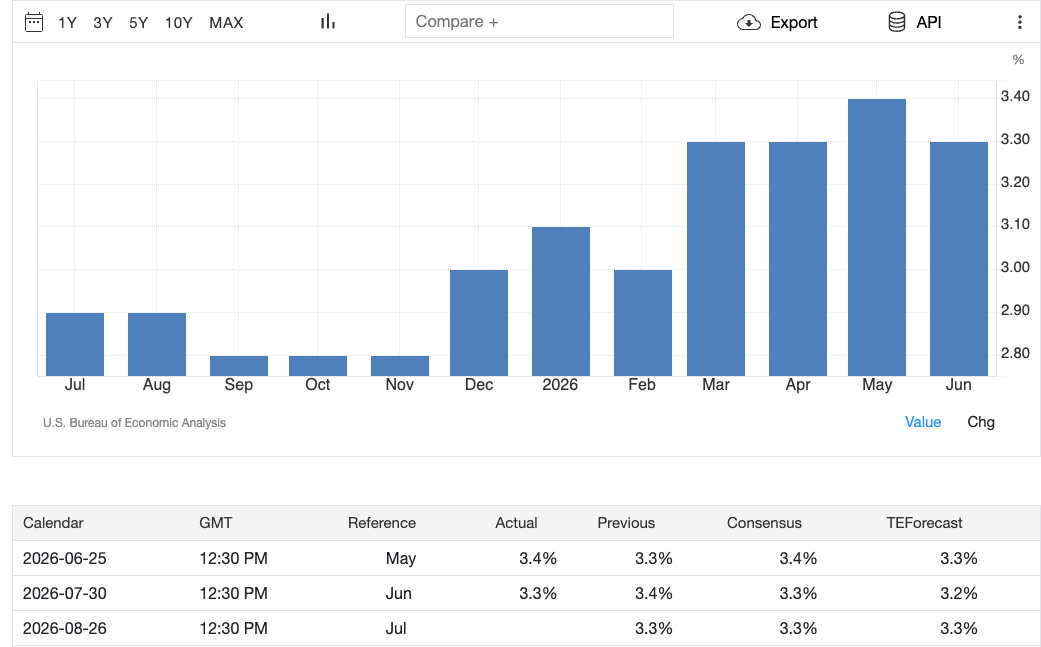
If the latest PCE report shows that inflation remains sticky, while economic growth data continue to demonstrate strength, markets may become more convinced that the Fed has little reason to pivot toward monetary easing anytime soon.
Under such circumstances, U.S. Treasury yields could rise and the U.S. dollar could gain support. For equity markets, higher interest rates often place greater pressure on highly valued technology stocks and AI-related names in particular.
The reason is that higher rates increase the discount rate applied to companies’ future cash flows, which can reduce the justified valuation of high-growth stocks. At the same time, while the AI sector continues to benefit from a compelling long-term growth narrative, data center construction, energy infrastructure expansion, advanced chip procurement, and cloud infrastructure all require significant capital investment. If financing costs remain elevated, pressure on corporate investment returns and earnings growth may increase.
As a result, strong economic data are not necessarily entirely bullish for markets. If stronger data imply a “higher-for-longer” interest rate environment, U.S. equities—especially technology stocks—could face the risk of valuation repricing.
Weaker Data May Not Be Entirely Bullish Either
On the other hand, if PCE inflation cools meaningfully or economic growth data fall short of expectations, markets may theoretically reduce their bets on further rate hikes and increase expectations for future rate cuts. This would generally be supportive of bonds, gold, and certain growth-oriented assets.
However, markets could quickly face another layer of concern: Does slower economic growth indicate weakening corporate demand? Can AI-related capital expenditure continue to maintain high growth? Can corporate earnings support current market valuations?
This is the dilemma markets are currently facing:
-
Data that are too strong: May push interest rate expectations higher and weigh on technology stocks and high-valuation assets.
-
Data that are too weak: May support rate-cut expectations but could also trigger concerns over economic growth and corporate earnings.
-
Data that meet expectations: May shift market attention further toward Fed commentary, corporate earnings, and upcoming economic indicators.
In other words, investors are not simply waiting for data to be “good” or “bad.” They are assessing whether the economy can achieve the ideal scenario of declining inflation without a sharp loss of growth—commonly referred to as a “soft landing.”
Jackson Hole, Warsh’s Speech, and the Market’s Policy Interpretation
The Jackson Hole symposium has long been one of the most closely watched policy events in global financial markets. Speeches from Fed officials can influence not only short-term interest rate pricing, but also the market’s understanding of inflation tolerance, labor market conditions, balance sheet policy, and the future monetary policy framework.
Following the release of PCE and economic growth data, markets will use the latest figures as the basis for interpreting policy remarks. If inflation remains high and the economy stays resilient, hawkish signals could intensify upward pressure on Treasury yields. If inflation cools and growth slows, any comments leaning toward patience or easing could prompt markets to reassess the outlook for the U.S. dollar, gold, and U.S. equity indices.
In addition, even if the U.S. Treasury expands its buyback operations, market yields may not necessarily decline sustainably. This suggests that the bond market is still absorbing substantial fiscal supply, inflation risks, and uncertainty surrounding the interest rate path. Short-term capital flowing into high-volatility assets such as Bitcoin also reflects the search among some market participants for trading themes and hedging alternatives beyond traditional assets.
Three Major Events Will Test Whether the U.S. Equity Rally Can Continue
The next key developments for markets are likely to focus on three areas:
1. PCE and economic growth data
These will test whether the U.S. economy remains resilient or is beginning to feel the pressure of a high interest rate environment.
2. Fed policy signals and Warsh’s speech
These may help markets understand how policymakers view inflation, growth, and the future path of interest rates.
3. AI sector fundamentals and corporate earnings
Using bellwether companies such as Nvidia as an example, markets still need to see that AI investment, chip demand, and data center spending remain supported by strong fundamentals.
If AI companies continue to report strong results while PCE data show inflation gradually coming under control, the U.S. equity rally may have room to continue. However, if inflation exceeds expectations, yields rise again, or corporate earnings fail to meet market expectations, volatility could increase significantly.
Which Markets Should CFD Traders Watch?
During periods when PCE, GDP, and Fed remarks are released in close succession, traders may want to monitor the correlations between different asset classes:
-
Forex: The U.S. dollar is typically highly sensitive to changes in inflation and interest rate expectations. The U.S. Dollar Index and major currency pairs may experience rapid volatility.
-
Gold: Gold is often influenced by the U.S. dollar, Treasury yields, and safe-haven sentiment. If real yields rise, gold prices may come under pressure. If markets shift toward rate-cut expectations or risk aversion increases, gold may find support.
-
Equity Indices: The Nasdaq 100, S&P 500, and Dow Jones Industrial Average have different levels of sensitivity to interest rate expectations. Indices with heavier technology exposure are generally more vulnerable to changes in Treasury yields.
-
Bitcoin and High-Volatility Assets: Changes in liquidity conditions, U.S. dollar trends, and risk appetite may amplify short-term price movements in crypto assets.
It is important to note that around major data releases, markets may experience wider spreads, slippage, and rapid reversals. Traders should avoid relying solely on one data outcome and should use stop-loss orders while managing leverage and position sizes carefully.
Conclusion: PCE Is More Than an Inflation Number—It Is a Key Market Signal
The upcoming PCE Price Index and economic growth report will be important references for assessing the U.S. economy, Fed policy, and the direction of global risk assets. What matters most to markets is not a single headline number, but whether inflation, growth, and interest rate expectations can remain in balance.
For CFD traders, this is also an important period for monitoring movements in the U.S. dollar, gold, and U.S. equity indices. By understanding economic data, policy signals, and cross-asset correlations, traders can develop a more systematic trading strategy rather than chasing prices during periods of rapid market volatility.
Looking to capture market opportunities driven by PCE data, Fed policy, and U.S. earnings reports? Explore forex, gold, and equity index markets through Bitget CFD, and position flexibly according to your own trading strategy.


- Why Is the PCE Price Index So Important?
- Sticky Inflation Could Push Rate Expectations Higher Again
- Weaker Data May Not Be Entirely Bullish Either
- Jackson Hole, Warsh’s Speech, and the Market’s Policy Interpretation
- Three Major Events Will Test Whether the U.S. Equity Rally Can Continue
- Which Markets Should CFD Traders Watch?
- Conclusion: PCE Is More Than an Inflation Number—It Is a Key Market Signal