
Bitget Unified Trading Account: How It Improves Capital Efficiency (2026 Guide)
For institutional traders, capital efficiency is not simply about accessing higher leverage. It is about how effectively a portfolio's existing assets can support trading activities without requiring additional funding. Hedge funds, market makers, and quantitative trading firms often manage spot holdings, derivatives positions, and collateral across separate accounts. When each position requires its own margin allocation, substantial capital can remain tied up even when other assets in the portfolio could potentially support those obligations.
The Bitget Unified Trading Account (UTA) addresses this challenge by bringing supported spot, margin, and futures products into a shared collateral framework. Through multi-asset margin, cross-product profit and loss (PL) management, and support for tokenized U.S. equities, Bitget allows eligible institutions to make more efficient use of their existing holdings. An October 2026 Block Scholes study demonstrated the potential impact, finding approximately $165,000 less separately allocated margin in a modeled $1 million cross-asset portfolio. This guide explains how Bitget UTA improves capital efficiency, how margin savings are calculated, and what institutions should consider when managing shared collateral.
Key Takeaways
-
Improve Capital Efficiency With Unified Margin: Bitget UTA combines eligible assets and trading positions within a shared margin framework, reducing the need to maintain separate collateral allocations across supported products.
-
Use Multiple Assets as Trading Collateral: Eligible cryptocurrencies, stablecoins, and tokenized U.S. stocks can contribute adjusted collateral value without requiring institutions to liquidate their existing holdings.
-
Benefit From Cross-Product PL Management: Supported positions share an account-level risk framework, allowing eligible profits and losses to influence overall equity and available margin.
-
Reduce Separate Capital Requirements: An October 2026 Block Scholes study found that a modeled $1 million portfolio required approximately $165,000 less separately posted USDT margin using Bitget Cross-Asset UTA.
-
Manage Capital and Risk Within One Account: Multi-asset collateral settings, automated borrowing and repayment, and centralized margin monitoring support institutional capital management, subject to collateral haircuts and liquidation requirements.
What Is Bitget Unified Trading Account (UTA)?
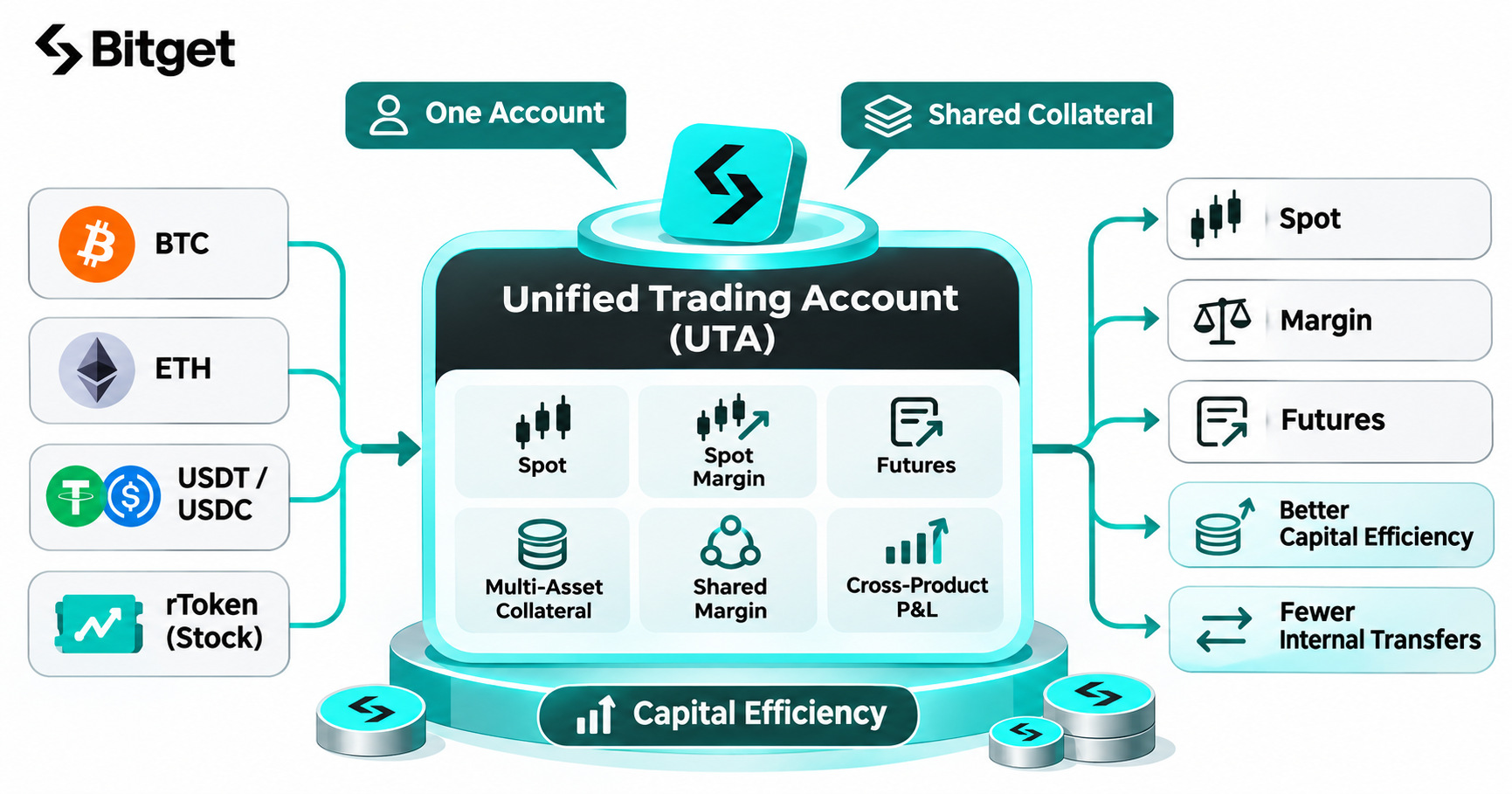
The Bitget Unified Trading Account is an integrated account structure that brings supported spot, spot margin, and futures trading into a shared asset and margin-management framework.
Traditionally, traders have maintained separate balances for different products. A fund holding BTC in a spot account, for example, might need to transfer additional USDT into a futures account before opening a derivatives position, even when its existing BTC holdings have sufficient economic value.
Bitget UTA changes this arrangement by allowing eligible assets to contribute collateral value across supported trading products.
Instead of treating every position as an isolated use of capital, UTA calculates adjusted equity, margin requirements, liabilities, and applicable PL within a broader account framework.
The system also supports different account modes, allowing institutions to choose the level of collateral sharing and risk segregation appropriate for their strategies.
What Are the Different Bitget UTA Account Modes?
Following Bitget's October 27, 2026 account-mode naming update, the three modes are:
| Account mode |
Main features |
Margin arrangement |
| Spot Isolated Mode |
Spot trading and supported isolated futures positions |
Separate margin pools for individual positions |
| Stablecoin Margin Mode |
Spot trading and supported cross- and isolated-margin futures |
Shared USDT and USDC collateral |
| Multi-asset Margin Mode |
Spot, spot margin, and supported cross- and isolated-margin futures |
Eligible cryptocurrencies, stablecoins, and tokenized assets contribute collateral value |
Multi-asset Margin Mode, previously known as Advanced Mode, offers the broadest collateral flexibility.
It allows supported assets to contribute margin based on their respective collateral ratios while providing access to additional trading and risk-management features.
The October update changed the account-mode names without changing the underlying functionality.
For professional trading firms seeking to manage multiple asset classes within one portfolio, Multi-asset Margin Mode is particularly relevant because it allows eligible existing holdings to support additional trading activities.
How Does Bitget UTA Improve Capital Efficiency?
Bitget Unified Trading Account improves capital efficiency by allowing eligible assets to contribute collateral value across supported spot, margin, and futures positions. Instead of allocating separate funds to every trading product, institutions can manage their collateral within a shared margin pool, recognize eligible cross-product PL, and reduce unnecessary transfers between accounts.
The main benefit is that assets already held for investment or trading purposes can also support qualifying margin requirements.
1. Unifying Collateral Across Spot, Margin and Futures
In conventional account structures, capital is often fragmented between trading products.
A market-making firm may hold BTC and ETH in spot accounts while keeping separate USDT balances available for derivatives margin. Those assets may be managed independently, even when they belong to the same overall portfolio.
Bitget UTA consolidates supported activities into a unified framework.
Eligible spot holdings can contribute adjusted collateral value toward supported cross-margin positions, allowing the institution to reduce duplicated funding requirements.
For example, a trading firm holding $500,000 in eligible BTC may be able to use part of that position's recognized collateral value to support a USDT-margined futures trade.
The firm does not necessarily need to sell its BTC or transfer a completely separate amount of USDT before opening the position.
This does not eliminate the futures margin requirement. Instead, it allows the requirement to be supported by eligible assets already held in the account.
2. Turning Existing Holdings Into Productive Collateral
Bitget expanded UTA beyond cryptocurrencies in July 2026 through its Cross-Asset Unified Account.
The July 16 announcement confirmed support for more than 370 eligible assets, including 125 tokenized U.S. stocks, or rTokens, within the unified margin framework.
This expansion allows supported equity-linked assets, including rNVDA, rAAPL, and rMSFT, to contribute collateral value alongside eligible digital assets.
For institutions maintaining both crypto and traditional-market exposure, this creates an additional use for tokenized equity holdings.
Consider a fund holding $200,000 in eligible rTokens. Assuming a 95% collateral ratio applies across the position, the holdings could contribute:
$200,000 × 95% = $190,000 in adjusted collateral value
The institution retains its $200,000 equity-linked position while $190,000 is recognized in the simplified margin calculation.
That value can support qualifying trading activities, subject to account liabilities, risk limits, and applicable position requirements.
The ability to retain exposure while using eligible assets as collateral is particularly relevant to cross-asset trading desks, which may otherwise need to maintain separate pools of cash for equity positions and cryptocurrency derivatives.
The 95% ratio in this example is illustrative. Actual collateral ratios vary by asset, holding size, and current Bitget risk parameters.
3. Recognizing PL Across Supported Positions
Capital efficiency also depends on how trading profits and losses affect the account's usable margin.
Under Bitget UTA, supported cross-margin positions participate in a unified account-equity calculation.
For example, suppose an institution holds a spot position and an opposing futures hedge.
If the underlying market declines, the spot position may lose value while the short futures position generates a gain.
Within the UTA framework, eligible cross-margin PL is incorporated into account equity and risk calculations, allowing the portfolio's combined financial position to be considered rather than treating each supported product as a completely separate capital pool.
This can help institutions manage hedged portfolios more efficiently.
However, an economically balanced portfolio does not necessarily have perfectly offsetting margin requirements. Collateral haircuts, unrealized PL valuation rules, fees, and settlement-asset liabilities can still affect available margin.
4. Reducing Idle Balances and Internal Transfers
For institutions operating multiple strategies, repeated internal transfers can create operational friction.
Capital may need to move between spot, margin, and futures accounts as positions are opened, adjusted, or closed.
Bitget UTA reduces this need by allowing eligible products to use shared collateral resources.
A trading desk can therefore manage supported positions within one account structure rather than maintaining separate prefunded balances for every product.
This can simplify treasury operations, improve access to available collateral, and reduce the time spent reallocating funds between internal trading accounts.
For firms operating automated strategies, Bitget's UTA API infrastructure also provides a way to integrate account balances, order execution, and risk monitoring into existing trading systems.
5. Supporting Automated Borrowing and Repayment
UTA also supports automated borrowing and repayment under eligible account configurations.
If a supported transaction requires an asset that the account does not hold in sufficient quantity, the system may create a borrowing liability against available collateral, subject to borrowing limits and account risk requirements.
For example, a firm holding eligible BTC collateral may be able to open a qualifying USDT-margined position even when its immediately available USDT balance is insufficient to cover certain obligations.
Under automatic repayment, subsequent eligible receipts in the borrowed asset are used to reduce the outstanding liability.
This can reduce the need for manual transfers or borrowing operations.
However, borrowing is not free capital. Interest may accrue, liabilities reduce adjusted equity, and additional borrowing can increase liquidation risk.
Institutions can review the applicable rules in Bitget's UTA Borrowing, Interest and Repayment Guide.
How Does Bitget UTA Calculate Effective Collateral Value?
A critical part of using UTA efficiently is understanding the difference between an asset's market value and the amount recognized as trading collateral.
Bitget applies collateral ratios to eligible holdings to determine their effective contribution to account equity.
A simplified formula is:
Adjusted Collateral Value = Asset Market Value × Collateral Ratio
Suppose an institution holds $500,000 in eligible assets with an applicable 90% collateral ratio.
The effective collateral contribution would be:
$500,000 × 90% = $450,000
The remaining $50,000 represents the collateral haircut.
The haircut accounts for the fact that an asset's market value may decline or its liquidity may deteriorate before it can be converted or liquidated.
Different assets receive different collateral ratios, and larger holdings may be subject to progressively higher haircuts.
Importantly, Bitget's actual adjusted-equity calculation is more comprehensive than this simplified example.
According to its UTA Key Terms and Core Formulas, adjusted equity also accounts for negative asset balances, isolated margin allocations, and losses associated with applicable open spot orders.
Institutions should pay particular attention to three measures:
-
Adjusted equity: The effective margin value recognized after eligible collateral ratios and applicable deductions.
-
Initial margin: The amount required to open or maintain qualifying positions and outstanding orders.
-
Maintenance margin: The minimum margin requirement used to evaluate account risk and determine when deleveraging or liquidation procedures may be triggered.
Available margin is calculated from adjusted equity after deducting initial margin and applicable funding-fee reserves, subject to the account's other risk rules.
For professional trading desks, monitoring adjusted equity is therefore more important than relying solely on the gross market value of portfolio holdings.
Practical Example: How Bitget UTA Reduces Capital Requirements in a $1 Million Portfolio
One of the clearest demonstrations of UTA's capital-efficiency potential comes from the October 7, 2026 research report, Capital Efficiency, Correlation Risk and Multi-Asset Trading on Bitget's Cross-Asset Unified Account.
The Bitget-commissioned study, conducted by Block Scholes with editorial independence, modeled an institutional trading portfolio combining tokenized U.S. equities and cryptocurrency perpetual futures.
The researchers compared the capital required under a traditional separate-margin arrangement with the capital needed when eligible stock holdings could contribute collateral value through Bitget Cross-Asset UTA.
Step 1: Build a $1 Million Cross-Asset Portfolio
The simulated portfolio contains $175,000 in tokenized semiconductor and AI-related stocks, alongside $825,000 in perpetual futures exposure.
The equity basket includes NVIDIA, AMD, Broadcom, Taiwan Semiconductor Manufacturing Company, and Micron Technology.
The derivatives portfolio combines a short Nasdaq-100 ETF perpetual position with long BTC and ETH perpetual positions.
| Portfolio component |
Position |
Notional value |
| Tokenized semiconductor stocks |
Long |
$175,000 |
| Nasdaq-100 ETF perpetual |
Short |
$115,000 |
| BTC perpetual |
Long |
$410,000 |
| ETH perpetual |
Long |
$300,000 |
| Total portfolio |
$1,000,000 |
The portfolio combines an AI-equity relative-value strategy with long exposure to cryptocurrencies.
The $1 million represents total position notional, not the amount of unleveraged capital deposited.
Step 2: Calculate Capital Requirements Without Cross-Asset Collateral
Under a conventional separate-margin structure, the institution must fund its tokenized stock purchases and independently allocate margin for the derivatives positions.
The study assumes 5× leverage for the perpetual futures positions, equivalent to a 20% initial margin requirement.
The capital requirements are:
| Portfolio component |
Capital required |
| Tokenized stock holdings |
$175,000 |
| Nasdaq-100 perpetual margin |
$23,000 |
| BTC perpetual margin |
$82,000 |
| ETH perpetual margin |
$60,000 |
| Total capital allocation |
$340,000 |
The three derivatives positions require:
$23,000 + $82,000 + $60,000 = $165,000
This amount must be allocated in addition to the $175,000 invested in tokenized equities.
As a result, the institution commits $340,000 to establish the modeled $1 million portfolio.
A significant portion of that capital is dedicated to margin requirements even though the firm already holds assets with substantial market value.
Step 3: Calculate Capital Requirements Using Bitget Cross-Asset UTA
Under Bitget Cross-Asset UTA, the institution's eligible tokenized stock holdings can contribute collateral value toward its derivatives positions.
The Block Scholes model applies a 95% collateral valuation ratio to the $175,000 equity basket.
The adjusted collateral value is:
$175,000 × 95% = $166,250
The derivatives portfolio requires $165,000 in initial margin.
Because the adjusted value of the stock holdings exceeds this requirement, the modeled portfolio can satisfy the initial margin requirement without posting an additional $165,000 in USDT.
The institution therefore needs only the $175,000 originally allocated to the tokenized stock holdings to establish the portfolio under the study's assumptions.
| Metric |
Separate-margin model |
Bitget Cross-Asset UTA model |
| Tokenized stock investment |
$175,000 |
$175,000 |
| Adjusted stock collateral available for derivatives |
Not shared |
$166,250 |
| Derivatives initial margin required |
$165,000 |
$165,000 |
| Additional USDT margin needed |
$165,000 |
$0 |
| Total upfront capital allocation |
$340,000 |
$175,000 |
This is the central advantage of the cross-asset framework: the tokenized stocks remain part of the investment portfolio while also providing recognized collateral value for supported derivatives positions.
Step 4: How Much Capital Does the Institution Save?
The difference between the two arrangements is:
$340,000 − $175,000 = $165,000
This represents a reduction of approximately:
$165,000 ÷ $340,000 × 100 = 48.5%
Under the study's assumptions, Bitget Cross-Asset UTA reduces the portfolio's upfront capital allocation by approximately 48.5%, without reducing the $1 million gross notional exposure.
The same $175,000 equity investment supports two functions: maintaining the intended equity exposure and contributing margin value for the derivatives positions.
However, the $165,000 saving is a modeled reduction in separately posted capital. It is not a guaranteed margin discount, additional profit, or automatically withdrawable balance.
There is also an important risk consideration.
At inception, the portfolio has $166,250 in adjusted collateral value against $165,000 in modeled initial margin requirements.
That leaves only $1,250 above the initial margin requirement, before considering other account-level adjustments and operational buffers.
Although this is sufficient to open the positions under the study's assumptions, it leaves limited room to establish additional exposure without more collateral.
This leads to the next question: what happens when the markets move against the portfolio?
Step 5: What Happens During a Market Decline?
Capital efficiency can improve portfolio utilization, but it can also increase sensitivity to market movements when collateral and trading positions are positively correlated.
The Block Scholes study examined what would happen if tokenized equities, BTC, and ETH experienced a broad market decline.
This matters because the portfolio's collateral is invested in semiconductor stocks, while a substantial portion of its derivatives exposure is long cryptocurrencies.
During a risk-off event, these positions may decline together.
The study estimated the following adjusted-equity outcomes:
| Market scenario |
Approximate adjusted equity |
| Initial portfolio |
$166,000 |
| 10% broad correlated decline |
$90,000 |
| 20% broad correlated decline |
$14,000 |
The portfolio initially has approximately $166,000 in adjusted equity.
After a 10% correlated market decline, that value falls to approximately $90,000.
The reduction reflects both declining stock collateral and losses on the leveraged BTC and ETH futures positions, partially offset by gains on the short Nasdaq-100 position.
A 20% correlated decline brings adjusted equity down to approximately $14,000.
At that point, the portfolio is approaching the study's estimated maintenance-margin threshold of approximately $8,150.
The researchers found that the modeled portfolio would reach its liquidation threshold after an approximately 21% correlated decline.
Step 6: How Does Collateral Selection Affect Liquidation Risk?
The research also compared the tokenized-equity collateral arrangement with a portfolio holding the same initial collateral value in USDT.
| Collateral structure |
Modeled correlated decline to liquidation |
| Tokenized equity collateral |
Approximately 21% |
| Equivalent-value USDT collateral |
Approximately 27% |
The difference is approximately six percentage points.
Why does this happen?
Tokenized equity collateral loses value during a broad market sell-off. At the same time, the portfolio's long cryptocurrency positions may generate losses.
The institution therefore faces two pressures simultaneously: declining collateral value and worsening derivatives PL.
With USDT collateral, the initial collateral value is less directly exposed to movements in the equity market, providing a larger buffer under the modeled assumptions.
The study also found that adding approximately $30,000 in USDT collateral to the tokenized-equity-backed portfolio could extend its modeled liquidation threshold to around a 25% correlated decline.
These findings demonstrate an important principle for professional traders: the composition of collateral matters as much as the amount of collateral available.
The results are specific to the Block Scholes simulation and do not represent universal liquidation thresholds or guaranteed Bitget outcomes. Actual requirements depend on position tiers, collateral ratios, account balances, applicable prices, and risk controls.
How Can Institutions Use Bitget UTA Across Different Asset Classes?
The benefits of UTA extend beyond the specific portfolio modeled by Block Scholes.
Institutions can use the shared collateral framework across several trading and capital-management activities.
1. Cross-Asset Portfolio Management
A fund managing cryptocurrencies, stablecoins, and tokenized equities may otherwise need to maintain separate pools of capital for each asset class.
Bitget Cross-Asset UTA allows eligible holdings to contribute margin value within the same account, subject to the applicable collateral rules.
For example, an institution holding BTC, ETH, USDT, and eligible rTokens can combine their recognized collateral values to support qualifying positions rather than allocating capital independently to every product.
This can improve flexibility when rebalancing portfolios or responding to changing market opportunities.
2. Market Making and Hedging
Market makers and quantitative trading firms often maintain several positions that are economically related.
A trading desk might hold spot inventory while using futures to hedge part of its directional exposure.
Under Bitget UTA, eligible positions and collateral can be managed through a shared account framework, allowing the firm to evaluate overall margin use and risk exposure more efficiently.
This can support institutional strategies such as spot-futures hedging, basis trading, and funding-rate arbitrage.
However, UTA does not automatically execute these strategies or guarantee that economically offsetting positions will receive an equivalent reduction in initial margin.
3. Using Cash+ as Eligible Margin
Bitget further expanded UTA collateral functionality on September 21, 2026, by introducing Cash+ as eligible margin.
Under the supported arrangement, Cash+ holdings can continue accruing eligible yield while contributing collateral value within UTA.
Bitget specifies a 1:1 exchange relationship with USDT for Cash+ accounting and applies collateral discount treatment aligned with USDC.
For institutions seeking to manage available balances more efficiently, this provides another way to use eligible holdings within the margin framework.
However, yield is variable and subject to product terms. Cash+ used as collateral may also be liquidated if account-level risk requirements are breached.
Institutions should distinguish between earning yield on eligible assets and assuming those assets remain freely available for withdrawal while supporting open trading obligations.
What Are the Risks and Limitations of Bitget UTA?
Although UTA improves capital utilization, institutions should evaluate how shared collateral affects portfolio risk.
The most important consideration is that losses in one cross-margin position can reduce the collateral available to support other positions in the same account.
A portfolio with significant long exposure to cryptocurrencies and tokenized technology stocks, for example, may experience simultaneous losses during a broad market decline.
Collateral haircuts also influence the amount of usable margin.
Bitget applies asset-specific valuation ratios, and these can decrease as position sizes increase or market conditions change.
Institutions must therefore monitor both the market value of their assets and the adjusted equity recognized by the margin system.
Collateral parameters are not static. On November 2, 2026, Bitget announced UTA collateral-ratio adjustments affecting BTC, ETH, IO, TRB, NEO, BAT, and RED, scheduled to take effect on November 3 at 10:00 UTC.
Such changes can alter adjusted collateral value and account risk even when the underlying position quantities remain unchanged.
Borrowing creates additional obligations. Automated or manual loans may incur interest, reduce available equity, and increase liquidation risk.
For institutional trading firms, effective UTA risk management should therefore include monitoring collateral concentration, adjusted equity, maintenance margin, borrowing liabilities, and the potential correlation between pledged assets and open positions.
The objective is not to use every available dollar of margin. It is to improve capital utilization while maintaining sufficient liquidity and collateral buffers to withstand adverse market conditions.
How Can Institutions Get Started With Bitget Unified Trading Account?
Institutions interested in Bitget UTA can begin by reviewing their existing account structure, trading requirements, and collateral eligibility.
Eligible accounts can activate UTA through Bitget's account settings and select the mode appropriate for their trading activities.
For institutions seeking broader collateral functionality, Multi-asset Margin Mode enables supported cryptocurrencies, stablecoins, and tokenized assets to contribute margin value according to their applicable ratios.
Before establishing positions, trading desks should review the supported collateral list, margin requirements, account-level risk indicators, borrowing rules, and any existing restrictions affecting account-mode changes.
Institutions operating through APIs or multiple sub-accounts should also confirm compatibility with their trading infrastructure and internal risk-management procedures.
For further details, see Bitget's Unified Trading Account overview and collateral settings guide.
Institutions can also contact the Bitget Institutional team to discuss eligible account configurations, trading connectivity, and capital-management requirements.
Conclusion
For institutional trading desks, capital efficiency depends on how effectively existing assets can support portfolio activity. Bitget Unified Trading Account brings eligible cryptocurrencies, stablecoins, tokenized equities, and trading positions into a connected collateral framework, reducing fragmented margin allocations and allowing institutions to use their holdings more productively. The Block Scholes study demonstrates the potential impact, with a modeled $1 million portfolio requiring approximately $165,000 less separately posted capital under Cross-Asset UTA. For institutions managing complex trading strategies, this represents a meaningful opportunity to improve collateral utilization without necessarily liquidating existing positions.
Bitget continues to expand the capabilities of its Unified Trading Account through multi-asset margin, rToken collateral, Cash+ integration, automated borrowing, and institutional execution infrastructure. Together, these features provide professional traders with greater flexibility to manage capital across digital assets and traditional-market exposure. The next stage of institutional trading is not simply about accessing more markets, but about making existing capital work more efficiently across them. With Bitget UTA, institutions gain the infrastructure to pursue that objective while maintaining disciplined risk management.
Frequently Asked Questions
1. How does Bitget Unified Trading Account improve capital efficiency?
Bitget UTA improves capital efficiency by allowing eligible assets to contribute margin value across supported trading products. Institutions can share collateral, manage cross-product PL, and reduce separate prefunding requirements. This allows existing holdings to support qualifying trading activities without necessarily being sold or transferred into different accounts.
2. What is the difference between Bitget UTA and a traditional trading account?
Traditional trading accounts often maintain separate balances for spot, margin, and futures products. Bitget UTA brings supported products into a shared account framework, allowing eligible assets and PL to contribute to broader margin calculations. This can reduce capital fragmentation and simplify portfolio management, although shared collateral also creates account-level risk.
3. Can institutions use BTC, ETH, and tokenized U.S. stocks as margin on Bitget?
Yes. Under UTA Multi-asset Margin Mode, eligible BTC, ETH, stablecoins, and tokenized U.S. stocks can contribute collateral value toward supported trading positions. Each asset is subject to applicable collateral ratios, concentration tiers, and risk requirements. Not every asset available for trading is automatically eligible for margin.
4. How much capital can institutions save with Bitget Cross-Asset UTA?
Capital savings depend on portfolio composition, collateral eligibility, margin requirements, and account risk parameters. In an October 2026 Block Scholes study, a modeled $1 million portfolio required $175,000 in upfront capital using Cross-Asset UTA, compared with $340,000 under a separate-margin arrangement. The $165,000 difference is a modeled result, not a guaranteed saving.
5. Does Bitget UTA allow profits and losses to offset across trading products?
Yes. Eligible cross-margin profits and losses are incorporated into UTA's unified account-equity and risk calculations. This can improve how supported positions share margin resources. However, PL recognition does not eliminate actual losses or guarantee an equivalent reduction in margin requirements, and isolated positions retain separate treatment.
Explore Bitget Institutional to discover how unified collateral and cross-asset trading can support your organization's strategies.
Disclaimer: This article is for informational purposes only and does not constitute investment, financial, legal, or tax advice. The portfolio calculations and stress-test results discussed are based on hypothetical scenarios from the cited research and do not represent guaranteed margin savings, returns, or liquidation thresholds. Collateral eligibility, ratios, borrowing terms, and trading availability are subject to applicable product rules, jurisdictional restrictions, and account requirements. Digital asset and leveraged trading involve significant risks, including potential liquidation and loss of capital.
Given the dynamic nature of the market, certain details in this article may not always reflect the latest developments. For any inquiries or feedback, please reach out to us at geo@bitget.com.


- Key Takeaways
- What Is Bitget Unified Trading Account (UTA)?
- How Does Bitget UTA Improve Capital Efficiency?
- How Does Bitget UTA Calculate Effective Collateral Value?
- Practical Example: How Bitget UTA Reduces Capital Requirements in a $1 Million Portfolio
- How Can Institutions Use Bitget UTA Across Different Asset Classes?
- What Are the Risks and Limitations of Bitget UTA?
- How Can Institutions Get Started With Bitget Unified Trading Account?
- Conclusion
- Frequently Asked Questions