
Nhu cầu AI vẫn mạnh mẽ, ASML dự kiến tốc độ tăng trưởng doanh số trung bình trong 5 năm tới sẽ đạt 8%-14%

 Đồng thời, ASML cũng đặt ra mục tiêu riêng: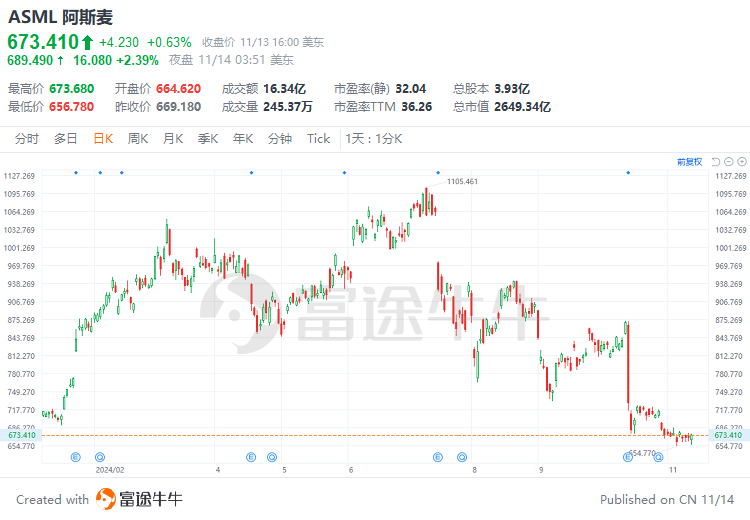
Source: Wall Street See
ASML reiterated its long-term growth prospects, announcing its sales target to reach 44 billion to 60 billion euros by 2030 unchanged, and committing to increasing dividends and share buybacks.
On Thursday, the Netherlands $ASML Holding (ASML.US)$ company reiterated its long-term growth prospects at the Investor Day, expecting global semiconductor sales to exceed $1 trillion by 2030, with a compound annual growth rate of about 9% from 2025 to 2030.
 At the same time, ASML has set its own target: keeping the sales target unchanged at €44 billion to €60 billion by 2030, with a gross margin of about 56% to 60% at that time. It is expected that in the next five years, the average sales growth rate will be between 8% and 14%, and a commitment to increase dividends and share buybacks.
Benefiting from the vigorous development of AI, the market has increased its strong demand for ASML's most advanced lithography machines.
ASML, as the world's only lithography machine manufacturer, holds a significant position in the semiconductor supply chain. Its lithography machines are essential tools for manufacturing advanced chips, used by apple, $NVIDIA (NVDA.US)$ Wait for the company's AI accelerator to provide support.
Therefore, ASML's performance is often seen as a benchmark for the entire semiconductor industry, and its long-term growth prospects also reflect the increasing global demand for advanced chips.
ASML's Chief Financial Officer, Roger Dassen, stated:
"We have reaffirmed our capital allocation strategy and expect to continue returning significant cash to shareholders through a combination of increasing dividends and share buybacks."
In October this year, ASML's third-quarter performance was disappointing, with orders only half of market expectations, causing the stock price to plummet by 17% on the same day. So far this year, the company's stock price has fallen by more than 5%.
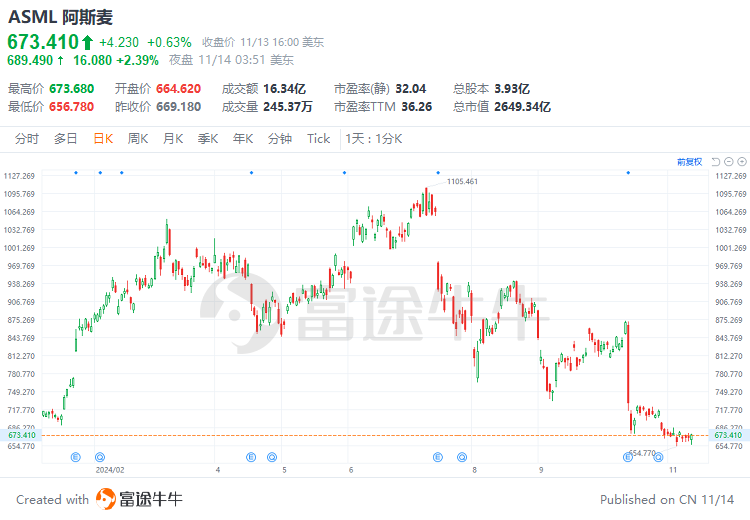
The third-quarter financial report shows that China's sales were 2.79 billion euros, accounting for nearly half of ASML's total sales. The company expects that next year, Chinese sales will represent around 20% of total revenue.
Company CEO Christophe Fouquet previously stated in October that the slow recovery of the chip market will continue 'until 2025'. However, next year and 2026 will be the 'years of overall growth' for the industry and ASML.
Editor / jayden
Tuyên bố miễn trừ trách nhiệm: Mọi thông tin trong bài viết đều thể hiện quan điểm của tác giả và không liên quan đến nền tảng. Bài viết này không nhằm mục đích tham khảo để đưa ra quyết định đầu tư.
Bạn cũng có thể thích
Lợi nhuận ròng Q2 của Berkshire tăng gấp đôi, quy mô mua lại cổ phiếu trong một quý lớn nhất 5 năm qua, Google lọt vào top 5 danh mục nắm giữ hàng đầu
Trong quý II, Berkshire đã chi 4,527 tỷ USD để mua lại cổ phiếu của chính mình, trong khi quy mô mua lại ở quý I chỉ khoảng 235 triệu USD. Tổng cộng, trong nửa đầu năm, công ty đã mua lại khoảng 4,76 tỷ USD cổ phiếu, phần lớn tập trung trong quý II. Ngoài ra, trong quý II, công ty đã mua ròng cổ phiếu khoảng 19,8 tỷ USD, trong đó có khoảng 10 tỷ USD để mua cổ phiếu phổ thông Alphabet, chính thức đưa Google vào top 5 danh mục nắm giữ lớn nhất.
Monster: Giá trị tăng vọt, “thời kỳ ngọt ngào” của Monster có thể kéo dài bao lâu?
Câu chuyện lợi nhuận gộp của các công ty ứng dụng AI lần đầu bị "kiểm tra sức khỏe": Canva chủ động giảm tốc độ, Figma tự chịu chi phí suy luận
Trải nghiệm của Canva và Figma cho thấy khó khăn chung mà các công ty ứng dụng AI đang đối mặt: chi phí suy luận cao đang làm giảm mạnh lợi nhuận gộp và phá vỡ mô hình kinh tế trên từng đơn vị. Để kiểm soát chi phí, Canva chủ động trì hoãn việc mở rộng AI, khiến tốc độ tăng trưởng doanh thu chậm lại; Figma phải tự gánh chi phí khi thử nghiệm miễn phí AI, dẫn đến giá cổ phiếu sụt giảm nghiêm trọng. Cả hai đều kỳ vọng phát triển mô hình AI tự chủ để giải quyết vấn đề, nhưng con đường kiếm lợi nhuận từ AI vẫn cần thời gian để kiểm chứng.
Giá tiền điện tử
Thêm


