
Gold price approaches late October high, why does Goldman Sachs cut the target to $4,150 instead?

FX678 November 9th News—— Goldman Sachs has lowered its gold target for the end of 2026 from $4,650 to $4,150, and its 2027 year-end target from $5,400 to $4,800, due to the hawkish stance of the Federal Reserve (including the expected rate hike in December), which dampens demand for gold as a policy hedge. However, the bank maintains a constructive long-term outlook, expecting central banks to purchase about 60 tons per month in 2026-2027, much higher than the pre-2022 average of 17 tons, which will account for the majority of the roughly 15% rise in price expected by the end of 2027.
On Monday (November 9th) during the Asian session, spot gold fluctuated higher, currently up over 1% near $4,130/oz, in the high range since late October.
Goldman Sachs recently lowered its gold price forecasts, cutting the end-2026 target from $4,650 per ounce to $4,150, and the end-2027 target from $5,400 to $4,800, as the increasingly hawkish Federal Reserve suppressed investor demand for gold.
Strategists at the bank stated in a November 5th report that this downgrade assumes a tighter stance from the Fed—including the anticipated rate hike in December—which will limit gold's appeal as a hedge against currency devaluation and broader policy risks.
They expect this hedge demand to fall back towards historical averages, rather than return to the elevated levels seen earlier this year, and believe interest in bullish gold options is also diminishing.
Comparison with 2022: Central Bank Buying Provides a Floor, but Rates Suppress Investment Demand
Goldman Sachs clearly compares the current market environment to 2022: back then, large-scale gold purchases by central banks built a solid price floor, but simultaneously rising interest rates significantly suppressed private investment demand.
As a non-interest-bearing asset, gold faces rising opportunity costs versus interest-bearing assets (such as bonds and cash) during periods of rising rates, leading to ETF outflows and reduced speculative positions.
The current structure similarly shows “official buying underpinning the market, while investment demand is being suppressed”—central banks’ continuous purchases are providing downside support for prices, while the Fed’s more hawkish path is limiting upside potential.
This means it will be difficult for gold prices to see a broad-based surge in demand in the short term, with price fluctuations being mainly constrained by interest rate levels rather than merely driven by risk aversion.
Strategists emphasize that this structure suggests near-term trends are more likely to be volatile and rangebound, rather than showing a one-way breakout; investors need to distinguish between structural support and cyclical headwinds.
Central Bank Purchases: About 60 Tons Per Month, Far Higher Than Pre-2022 Average, Forming Main Price Driver
Despite near-term pressure on investment demand, Goldman Sachs maintains its constructive long-term view, anchored largely on official sector demand.
The bank expects central banks to purchase around 60 tons of gold per month in 2026-2027, well above the historical pre-2022 monthly average of about 17 tons; adjusted for seasonality on a three-month rolling basis, the current actual buying has already reached about 85 tons per month. This ongoing buying is seen by Goldman Sachs as the main driver behind the roughly 15% price increase forecast by the end of 2027.
Strategists particularly point out that the gold allocations of emerging market central banks (especially China) are still significantly below their potential long-term targets, leaving considerable room for further increases in the future.
Additionally, the market debate is shifting from "whether to hold gold" to "where to store gold," reflecting deep concerns over reserve safety and geopolitical trust. This resilience of official demand gives gold a structural downside support despite pressure from higher rates.
Path and Risks: Late-2027 Rate Cuts as Catalyst, but Near-Term Headwinds Persist
Goldman Sachs expects that once the Federal Reserve begins cutting rates—which its economists believe will start at the end of 2027 and continue into early 2028—gold will receive further support.
However, in the near term, the bank believes that over the next three to six months, commodity trading advisors and macro hedge funds face headwinds from rising rates, uncertainty in energy prices, and tighter risk limits. It warns that higher oil prices could prompt systematic strategies to sell further.
On the risk front, Goldman Sachs notes that if there is another rate hike in March 2027, if monetary easing is delayed, or if the terminal rate forecast is higher, gold could end 2027 at around $4,660, below the baseline scenario; conversely, renewed concerns over government debt sustainability could push prices above the baseline. This downgrade follows a sharp reversal in gold: in 2025, gold surged about 64%, its best year since 1979, peaking at about $5,600 in January, before falling to about $4,070 on November 6, nearly 27% below the high.
Goldman Sachs notes that long-term investors seeking central bank buying exposure or policy risk protection may view this pullback as a potential entry opportunity.
Conclusion
Goldman Sachs has lowered its gold targets for the end of 2026 and 2027 to $4,150 and $4,800 respectively. The core reason is the hawkish stance of the Federal Reserve—including the expected rate hike in December—suppressing gold’s role as a policy hedge, with hedge demand expected to return to historical averages and bullish option interest waning. However, the bank maintains a constructive long-term outlook: in 2026-2027, central banks are expected to buy about 60 tons per month, far higher than the pre-2022 average of 17 tons, currently about 85 tons/month, which forms the bulk of the anticipated 15% price increase by the end of 2027; emerging market central banks, especially China, are still under-allocated, and the debate is shifting from “whether to hold” to “where to store.” Over the next three to six months, rising interest rates, uncertain energy prices, and tighter risk limits pose headwinds, and higher oil prices could prompt systematic strategies to sell. Late-2027 rate cuts will further support gold; in risk scenarios, if rate hikes come earlier or terminal rates are higher, gold could end 2027 at around $4,660, while renewed debt sustainability concerns could push prices above the baseline.
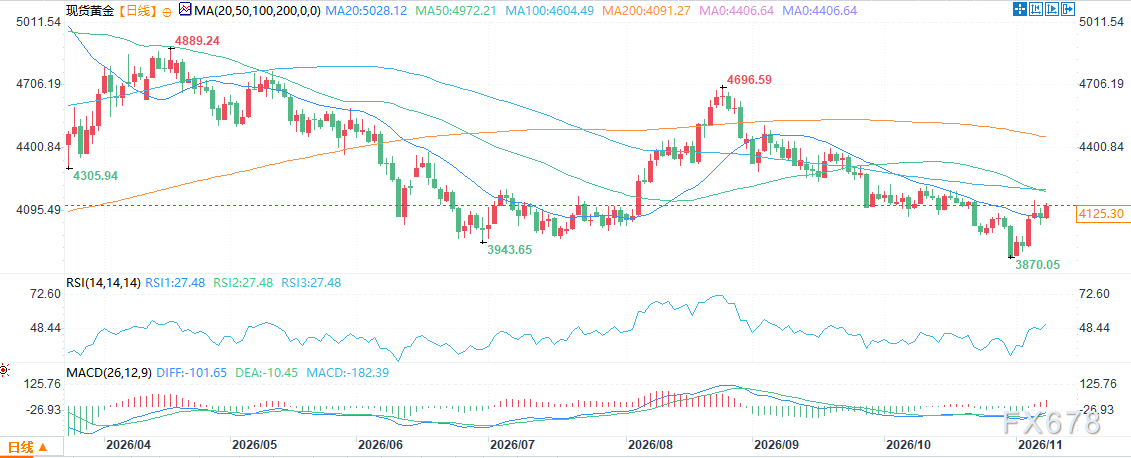
(Spot Gold Daily Chart, Source: EasyFX78)
Beijing Time 10:44, spot gold at $4,129.48/oz.
Disclaimer: The content of this article solely reflects the author's opinion and does not represent the platform in any capacity. This article is not intended to serve as a reference for making investment decisions.
You may also like
Berkshire's stock hits a new high amid tech plunge as return to yen bonds sparks heated "increase positions in Japan" discussion
Berkshire Hathaway has hired banks to prepare for its first yen bond issuance since April, aiming to raise more funds in Japan. According to sources familiar with the matter, Berkshire has mandated Mizuho Securities and Bank of America Securities for a potential benchmark yen bond issuance, which is expected to take place in the near future, though the exact timing will depend on market conditions.
Nomura's monopoly is being challenged! Mizuho (MFG.US) is reshaping Japan's underwriting landscape with global IPOs
Mizuho is establishing a solid foothold in Japan's equity capital market by leveraging a unique and highly profitable track: on one hand, it is tapping into the strong demand for AI financing from the US market, and on the other, connecting with the vast domestic household savings in Japan.

Logistics and marketing erode profit margins, Morgan Stanley lowers MercadoLibre (MELI.US) target price but maintains "Overweight"
Morgan Stanley released a research report after Latin American e-commerce giant MercadoLibre announced its Q3 2026 earnings, outlining six key points. The firm maintained its "Overweight" rating, but lowered the target price from $2,450 to $2,350.
After the most severe market cap evaporation in Nasdaq's history, Trump declares: The market will return in an “unprecedented manner”
Over the weekend, U.S. President Donald Trump posted on Truth Social, stating that after the midterm election results were announced, the United States has taken "a big step backwards in history."

Crypto prices
More


