
US stock market AI goes down, Biden goes up! Berkshire hits another new high

While Wall Street continues to debate the returns of AI capital expenditures, a trillion-dollar giant—composed of insurance, railroads, energy, and traditional consumer businesses—is quietly moving towards historical highs.
On November 2nd local time, Berkshire Hathaway's Class B shares closed at $556.11, with an intraday high of $557.59, both reaching new record highs. Meanwhile, AI trading in the US stock market has faced headwinds: the Nasdaq dropped 5.3% in October, and concerns about whether tech giants' massive AI investments can translate into returns are escalating.
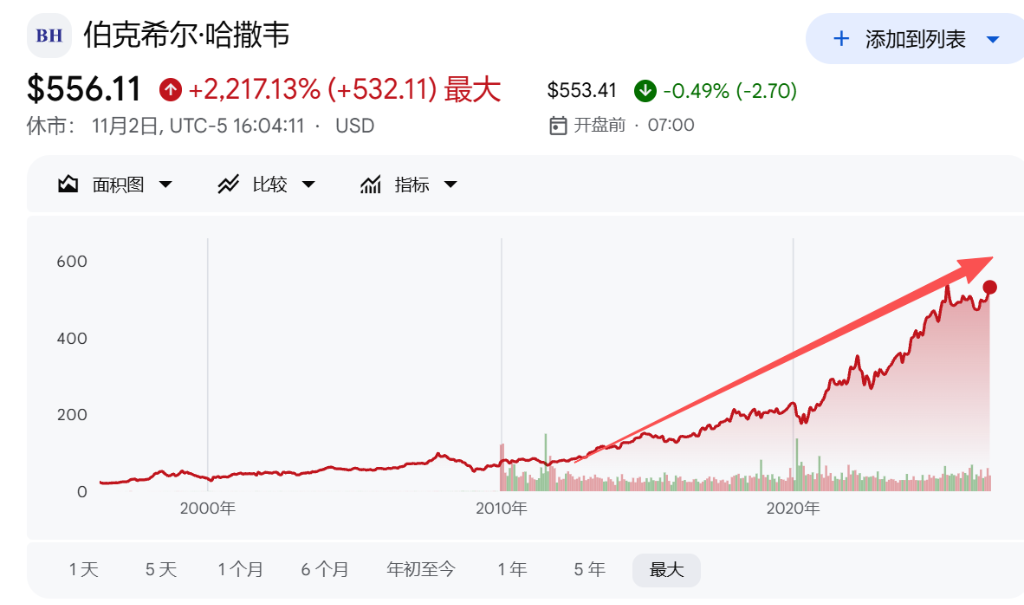
While AI tech stocks are under pressure, Berkshire—often viewed as an “old economy stock”—is gaining strength. The contrast in market style is becoming one of the most noteworthy shifts in recent US markets.
Berkshire's rally is both a result of defensive capital seeking a new haven and a sign that the market is gradually absorbing the uncertainty brought by Buffett's planned CEO transition. For Greg Abel, Buffett's designated successor, this wave of stock price appreciation is doubtlessly a positive signal.
AI Trade Recedes, Berkshire’s Defensive Qualities Resurface
For a period, AI was the central trading theme in the US stock market. Tech giants continually ramped up investments in data centers, chips, and computing infrastructure, driving related stock prices higher.
But cracks are beginning to appear in this feast.
As companies like Alphabet and Amazon posted earnings that fell short of market expectations, investors have begun to reassess the costs and returns of AI investment. Massive capital outlays require ongoing financing, and whether these investments can translate into adequate cash flow within a reasonable timeframe is fast becoming the market's focal point.
In October, the Nasdaq fell 5.3%, with AI-related stocks facing significant sell-offs. The market is no longer focusing solely on technology prospects, but is also asking: When will such huge investments finally convert into profits?
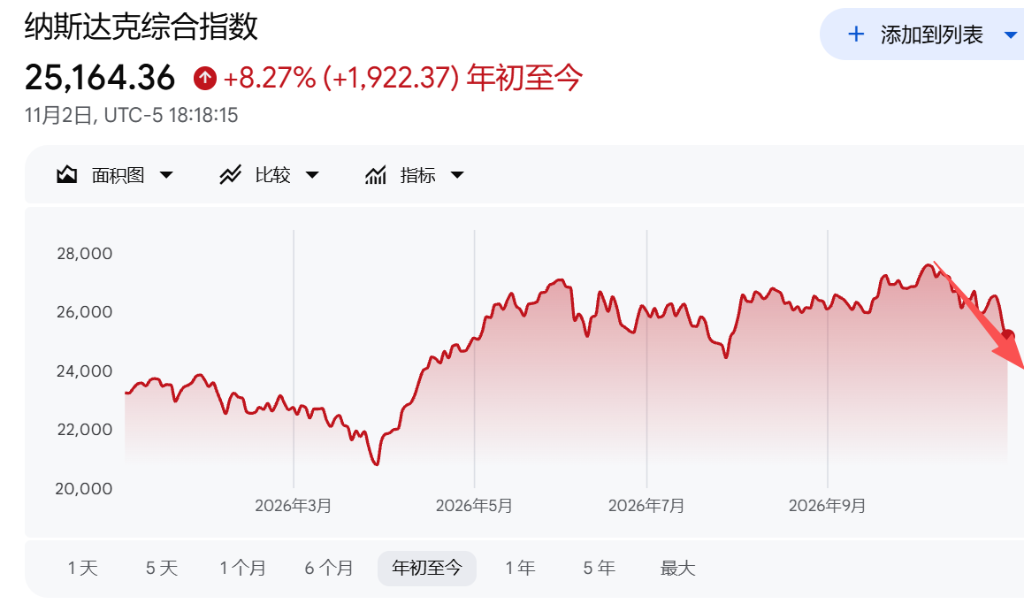
Against this backdrop, Berkshire’s advantages are coming into focus.
With a market value exceeding $1.1 trillion, Berkshire possesses diversified businesses in insurance, railroads, energy, and industry, and its annual after-tax profit nears $50 billion. As of the end of the second quarter, the company held over $365 billion in cash and cash equivalents.
Berkshire’s massive cash reserves provide a buffer against market volatility, while its diversified operations mean it doesn’t have to rely on the growth of a single sector.
More importantly, Berkshire is not simply a collection of traditional industries. Its $360 billion stock portfolio—with major holdings in Apple and Coca-Cola, among others—has recently performed well, providing a strong backbone for asset value.
Judging by market performance, capital is re-evaluating Berkshire's defensive attributes. Over the past month, Berkshire shares have risen by about 5%. As the AI trade recedes, investors are increasingly focused on asset safety and stable earnings.
Buffett Steps Down, Berkshire Reaches New Highs
Berkshire's record-setting share price also reflects diminishing uncertainty over its leadership transition.
In May 2025, Buffett announced at the annual shareholders’ meeting that he would step down as CEO at the end of that year. The announcement sparked a market sell-off as investors worried whether Berkshire—without Buffett—could maintain its longstanding prowess in capital allocation.
When Abel officially took over as CEO at the end of 2025, Berkshire's share price remained subdued for a period. However, with time, the market’s concerns over the succession have gradually eased.
Abel did not overhaul the operating framework that Buffett built.
In his inaugural annual shareholder letter, Abel stated that Berkshire would continue its decentralized management structure, giving business leaders broad operational autonomy; the company would also maintain a focused stock investment portfolio, with long-term core holdings continuing to be a key facet of capital allocation.
Abel joined Berkshire in 1999 and previously led Berkshire Hathaway Energy. He thus inherited a mature business system that had been operating for decades, not a company requiring a radical overhaul.
Berkshire’s historical track record has also bolstered market confidence.
From 1965 to 2025, Berkshire had just 11 down years, accumulating a total return of approximately 6,099,294% and an annualized return of 19.7%. Over the same period, the S&P 500’s total return was about 46,061%, with an annualized return of 10.5%.
This record did not stem from short-term bets, but from long-term ownership of quality businesses, the use of insurance float for capital allocation, and the compounding effects of continually accruing operating assets.
However, the new record high does not mean Abel has completely passed his test. His tenure remains short, and the market’s approval of Berkshire may be more about its asset quality and business structure than a final verdict on the new CEO's competence.
$365 Billion in Cash: Abel’s Real Challenge Lies Ahead
As Berkshire’s share price continues to climb, the spotlight on Abel’s capital allocation abilities becomes unavoidable.
As of the end of the second quarter in 2026, Berkshire’s cash and cash equivalents exceeded $365 billion. This capital serves as both a cushion against market downturns and a war chest for seeking future investment opportunities.
But these cash reserves also create pressure.
Berkshire has long refrained from paying dividends, a policy widely tolerated mainly out of trust in Buffett’s capital allocation. Now, with Abel at the helm, investors are likely to pay closer attention to whether this cash will be used for acquisitions, stock investments, or kept on the balance sheet.
For a company with a market cap exceeding $1 trillion, finding investment opportunities big enough to significantly impact overall earnings is becoming increasingly difficult.
Abel has already begun adjusting the investment portfolio.
Apple remains Berkshire’s largest equity holding. As of the end of June, the company held 227.9 million Apple shares, worth approximately $66 billion—that’s about 22% of the stock portfolio. This ratio is down significantly from a previous peak near 50%.
Berkshire has cut its Apple stake by about 75% since holding approximately 915 million shares in mid-2023. Buffett previously explained that the Apple position was disproportionately large relative to Berkshire’s overall size.
However, Berkshire has not sold any further Apple shares since the end of 2025. The market will keep a close eye on the next 13F filing to see whether the position was adjusted in Q3.
Meanwhile, Berkshire is looking for new investment opportunities. In the second quarter of 2026, the company acquired roughly $17 billion in Alphabet stock, with about $10 billion directly purchased from Alphabet.
This suggests that Abel is not simply replicating Buffett’s old portfolio, but—while maintaining the long-term investment framework—is seeking new capital allocation opportunities.
“Old Economy” Stocks Surge as the Market Seeks Answers Beyond AI
Berkshire reaching an all-time high doesn’t necessarily mean the market is abandoning AI trades altogether.
But at least for now, investors are re-examining valuation logic: When the relationship between massive capital expenditures and future returns becomes less certain, companies with strong cash reserves, diversified businesses, and relatively stable earnings are becoming attractive again.
Berkshire is the epitome of this logic.
It boasts large cash reserves, well-established operating assets, a long-term investment portfolio, and a capital allocation system that has been proven over decades. Buffett’s departure was once the market’s greatest worry—now, with share prices back at historic highs, investors are at least open to the possibility of Berkshire’s continued relevance in the new era.
However, Berkshire’s long-term performance still depends on whether Abel can keep creating value. For a trillion-dollar enterprise, the real test is how to put massive cash reserves to work and how to find large enough investment opportunities for meaningful growth.
AI retreats as old-economy stocks rise. Perhaps the market style rotation is only temporary, but Berkshire is demonstrating that beyond tech narratives, capital markets still pay a premium for robust asset quality and durable capital allocation prowess.
Disclaimer: The content of this article solely reflects the author's opinion and does not represent the platform in any capacity. This article is not intended to serve as a reference for making investment decisions.
You may also like
Disney (DIS.US) plans to lay off thousands of employees! Some management are required to cut costs by up to 20%. The new CEO continues "slimming down" after taking office.
According to sources familiar with the matter, Disney is planning to lay off thousands of employees as part of its new round of cost-cutting measures.
Bitcoin rises 0.7%, tech stocks rebound as US election uncertainty weighs on markets

Crypto prices
More


