
Nearly $1 Trillion Surge in 90 Days! AI Off-Balance Sheet Liabilities Quietly Surpass $4.1 Trillion

Amid the frenzy for AI infrastructure construction, an unprecedented wave of off-balance sheet liabilities is quietly accumulating in Silicon Valley.
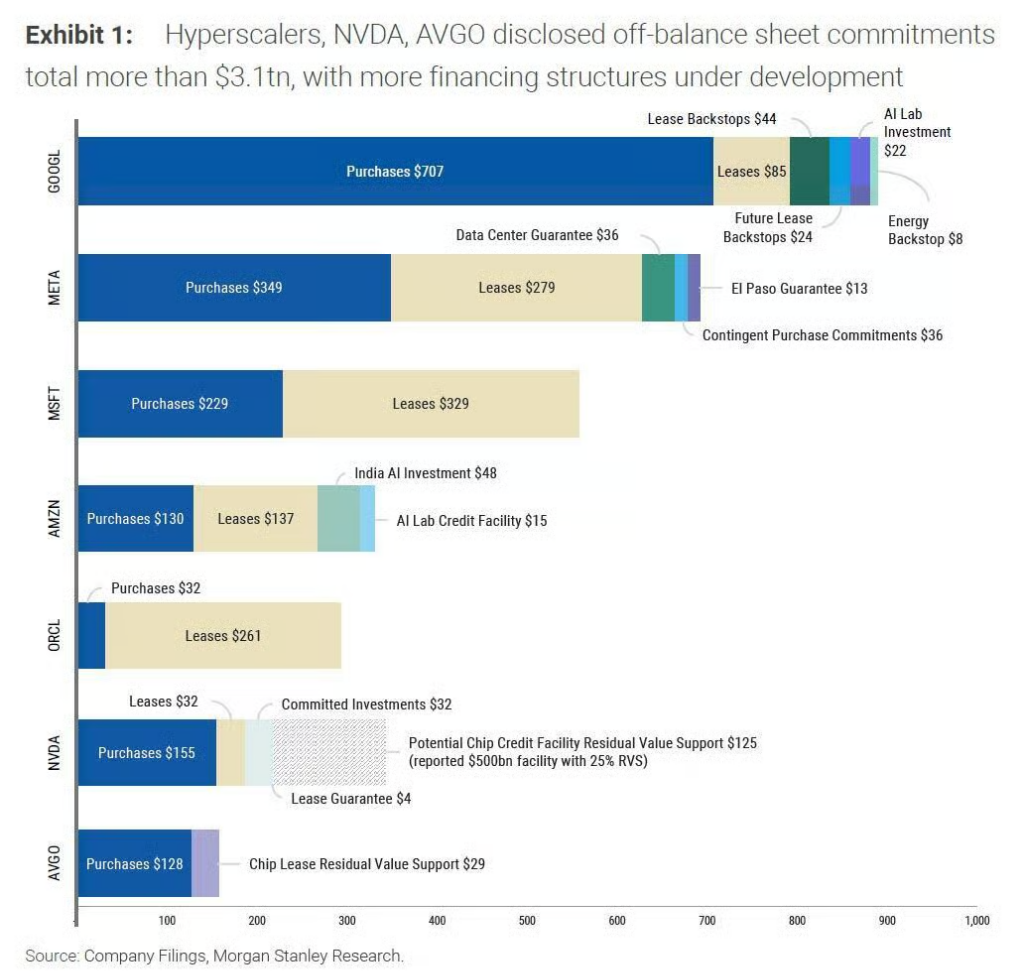
According to the latest quarterly data, the total scale of off-balance sheet commitments disclosed by major hyperscale cloud firms—including Alphabet, Meta, Microsoft, Amazon—as well as Nvidia, Broadcom, and SpaceX, has reached $4.11 trillion, an increase of nearly $992 billion compared to Morgan Stanley’s August figure of $3.12 trillion—meaning that in just about 90 days, nearly $1 trillion in new commitments were added. If off-balance sheet commitments included in Morgan Stanley’s previous statistics, which are based on news reports rather than official financial disclosures, are also counted, the total would reach $4.29 trillion.
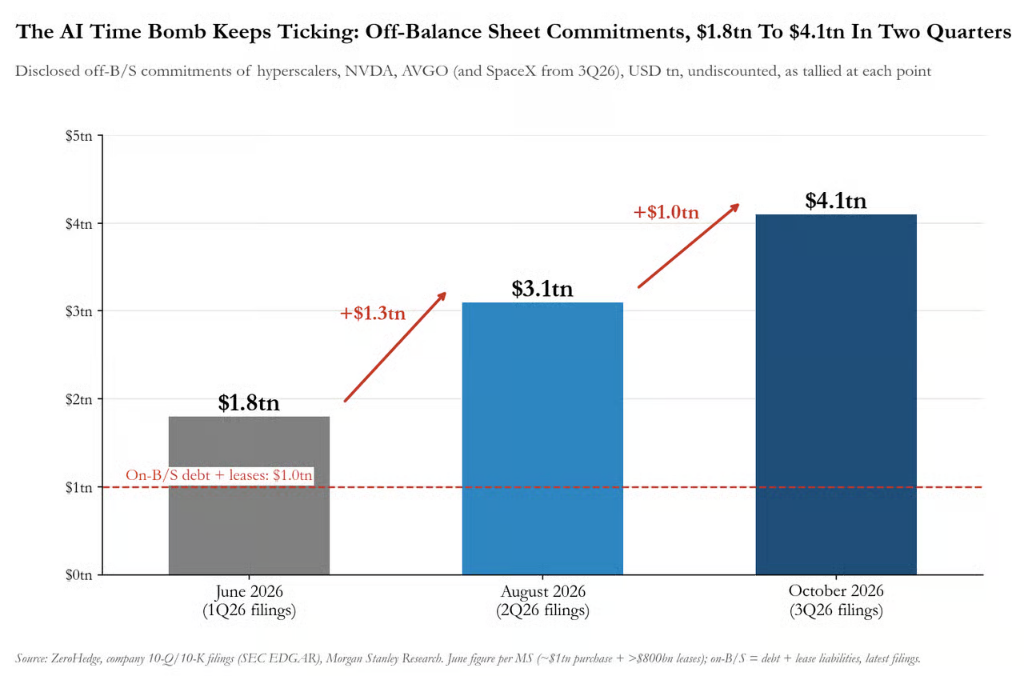
At the same time, the actual debt and lease liabilities on the books of these companies total about $1 trillion, meaning that for every $1 of on-balance sheet liability, there are over $4 of commitments not shown on the balance sheet.
This number has not yet peaked. Nvidia will release its quarterly report in late November, while Oracle and Broadcom will report in December—none have updated to the latest quarter yet. The current $4.1 trillion figure is only the lower bound. Amanda Lynam, Chief Credit Strategist at Goldman Sachs, has also noted that investor attention to these off-balance sheet exposures continues to rise and warned that rating agencies have not yet unified their approach—S&P adjusts leverage for off-balance sheet leases, while Moody's and Fitch do not, so potential changes in rating methodologies are worth ongoing attention.
$57.7 Billion Added in a Single Quarter, Showing No Signs of Slowing
To accurately portray the changes in Q3, five companies that have already reported Q3 results can be compared to their Q2 data. The combined off-balance sheet commitments of these five companies rose from $2.48 trillion to $3.05 trillion, a single-quarter increase of $577 billion, up 23%.
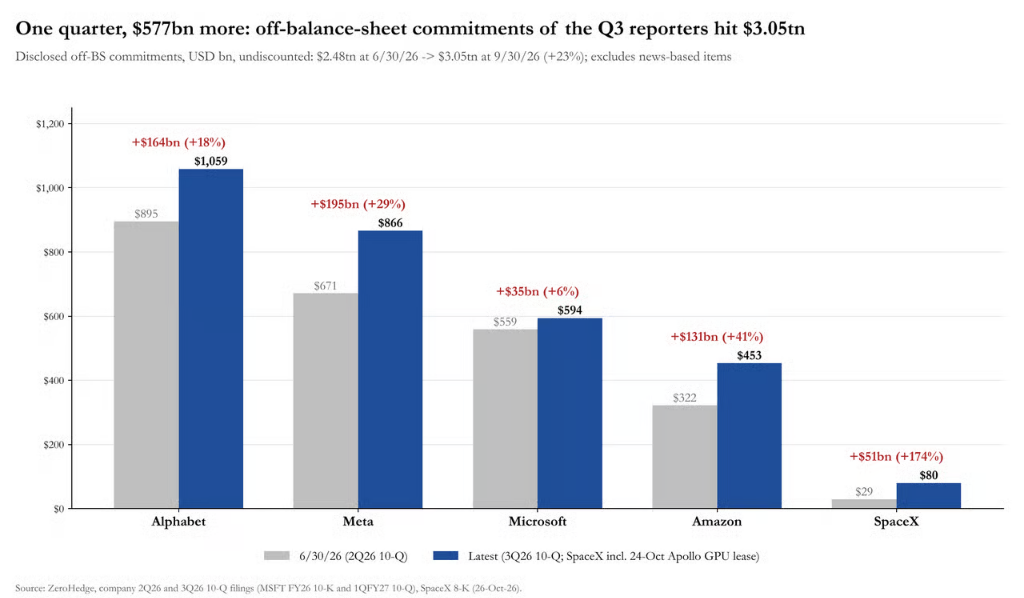
Details for each company are as follows:
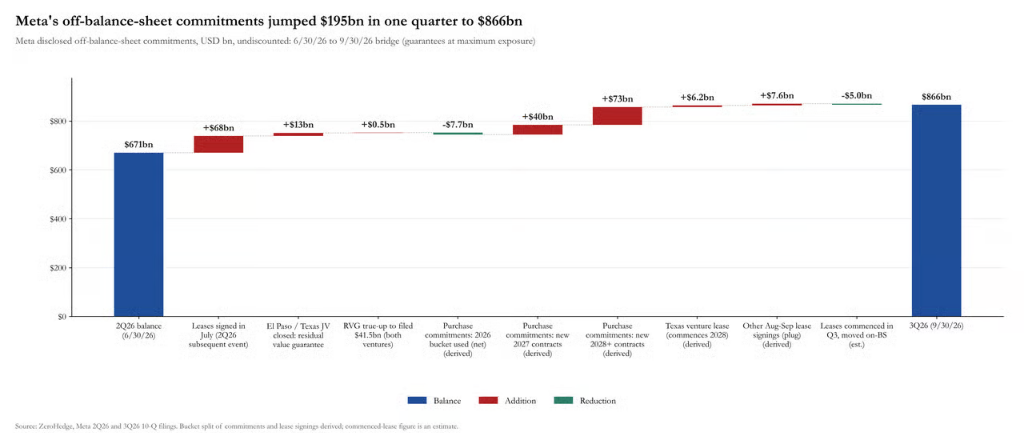
Meta added $195 billion, a 29% increase. Irrevocable purchase commitments soared from $349 billion to $455 billion, mainly related to third-party cloud computing capacity from 2027 to 2028 and beyond (counterparties not disclosed). Signed leases not yet commenced rose from $279 billion to $356 billion, including a $68 billion lease signed in July; the remaining value guarantee for its joint ventures at the Hyperion Data Center in Louisiana and the El Paso Data Center in Texas totals $41.5 billion. Notably, with $97 billion in operating cash flow and an Aa3/AA- credit rating, after Meta’s earnings release, credit default swaps (CDS) hit a record high and Meta immediately announced an equity financing plan of up to $95 billion, of which $37.5 billion has been completed, with about $60 billion in an ATM program pending execution.
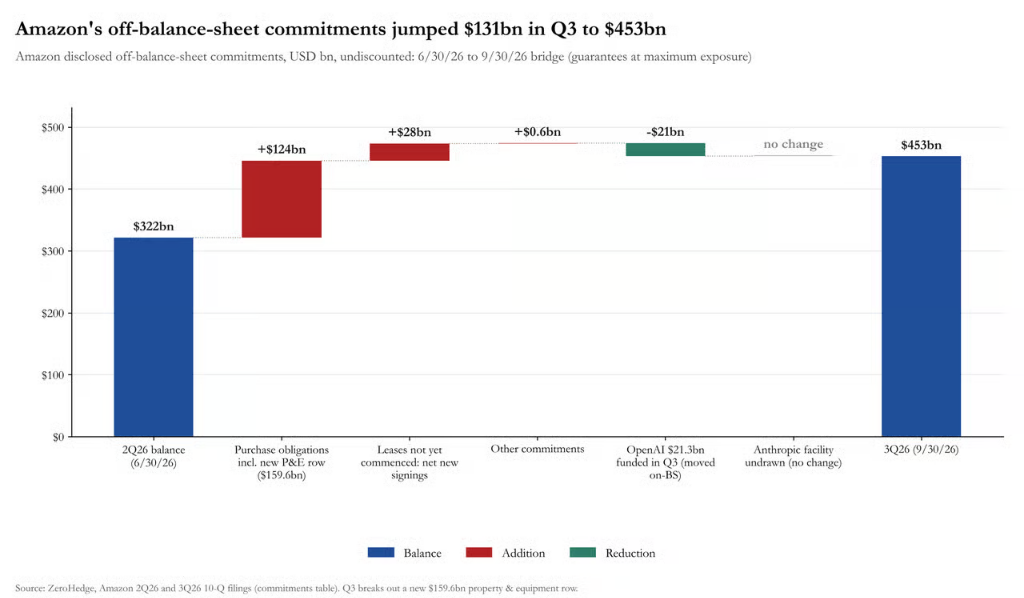
Amazon added $131 billion, a 41% increase, the largest percentage increase among hyperscale cloud firms. Unconditional purchase obligations nearly doubled, from $130 billion to $254 billion, with a new line of $159.6 billion for "property and equipment"; leases not yet commenced rose from $137 billion to $165 billion. The only offset was the $21.3 billion owed to OpenAI, which was booked in Q3 and transferred to the balance sheet. Amazon shares plunged last Friday due to unexpected capital expenditure shocks.
Alphabet added $164 billion, an 18% increase. Purchase commitments increased by $95 billion; leases not yet commenced rose from $85 billion to $131 billion; energy equipment guarantees (with terms extended to 2049) doubled from $7.6 billion to $16.2 billion, and a new $6.6 billion TPU hardware repurchase guarantee was added. Against the backdrop of having already raised $80 billion in equity markets and consistently negative free cash flow, Alphabet's off-balance sheet commitments have surpassed the trillion-dollar mark, making it the first single company to exceed $1 trillion in such commitments, now standing at $1.059 trillion.
Microsoft added $35 billion, up 6%, making it the most "restrained" in off-balance sheet commitment expansion. In Q3, it signed about $53 billion in new data center leases, of which $17 billion were commenced and transferred to the balance sheet, with leases not yet commenced rising from $329 billion to $365 billion. It should be noted that Microsoft's procurement and construction commitments are only disclosed annually in the 10-K filing—at present, the $229 billion figure is as of the end of June and is very likely to be revised substantially upwards. Even so, this "cleanest" hyperscale cloud firm still plans to issue $25 billion in bonds in the near term.
SpaceX added $51 billion, a 174% increase, the most aggressive growth rate. Its off-balance sheet commitments rose from $29 billion at the end of Q2 to $40 billion at the end of Q3, and then to $80 billion after the $40 billion Apollo GPU master finance lease (commencing in early 2027) was disclosed via an 8-K filing on October 26.
Rating Agency Definitions Diverge, Market Starts to Self-Price
Amanda Lynam from Goldman Sachs points out that if off-balance sheet leases and purchase commitments for the five major hyperscale cloud firms are combined, the relevant volume has grown eightfold since 2023. However, this risk exposure is not treated uniformly in rating systems: S&P adjusts for off-balance sheet leases in leverage calculations, while Moody's and Fitch do not use the same treatment—so potential changes in rating methodologies are a risk worth watching closely.
This lack of accounting transparency has already started to provoke direct market responses. Needham, an analytics firm, notes that if off-balance sheet liabilities are included, Meta's enterprise value would rise by 35%. Meta's CDS hit an all-time high after earnings, and it swiftly announced a massive equity financing plan. Lynam also emphasized that some companies have explicitly stated they need to lock in capital ahead of market saturation—a statement seen as a direct motivation for Meta’s equity financing, and likely not to be the last case of its kind.
Three Main Components of Off-Balance Sheet Commitment Expansion
The $4.1 trillion total can be broken down along three main lines:
First, signed leases not yet commenced, totaling $1.39 trillion, up from $1.12 trillion in August. These assets are typically data center shells funded by special purpose vehicles (SPVs) and will only be transferred to the company’s balance sheet when they are powered up and operational.
Second, purchase commitments, totaling $2.25 trillion, up significantly from $1.73 trillion at the end of August. This category includes Meta’s massive locking in of third-party cloud computing capacity, Amazon’s new property equipment purchase obligations, and more.
Third, guarantees and underlying commitments, which jumped from $158 billion to $273 billion, including Alphabet’s energy equipment guarantees and TPU hardware repurchase guarantees, as well as Meta’s residual value guarantees in two data center joint ventures.
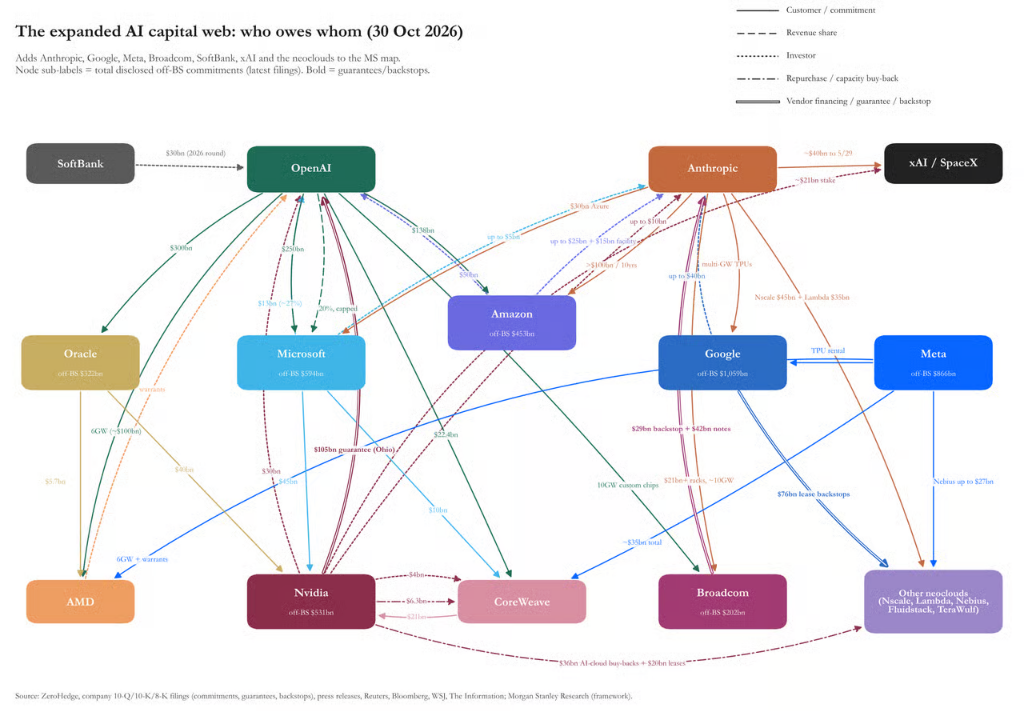
Off-Balance Sheet Debt Expansion Coincides with Market Value Evaporation
Morgan Stanley warned back in August that these commitments have "strategic value" during periods of constrained computing power supply, but "if supply and demand normalize sooner than expected, companies will have to pay for excess capacity or attempt to renegotiate contract terms."
The market has begun to respond. Alphabet shares experienced a record single-day drop this month, Amazon continued to decline, and the combined market cap of Nasdaq 100 constituents evaporated by over $1.2 trillion this month.
In other words, large tech firms added about $1 trillion in off-balance sheet liabilities in a single quarter, while in just one month their market value shrank by more than $1 trillion. Off-balance sheet commitments do not disappear with share price drops; they must be honored at maturity. The central question now is whether AI commercialization revenues can catch up before the next wave of commitments arrives—and the next 10-Q filing season is not far off.
Disclaimer: The content of this article solely reflects the author's opinion and does not represent the platform in any capacity. This article is not intended to serve as a reference for making investment decisions.
You may also like
Explosive Growth of Nearly $1 Trillion in 90 Days! AI Off-Balance Sheet Liabilities Quietly Surpass $4.1 Trillion
The AI infrastructure boom is driving massive off-balance-sheet liabilities, with commitments from seven technology companies reaching $4.11 trillion, surging by nearly $1 trillion in around 90 days—far exceeding on-balance-sheet debt. Data center leases, procurement obligations, and guarantees continue to expand, but rating agencies have yet to provide consistent definitions. The market is starting to worry: if AI revenue growth fails to keep pace with the fulfillment of these commitments, huge expenditures may undermine companies' cash flow and valuations.

Weekly U.S. Equity Macro Outlook Key Points (Nov 2 – Nov 6)
Uniswap Active Addresses Hit 2026 High: Why Is UNI Still Struggling Below $7?

Crypto prices
More


