
How did BTC perform after the four previous midterm elections in history?

Author: Gemini, Deep Tide TechFlow
On November 3, as the US midterm elections approach, there is renewed market discussion about the so-called "risk asset curse".
From a macro perspective, midterm elections do indeed affect risk assets. The core reason is "policy uncertainty". Who controls Congress is directly related to key issues such as subsequent fiscal spending, tax policy, regulatory intensity, and the debt ceiling.
These expectations are priced in by the market ahead of the elections. When uncertainty rises, capital instinctively becomes cautious, and risk appetite declines accordingly.
Today, BTC has been extensively incorporated into traditional financial channels and increasingly resembles a high-beta risk asset. Its correlation with the US stock market, US dollar liquidity, and global risk sentiment has significantly strengthened.
Therefore, policy expectation changes brought by the midterm elections are highly likely to be transmitted to BTC's price action. However, it should be noted that this does not mean BTC is directly linked to election results; it just means that in this cycle, BTC's sensitivity to macro risk sentiment has reached its peak.
So, how much real impact have macro shocks like midterm elections had in history?
The belief that elections always cause a drop does not hold
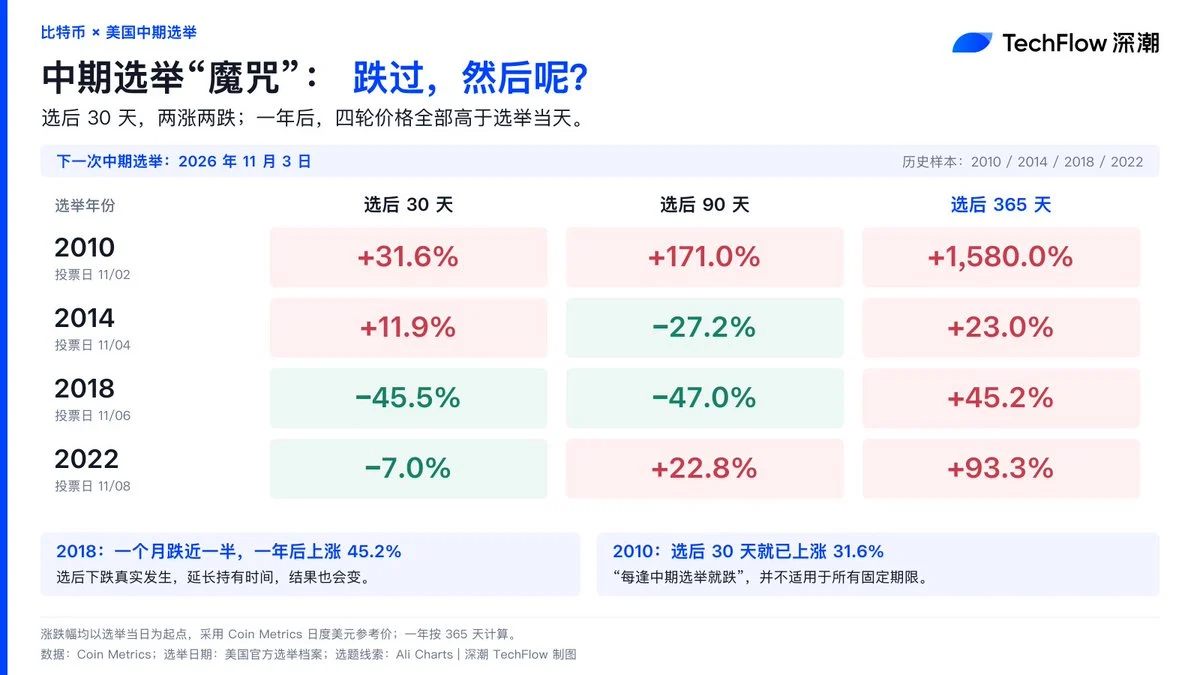
We pulled BTC price data from the last four US midterm elections (2010, 2014, 2018, 2022) before and after the event, and found that in the actual trading record, the so-called "midterm always crashes" is a cognitive bias when facing the data.
If we examine the short-term effect of midterm elections, BTC showed dramatic shakeouts and diverging trends.
In 2018, BTC suffered a nearly 50% drop in the month following the election, plunging 45.5%. But at the same time, in the 30 days following the 2010 midterms, it rose by 31.6%.
"Every midterm election results in a drop" does not apply to all fixed timeframes. This shows that in the short term, the results of elections do not immediately resolve market disagreements, and instead, intensify the fierce struggle between bulls and bears.
At the same time, this is only one variable. The market size, adoption, and macro conditions of BTC are different in each four-year cycle.
As for long-term performance, in the year following the elections, BTC almost always achieved absolute positive returns.
The lowest increase occurred in 2014 (+23.0%), while the highest occurred in 2010 (+1580.0%). The most typical case is 2018, where a post-election decline did happen, but if held longer, the result changed—a year later BTC still recorded a 45.2% positive return.
Liquidity traps and chip redistribution
Large-scale capital is not afraid of long-term policy fluctuations. On the contrary, the short-term macro uncertainty brought by elections is a natural scenario for them to rotate their positions.
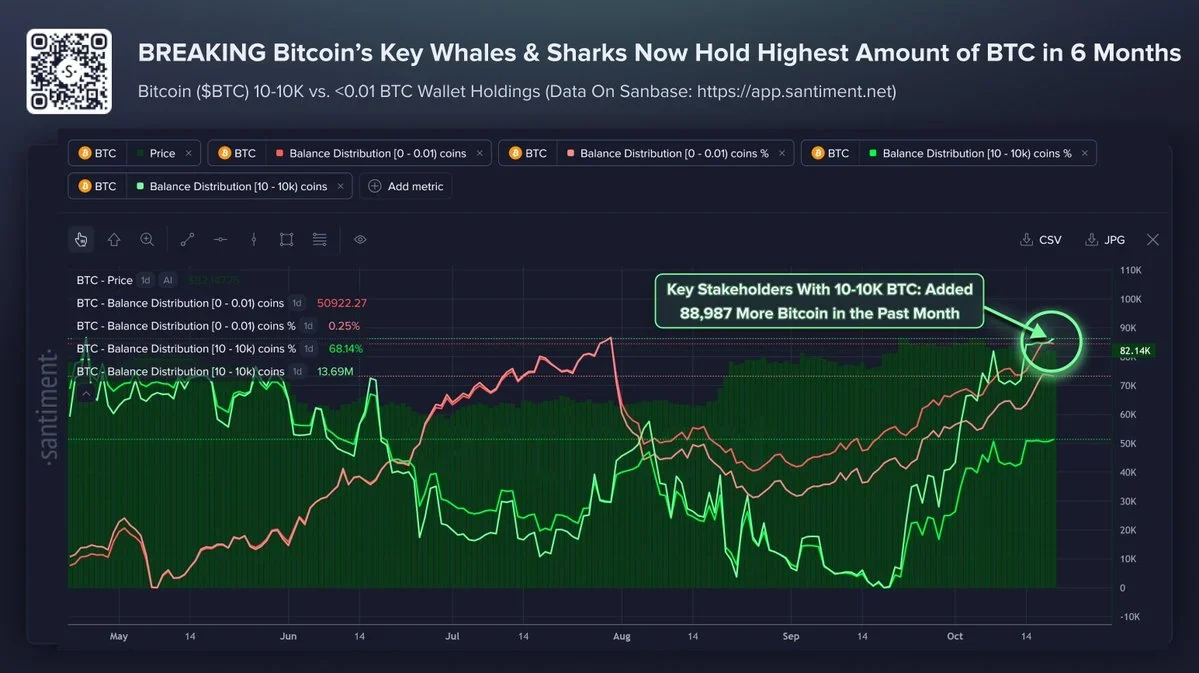
Facing risk-off sentiment around the elections, highly leveraged bulls and panicked retail investors are easily squeezed out, handing over their bloodied positions during the sharp 30-day post-election retracement. Meanwhile, smart money uses this macro noise to create liquidity traps, absorbing stop-loss sales at low prices and building up long-term positions.
We also mentioned in another article that in the past month, the pace of on-chain BTC accumulation by whales has accelerated, even reaching a new high since February of this year.
For BTC, the so-called "midterm election curse" is more like a process of position reshuffling using macro noise. Funds that exit due to short-term macro panic often end up becoming the excess returns on someone else's balance sheet a year later.
Disclaimer: The content of this article solely reflects the author's opinion and does not represent the platform in any capacity. This article is not intended to serve as a reference for making investment decisions.
You may also like



Crypto prices
More


