The best answer isn’t one specific date, but rather a range of risk periods: the risk of the next bear market is already heightened, with late 2026 serving as an important time to confirm.
Bitcoin’s fourth halving took place on April 20, 2024, and previous cycles often became most fragile after the post-halving rally matured; as of October 13, 2026, Bitcoin is trading around $83,516, so investors are no longer analyzing an early-cycle market.
A useful forecast should combine market cycle analysis, trend structure, on-chain profitability, ETF flows, macro policy, and investor behavior. The goal is not to guess the exact day of the crypto bear market; it is to know when the probability has shifted enough to reduce risk.
When is the start of the next crypto bear market?
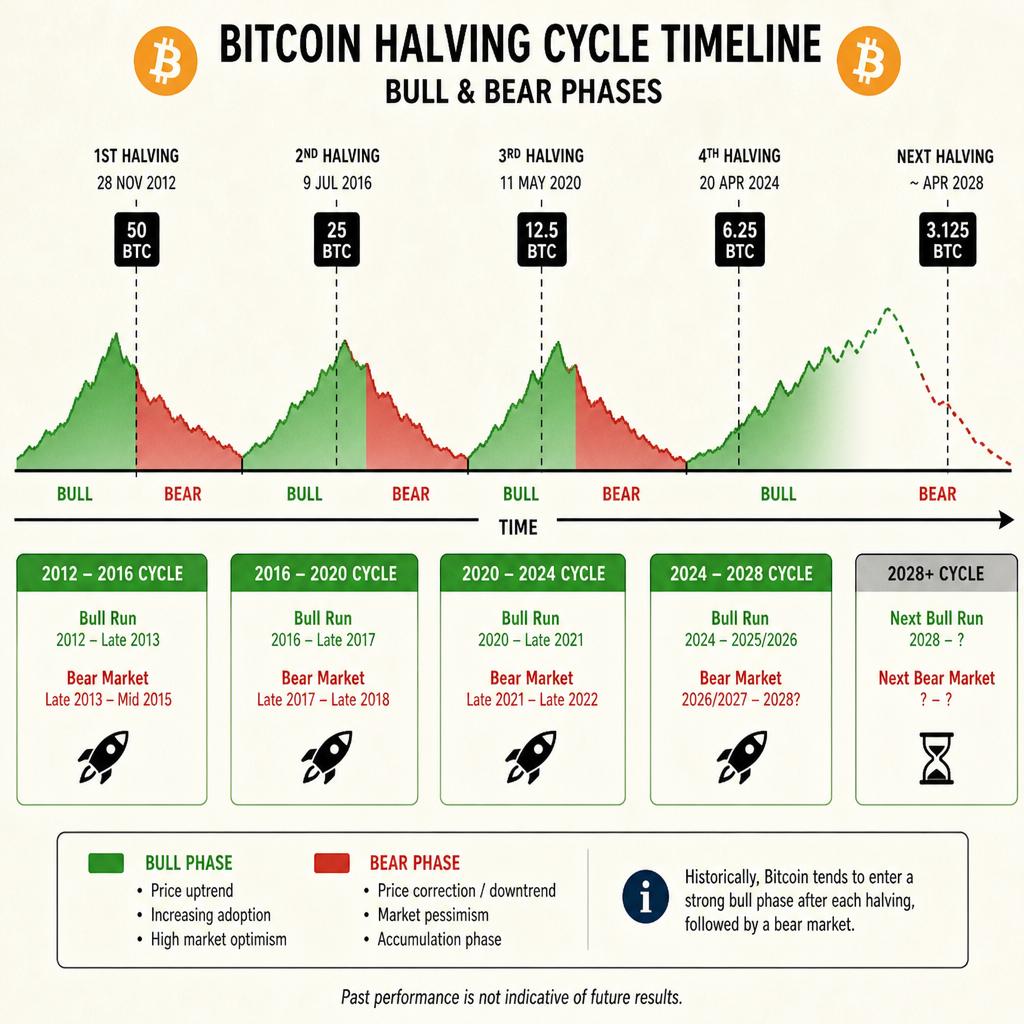
The start of the next crypto bear market is most likely confirmed when Bitcoin fails to reclaim major trend levels after a late-cycle peak, ETF demand weakens, altcoins break down faster than Bitcoin, and on-chain data shows broad profit-taking turning into realized losses. If you use the traditional Bitcoin halving framework, the highest-risk window opened after the 2024 halving cycle matured, making late 2025 through 2026 the period to watch rather than a distant future event.
That does not mean every crypto price drop is a bear market. Crypto often falls sharply inside bull markets, especially after leverage builds up. A real bear market is different: rallies become weaker, liquidity leaves riskier assets, long-term holders distribute into strength, and narratives stop converting into sustained demand.
The halving cycle still matters, but it is not enough
Bitcoin’s supply schedule remains the anchor for many crypto market trends. The block reward halves roughly every four years, and the current reward is 3.125 BTC after the April 2024 halving; the next halving is estimated for 2028.
Historically, halving cycles helped frame bull and bear phases because reduced new issuance met rising demand during periods of improving liquidity. But the market is more institutional now. Spot bitcoin exchange-traded products were approved in the U.S. on January 10, 2024, creating a new demand channel that earlier cycles did not have.
That changes the analysis. ETF inflows can extend rallies by absorbing supply, while persistent outflows can accelerate a downturn. In other words, the cycle clock still matters, but it now competes with fund flows, macro rates, regulation, and professional portfolio rebalancing.
What month does the next crypto bear market start in?
If you are asking, “what month does the next crypto bear market start in,” the most defensible answer is that confirmation is more likely to appear during a multi-month window than on one clean calendar turn. For risk planning, November 2026 through early 2027 is a reasonable confirmation window if Bitcoin remains below prior highs, ETF demand fades, and macro conditions tighten further.
However, some analysts would mark the start earlier if Bitcoin has already made its cycle high and is now trading in a sustained drawdown. The difference comes down to definition. A trader may call the bear market after a major moving-average breakdown; a long-term investor may wait for lower highs over several months; an on-chain analyst may wait for realized losses and declining profitability across cohorts.
A practical way to handle this uncertainty is to use three scenarios:
- Early-bear scenario: the cycle top is already behind the market, and 2026 is the first full bear-market year.
- Transition scenario: the market is moving from late bull to bear, with confirmation still dependent on price structure and flows.
- Extension scenario: institutional demand and easier liquidity delay the next bear market, causing choppy upside before a later breakdown.
The transition scenario is often the most useful because it prevents all-or-nothing thinking. You do not need to predict the exact month to manage exposure intelligently.
Which bear market indicators matter most now?
The most important bear market indicators are trend, profitability, liquidity, leverage, and participation. No single metric is reliable on its own; the warning grows stronger when several indicators deteriorate together.
Glassnode’s MVRV framework compares market value with realized value, and its historical bands treat high MVRV zones as late-cycle profit-taking areas while low zones are more associated with bear-market floors and accumulation. Glassnode also emphasizes confluence across MVRV, aSOPR, Puell Multiple, and Reserve Risk, because agreement between different investor-behavior measures carries more weight than one isolated signal.
Use this checklist to separate ordinary volatility from a probable crypto bear market:
- Bitcoin trend: price spends weeks below the 200-day moving average and failed rallies keep forming lower highs.
- Market breadth: fewer coins participate in rebounds, and altcoins lose strength before Bitcoin does.
- ETF flows: inflows slow, turn inconsistent, or become persistent outflows during attempted rallies.
- On-chain profitability: MVRV, NUPL-style profitability, and realized profit/loss trends show holders moving from gains into stress.
- Leverage: funding rates and open interest remain elevated while price stops advancing, setting up forced liquidations.
- Stablecoin liquidity: fresh buying power stagnates, making rebounds dependent on rotation rather than new capital.
- Narrative fatigue: strong news produces brief pumps instead of sustained trend continuation.
A single red flag is a caution. Four or five flashing together is a regime warning.

Institutional flows can delay or deepen the downturn
This cycle is different because institutions are not just watching crypto; they are part of market structure. Coinbase Research noted that U.S. spot BTC ETF demand stayed positive in September 2026, with roughly $2.6 billion of inflows that month, while altcoin open-interest dominance also rose.
That matters in both directions. Positive ETF demand can soften selloffs because regulated products keep absorbing supply. But if those flows reverse, the same channel can transmit risk-off behavior quickly, especially when portfolio managers reduce exposure across equities, high-beta tech, and crypto at the same time.
Institutional participation can also make the next bear market feel less dramatic at first. Instead of a sudden collapse, the market may grind lower while liquidity rotates into Bitcoin and away from smaller tokens. That can hide stress beneath the surface until altcoin drawdowns become severe.
Macro conditions are the pressure valve
Crypto is still a liquidity-sensitive asset class. When interest rates rise, cash and short-term bonds become more competitive, leverage gets more expensive, and speculative assets usually face tougher conditions.
The Federal Reserve raised the federal funds target range to 3.75%–4.00% on September 16, 2026, and its minutes showed most participants thought another increase would likely be appropriate by year-end if incoming data supported it.
For crypto, that means macro policy can either confirm or challenge the bear case. A higher-rate path would likely pressure valuations and reduce appetite for leverage. A surprise shift toward easier policy could extend the cycle, especially if ETF flows remain positive and Bitcoin holds key support.
A practical risk plan beats a perfect prediction
Trying to call the exact start of the next bear market can create overconfidence. A better approach is to define what you will do if the evidence worsens.
Consider a simple response plan:
- Define your bear-market line. Use a combination of Bitcoin trend, portfolio drawdown, and macro conditions rather than emotion.
- Reduce leverage first. Leverage turns a normal crypto price drop into a forced exit.
- Rebalance from weak assets. Late-cycle markets often punish illiquid altcoins before major assets.
- Keep dry powder. Cash or stable liquidity gives you choices if volatility spikes.
- Review monthly, not hourly. Bear markets develop through failed recoveries, not just one bad candle.
This is especially important for investors holding a mix of Bitcoin, Ethereum, and smaller tokens. The next bear market may not hit every asset at the same speed. Bitcoin can look stable while riskier sectors are already breaking down.
The clearest takeaway
The best answer to “when is the start of the next crypto bear market” is: watch the late-2026 confirmation window, but treat the risk as active now. Bitcoin’s halving cycle, current price structure, institutional ETF behavior, on-chain profitability, and Federal Reserve policy all point to a market that deserves more caution than early-cycle enthusiasm.
Do not rely on one forecast or one indicator. Build a dashboard, define your risk triggers, and adjust before the crowd agrees that the crypto bear market has already arrived.