
Crypto: Pump.fun Earns $18.6M Despite Memecoin Slump

According to data published by DefiLlama on October 9, 2026, Pump.fun generated $18.64 million in crypto protocol revenue over seven days. Earlier, a study conducted by Coin Metrics reveals that 81% of memecoins have lost at least 90% of their value since their peak. The crypto token launch platform on Solana charges fees on every trade, whether the crypto asset rises or not. According to our calculations, it retains about one third of that.
In brief
- $18.64M in revenue over seven days, $60.7M in 30 days (DefiLlama, October 9, 2026).
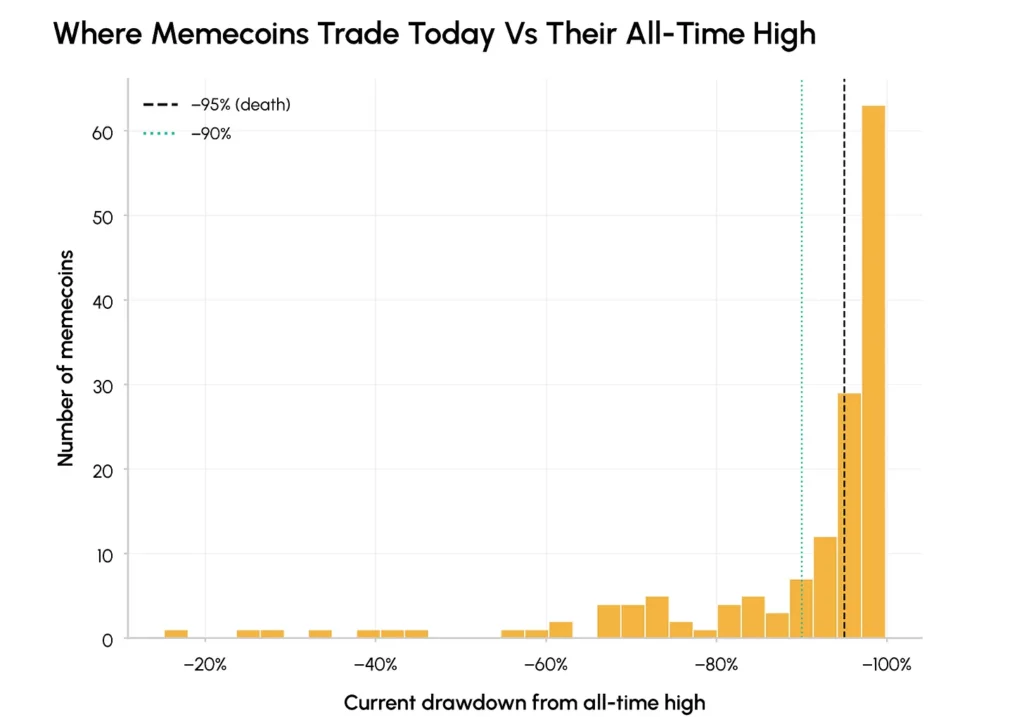
- 81% of the 150 memecoins studied have lost at least 90% since their peak (Coin Metrics, October 6, 2026).
- $478M cumulative buybacks of the PUMP token, then burned (Pump.fun, October 6, 2026).
Why does the crypto platform Pump.fun make money when memecoins fall?
Because Pump.fun is paid on every crypto transaction, not on the token value. Over seven days, traders paid $52.5 million in fees. The protocol kept $18.64 million, or 36% (Cointribune calculation based on DefiLlama data).
Note that a crypto trader who sells a token at a loss to buy another generates new fees.
For its part, Pump.fun announces in a newsletter published on October 5, 2026, $16.32 million in protocol fees from September 28 to October 4. This represents a 20% increase in one week.
What does the Coin Metrics study reveal about memecoins?
Recently published crypto data by Coin Metrics clearly show:
- 81% of the 150 memecoins analyzed have lost at least 90% from their all-time high;
- only 5 digital assets have recovered it.
Recovery essentially does not occur.
Victor Ramirez, Senior Data Scientist, Coin Metrics, report dated October 6, 2026 (translated from English)
However, beware! This figure does not measure losses of crypto traders nor all Pump.fun tokens. The sample only includes assets listed on centralized platforms, which overestimates a token launch’s lifespan.
Do memecoin holders benefit from gains of the crypto platform Pump.fun?
Not automatically. Since September 12, new tokens can redistribute their fees to holders with more than $20, without guaranteeing compensation for a declining token. The Pump.fun crypto platform devotes 50% of its revenue to buybacks and burning of PUMP. A recent publication shows the protocol has actually been overtaken by a social trading app.
Even PUMP (like TRUMP and PENGU) is worth less than at its launch on crypto exchanges, according to Coin Metrics.
One thing is certain: Pump.fun’s revenues follow the rotation of crypto traders, not the rise of already launched tokens. The next dated test: Pump.fun’s weekly newsletter, expected around October 12, 2026. It will indicate if the $16.32 million for the week ending October 4 is confirmed.
Maximize your Cointribune experience with our "Read to Earn" program! For every article you read, earn points and access exclusive rewards. Sign up now and start earning benefits.
Disclaimer: The content of this article solely reflects the author's opinion and does not represent the platform in any capacity. This article is not intended to serve as a reference for making investment decisions.
You may also like
U.S. Senate Democratic leader election to be voted on December 1, impacting AI regulation and tariff agenda
The election for the Democratic leader in the U.S. Senate will be held by secret ballot on December 1, and the winner must reach the threshold of 28 votes.

From Earning 20% Annually to Going Negative in a Single Month, Wall Street’s Favorite Arbitrage Trade “Fails”
After rising for six consecutive months, the Bloomberg FX Carry Index turned negative for the first time in November, falling by 0.9%. Cooling enthusiasm for AI has increased market volatility, and Brazil’s election led to an 8% single-day plunge in the real, nearly wiping out the carry trade's 18% annual return overnight. Industry giants such as Goldman Sachs and Citigroup have issued warnings: “The era of mindless long positions is over.” Although capital has not withdrawn, trading thresholds have surged, requiring defensive hedging and a shift toward selective strategies.

The global tobacco landscape is about to change! Marlboro's parent company Altria (MO.US) plans an all-cash takeover of Imperial Brands UK, targeting cigarette cash flow.
What Altria values is the overseas cigarette cash flow and the established distribution network. Since spinning off Philip Morris International in 2008, its cigarette business has been focused on the United States. Altria estimates that after adjusting for channel inventory changes, the U.S. cigarette industry’s sales volume declined by about 5% year-over-year in the third quarter. Acquiring Imperial Brands’ international business would allow Altria to instantly gain brands, retail channels, and operational scale in markets such as Europe, thereby reducing its dependence on the single U.S. market.

Crypto prices
More


