
From veteran in optical interconnects to "versatile water supplier," what makes Lumentum stand out?


Dolphin, when reviewing the optical connectivity industry, mentioned that regardless of changes in the positioning of optical modules, the status of high-value/high-barrier optical engines remains unshaken.
This time, Dolphin focuses on the leading company in this track—Lumentum (LITE.O). Its stock price has skyrocketed nearly 10 times in a year, with a market cap exceeding $70 billion, and even attracted Nvidia to directly invest $2 billion in March 2026.
If we break down an optical connectivity link: data transmission in a data center must go through optical-electrical conversion. The electrical signal must first be "translated" into an optical signal, transmitted via optical fiber, and then converted back into an electrical signal.
The component responsible for this translation is the optical module, while the core, most difficult, and most expensive part of the optical module is the laser chip responsible for emitting light—understood as the "bulb" for the entire optical link. What Lumentum sells is this "bulb," and it is one of the few global companies capable of making it in-house starting from indium phosphide wafers.
However, "selling light source chips" alone doesn't explain the current revaluation. The real core change lies in the AI supercycle, which has reshaped the pricing logic for optical devices:
Traditionally, optical device is a classic cyclical business: demand fluctuates with the capex of cloud service providers and traditional data center construction, supply and demand are largely balanced, competition is sufficient, and prices decline year by year. The wave of AI cluster construction has reshaped this structure—the surge in high-speed optical connectivity demand brought by large-scale horizontal GPU interconnects has exploded exponentially, and the iteration from 800G to 1.6T further increases the per-machine usage of high-end laser chips.
On the supply side, there is an extreme mismatch—high-end, high-speed laser chips (200G and above) have extremely high mass production barriers, with only a handful of global players capable of expansion, and capacity expansion relies solely on self-built fabs, leading to rigid short-term supply and prolonged mid-to-long-term ramp-up cycles.
With explosive demand growth and capacity struggling to keep pace, the original significant cyclicality is weakened, transforming the industry into a supply-constrained seller’s market—leading capacity companies simultaneously enjoy product premiums, long-term locked-in orders, and a rise in gross margins.
This is also why Dolphin has listed Lumentum as a core research target in the AI optical interconnect sector. In this article, Dolphin focuses on reviewing various businesses of Lumentum, mainly addressing two questions:
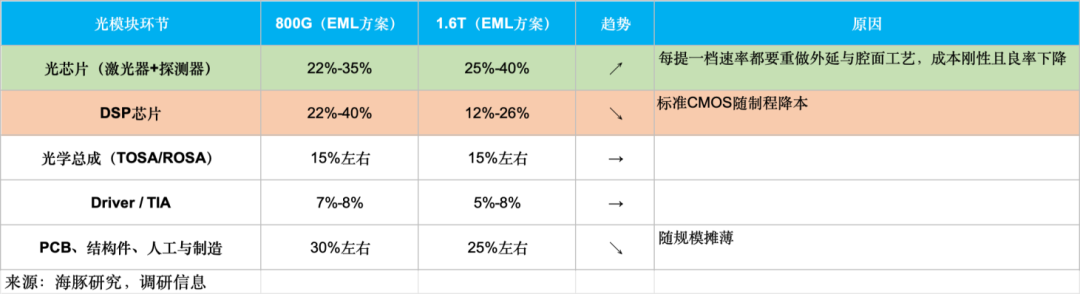
1. In an 800G/1.6T optical module, why are laser chips the dual bottleneck for both value and yield rate?
2. Lumentum’s five product lines (EML, CW, Telecom components, optical modules, OCS): How are they positioned in the AI cluster stack, and what is their competitive landscape? (Due to space, this article will mainly focus on the first two product lines.)
The following is a detailed analysis
I. From Standalone Optical Devices to Integrated Photonics Platform
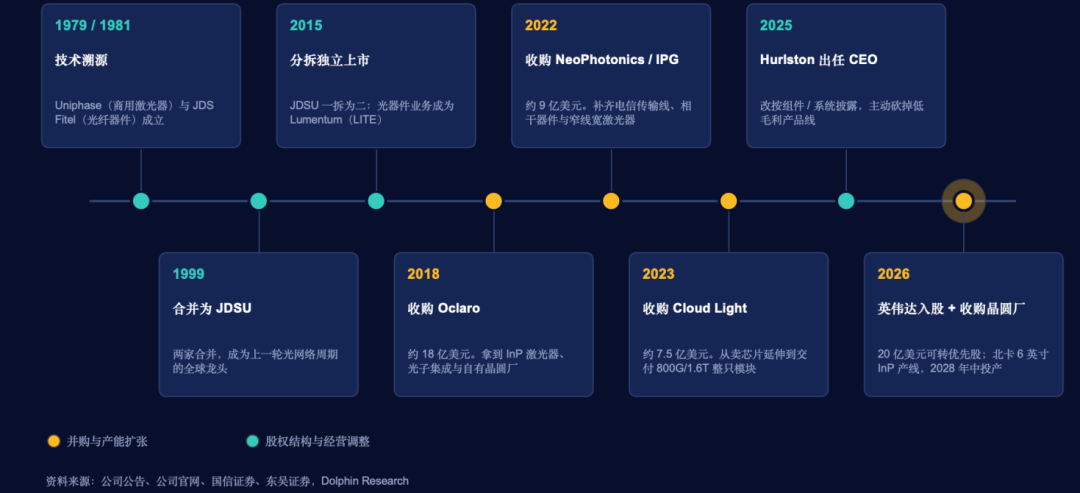
"Yi Zhong Tian" is the nickname Chinese investors have given to the three Chinese optical module suppliers (Eoptolink, Innolight, and TFC). However, the real "OG" in the optical communication industry is indeed Lumentum. It traces its roots back to Uniphase (commercial lasers, established in 1979) and JDS Fitel (fiber optic components, established in 1981). The two merged in 1999 to form JDSU, a star company in optical networks during the last internet bubble.
In 2015, JDSU split into two: the optical component business oriented towards communications and data centers went public as Lumentum; the entity retaining network testing instruments and specialty optics businesses was renamed Viavi (VIAV).
After going public independently, Lumentum’s growth has largely relied on M&A integration:
a: In 2018, acquired Oclaro for about $1.8 billion, obtaining technology reserves and production lines for indium phosphide lasers and photonic integrated circuits—the technological bedrock for its current AI high-speed optical chip narrative;
b: In 2022, completed two acquisitions: acquired NeoPhotonics, rounding out narrow-linewidth tunable lasers (ITLA, the core light source for coherent modules), high-speed coherent photonic integration (PIC), and coherent transceiver modules (TROSA); simultaneously acquired the telecom transmission business of IPG, gaining the ASIC self-development capability for coherent DSPs and full coherent module products for pluggable coherent modules targeting operators.
These two acquisitions combined enabled Lumentum to complete the entire chain for coherent transmission, providing a comprehensive coherent solution for inter-data center interconnect (DCI), metro, and long-haul transmission markets.
c: In November 2023, spent about $750 million to acquire Cloud Light, a company supplying high-speed optical modules to cloud hyperscalers, marking Lumentum’s leap from a pure optical chip/component provider to a company able to deliver complete optical modules externally.
You can see that a series of acquisitions have transformed Lumentum from a standalone optical device manufacturer to an integrated photonics platform simultaneously covering short-range AI compute interconnects, long-haul coherent transmission, and high-speed optical modules.
II. Breakdown of Product and Business Matrix
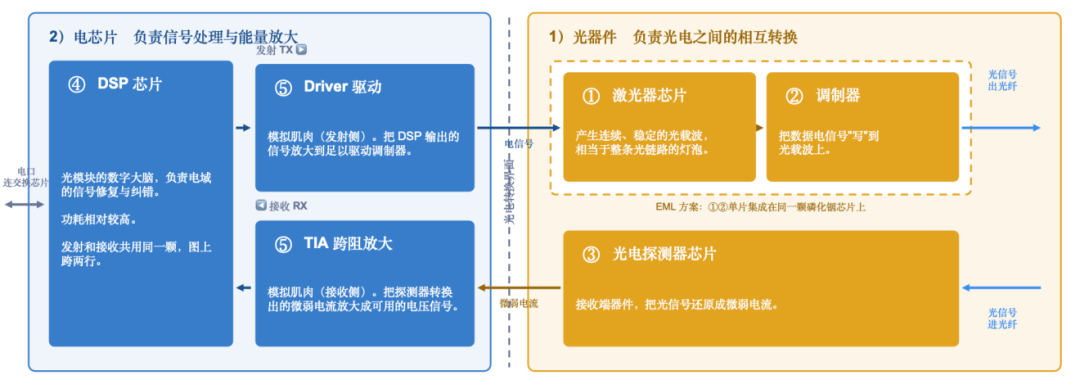
To better understand Lumentum’s product lines, let’s first talk about the technology: a traditional pluggable high-speed optical module (800G / 1.6T) has core hardware that can be divided into 1) optical devices and 2) electrical chips along the optoelectronic conversion pathway.
1) Optical Devices: Responsible for optical-to-electrical conversion
① Laser chip—the "light source" that generates continuous, stable optical carriers, essentially the bulb of the optical link.
② Modulator—writes the data electrical signal onto the optical carrier, modulating the optical signal.
③ Photodetector chip—device on the receiving end that converts optical signals back into weak currents.
2) Electrical Chips: Responsible for signal processing and amplification
④ DSP chip—the digital "brain" of the optical module, responsible for electrical domain signal restoration and error correction, with relatively high power consumption.
⑤ Driver and TIA—the "analog muscle" of the module. The transmitter-side Driver amplifies DSP output signals enough to drive the modulator; the receiver-side TIA amplifies the weak current from the detector into usable voltage signals.
It's important to emphasize that optical devices and electrical chips fundamentally differ in their manufacturing modes and capacity flexibility:
DSP and similar electrical chips are silicon-based CMOS chips, with most vendors Fabless—design done in-house, then sent to foundries like TSMC. While advanced process capacity is allocated, once booked, production scale can be flexibly adjusted thanks to mature lines, and chip vendors do not need to build their own wafer fabs.
In contrast, optical devices are a different story: as silicon cannot efficiently emit light, ultra-high-speed lasers must rely on compound semiconductors like indium phosphide; moreover, there’s no mature, highly standardized third-party foundry ecosystem like TSMC for compound optical chips.
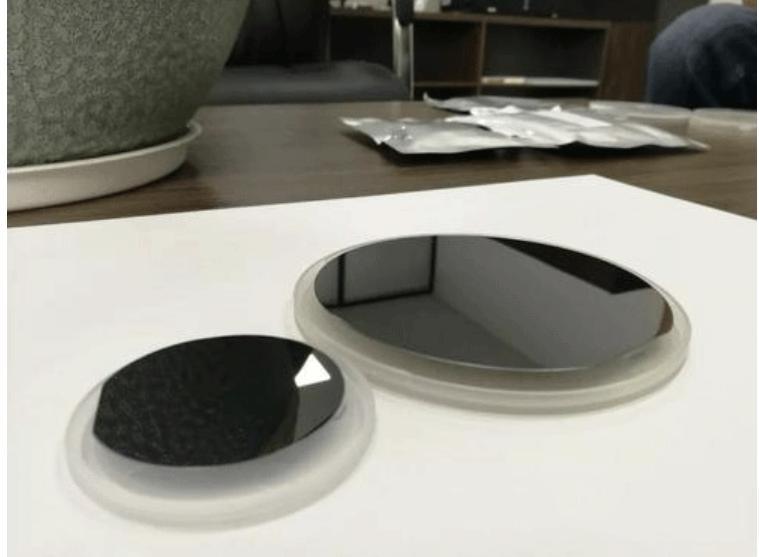
Thus, top global players mostly adopt a vertically integrated IDM model—self-building wafer fabs, in-house epitaxial growth, wafer processing, and coating processes.
Expansion requires construction, tuning, and yield ramp-up, usually taking 2-3 years, giving optical devices significantly less capacity flexibility than electrical chips. There are a handful of indium phosphide compound foundries globally, but they mainly support small batch production for smaller clients and can't sustain large-scale, stable shipments of high-end, high-speed optical chips.
Understanding this difference between optical and electrical chips, we see Lumentum’s positioning: its main products are optical devices, with capacity highly dependent on self-built indium phosphide wafer lines. This means that even if AI compute demand rapidly pulls up optical module needs, Lumentum can hardly ramp shipment volumes significantly in the short term—capacity expansion is inherently limited.
With this background, let’s look at Lumentum’s product lines.
According to financial reporting, Lumentum’s revenues comprise two main business segments:
1) Component Business (Components): Mainly includes EML high-speed laser chips, CW continuous-wave laser chips, and various traditional telecom optical components.
2) System Business (Systems): Includes high-speed optical module systems from Cloud Light acquisition and OCS optical circuit switches. There’s also an industrial laser business, which is non-communication revenue and relatively small.
The chart below shows that the share of system business has continued to climb sequentially, benefiting from the rapid growth in optical module shipments.
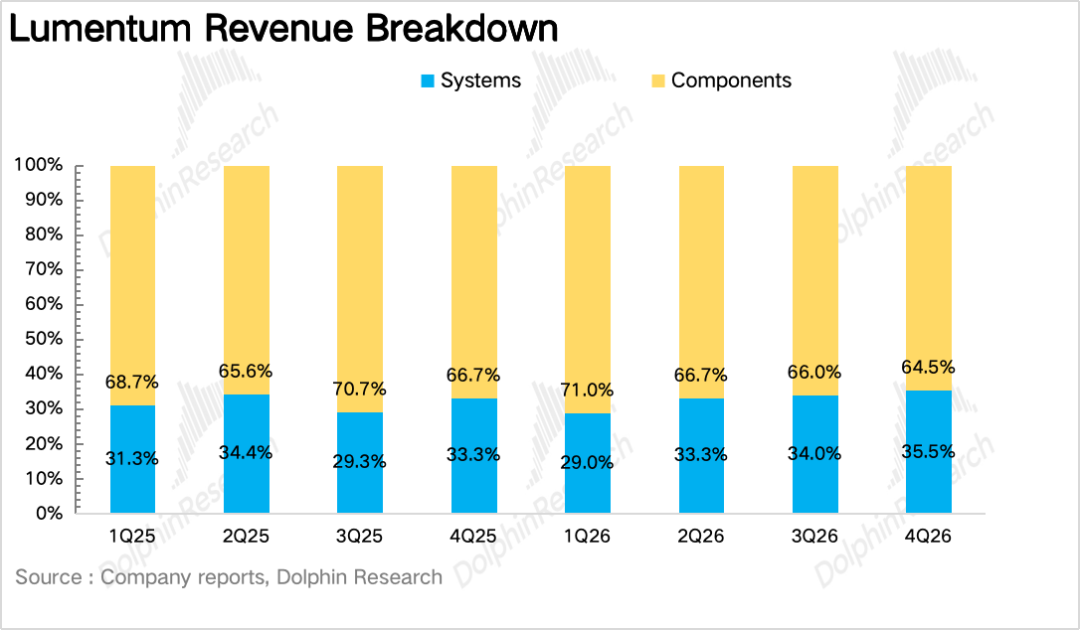
Because both the component/system segments include AI and traditional non-AI-related businesses, it's hard to dissect the underlying business logic from financials alone.
In the following, Dolphin does not use the report’s classification, but analyzes based on Lumentum’s five core product categories—EML, CW, telecom components (all counted as components), and optical modules, OCS optical switch (the last two as systems). For each product line, we analyze its technological position, competitive landscape, and growth potential.
Let’s look at Lumentum’s current business foundation—high-speed laser chips. The mainstream high-speed laser chip technology diverges into three distinct paths based on how emission/modulation are integrated:
a. EML (Electro-absorption Modulated Laser)—(integrated, edge-emitting): Integrates both emission and modulation on a single indium phosphide chip, outputting high-speed modulated optical signals directly. This is currently the mainstay solution for high-speed pluggable optical modules.
b. CW (Continuous Wave Laser)—(separated, edge-emitting): Focuses strictly on generating high-power, highly stable continuous light, with modulation handled by an external silicon photonics chip. This is the core light source for silicon photonics packaging/CPO architectures.
c. VCSEL (Vertical Cavity Surface Emitting Laser)—(low-cost, vertical emission): Designed for low-cost, arrayed mass production with short transmission distances, mainly used in consumer electronics 3D sensing, automotive short-range LiDAR, etc.
Note: Both EML and CW are edge-emitting lasers (EELs) that require complex processes like wafer cleaving, end-face coating, etc.—manufacturing is far more challenging than VCSEL.
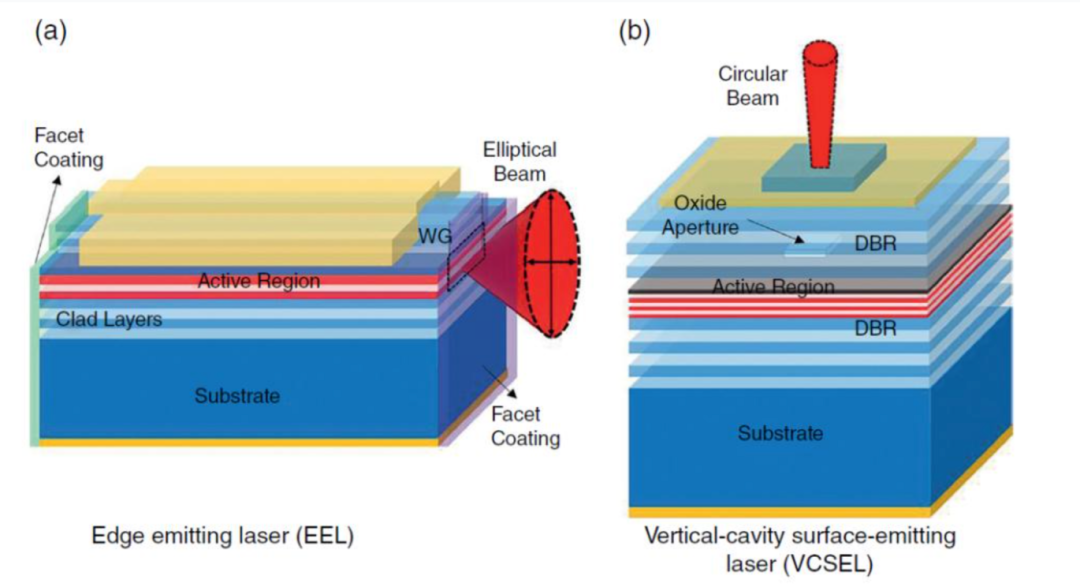
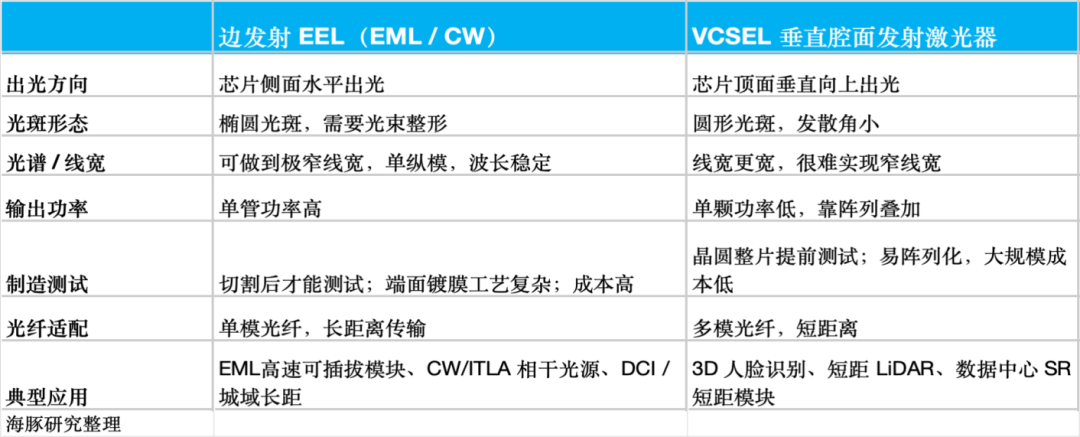
These three routes directly determine their difference in process complexity, unit price, gross margin, and competitive landscape. (Dolphin provides a detailed comparison table below.)
(Since VCSEL is mainly for consumer and industrial fields and now accounts for less than 10% of Lumentum's revenue—and is not an AI communications core driver—it is not elaborated here. Focus is on EML and CW lasers.)
1. EML Laser Chips: The Foundation for Scale-out Layer
EML is the main solution for 800G/1.6T discrete light source pluggable optical modules. A single 1.6T module usually requires 8×200G EMLs.
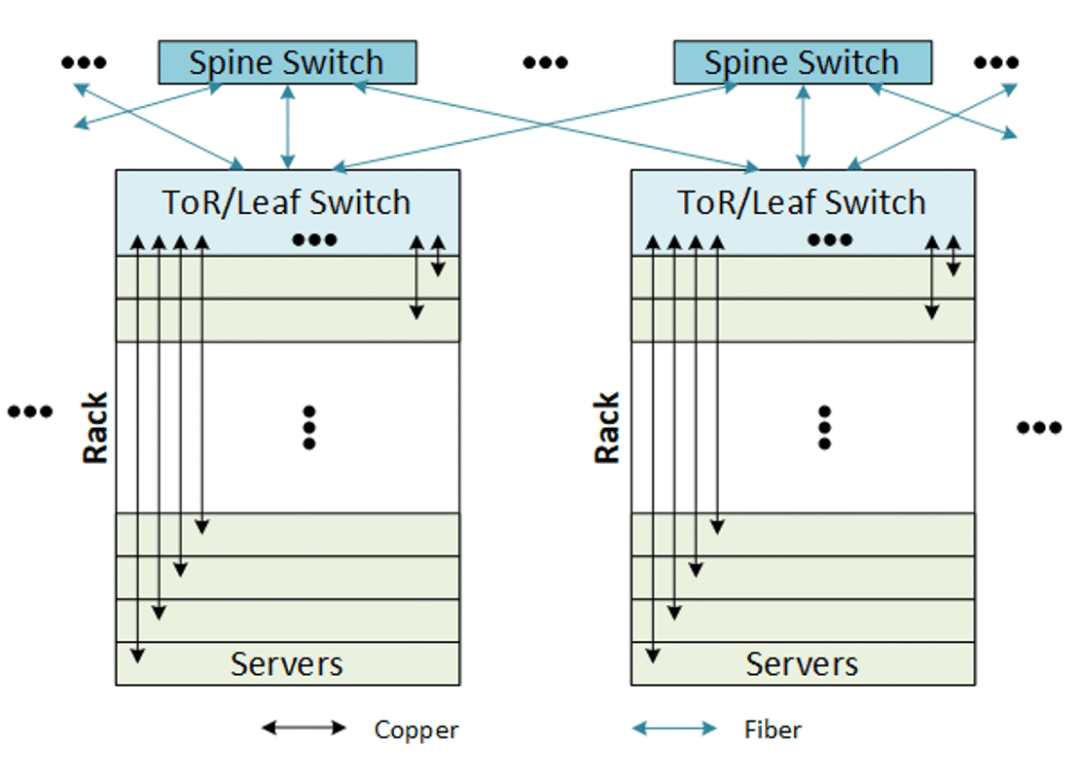
Application-wise, EMLs are mainly for AI cluster scale-out interconnect within cabinets, e.g., GPU-to-leaf switches, leaf-to-spine switches (tens to 500 meters).
Downstream clients are top optical module makers such as Innolight, Eoptolink, Coherent, etc., and ultimately North American cloud vendors—EML chips are Lumentum’s core base business.
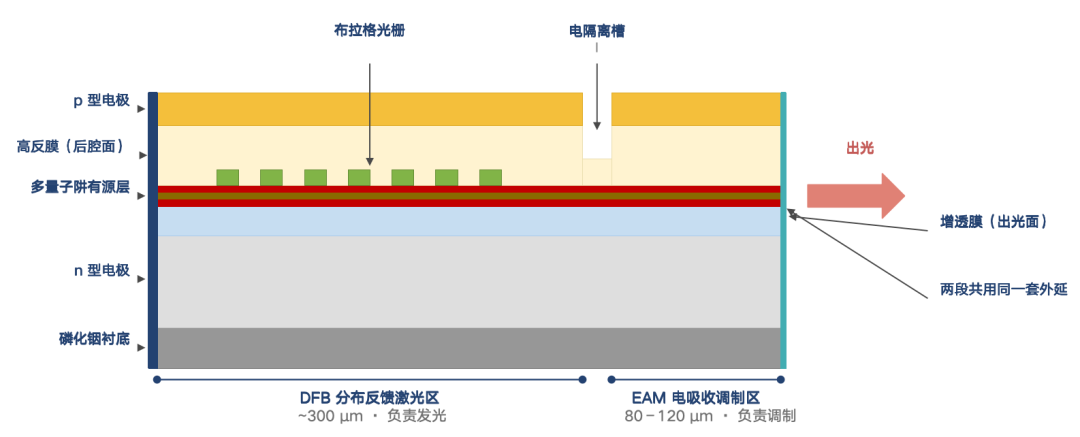
Industrial research shows that because EML involves monolithic integration of a DFB emission zone and EAM modulation zone on indium phosphide substrates (with complex secondary epitaxial growth), the process barriers are high and yields are hard to control.
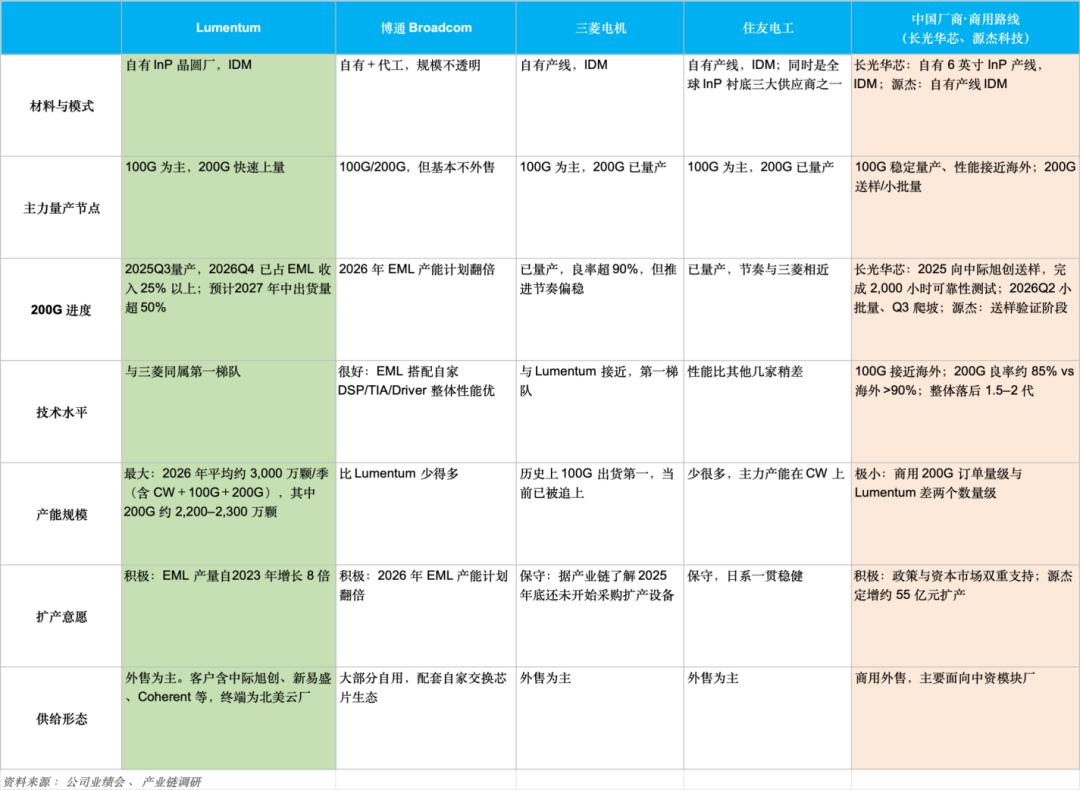
Currently, globally only Lumentum, Mitsubishi Electric, Sumitomo Electric, and Broadcom can stably and at scale supply head module manufacturers with high-yield 200G EMLs; combined, they hold over 80% market share, and Lumentum is in the first echelon for capacity.
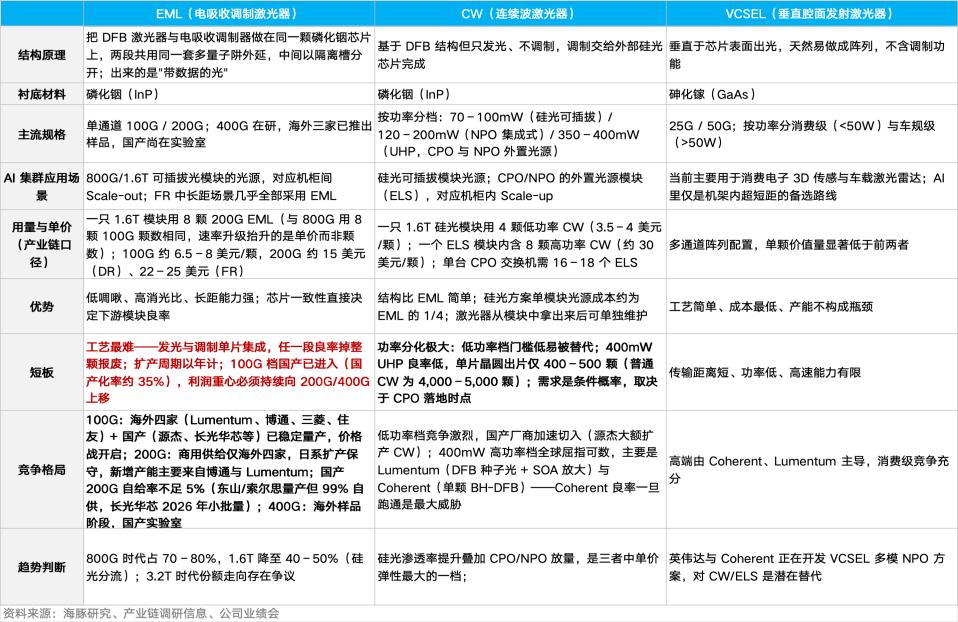
Dolphin summarizes leading EML manufacturers in the table below: in the 100G EML segment, Chinese firms (Yuanjie, Changguang Huaxin, etc.) have achieved stable mass production with local supply share approaching 35%—a price war has started; but for high-end 200G EML, China’s local self-sufficiency is less than 5%, mostly at sampling and small trial production stage.
Additionally, since the two Japanese players (Mitsubishi & Sumitomo) were hit by capacity oversupply during the last 5G bubble, their expansion strategy for this cycle is quite conservative—limited new 200G EML capacity. The main new supply comes from Lumentum and Broadcom.
As a result, Lumentum is actively shifting shipments toward higher-value 200G EMLs. Its guidance indicates that by mid-2027, over 50% of shipments will be 200G EML.
Survey data shows Lumentum’s EML laser chip revenue is about $640 million (about 20% of total revenue) and is in a high-growth, high-margin phase.
On one hand, massive expansion of AI compute clusters is driving booming 800G/1.6T pluggable module demand, directly pulling EML chip shipment records higher; on the other, shipment focus is shifting from 100G to 200G EML, with per-chip price nearly doubling—further amplifying revenue elasticity.
In terms of profitability, current EML chip gross margin exceeds 60%, making it the company's most profitable and highest bargaining-power product.
2. CW/UHP Lasers: The Biggest Increment at the Scale-up Layer
Unlike EML’s integrated emission+modulation, CW lasers are purely focused on "emission": generating a high-po, stable, unmodulated continuous beam of light, while an external silicon photonics chip modulates the signal.
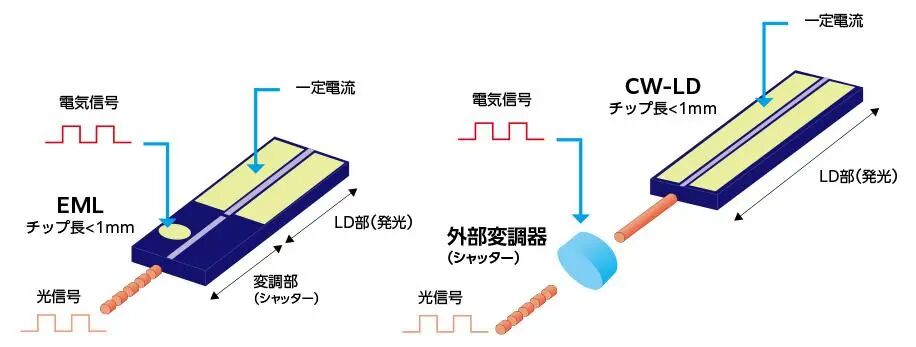
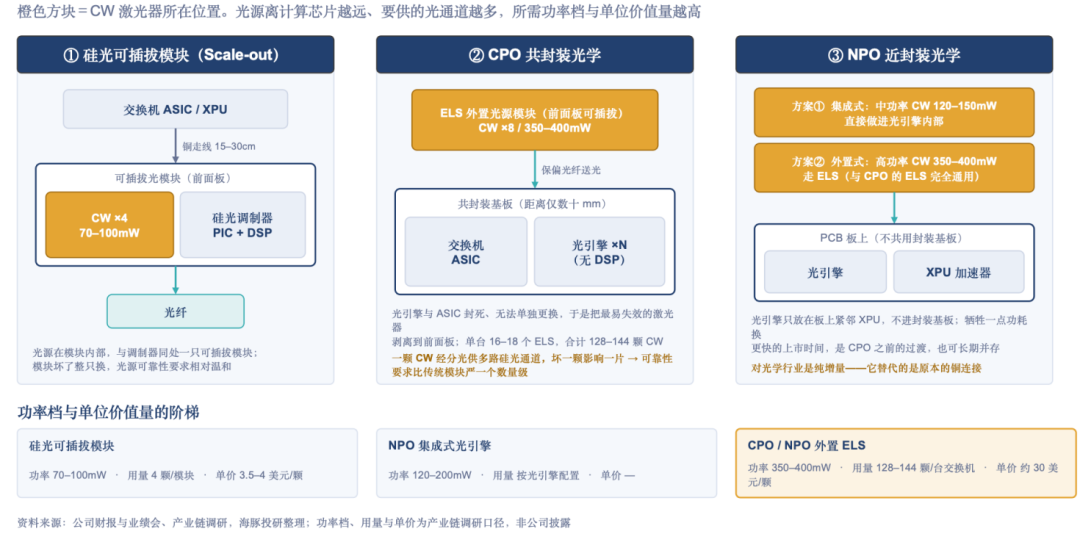
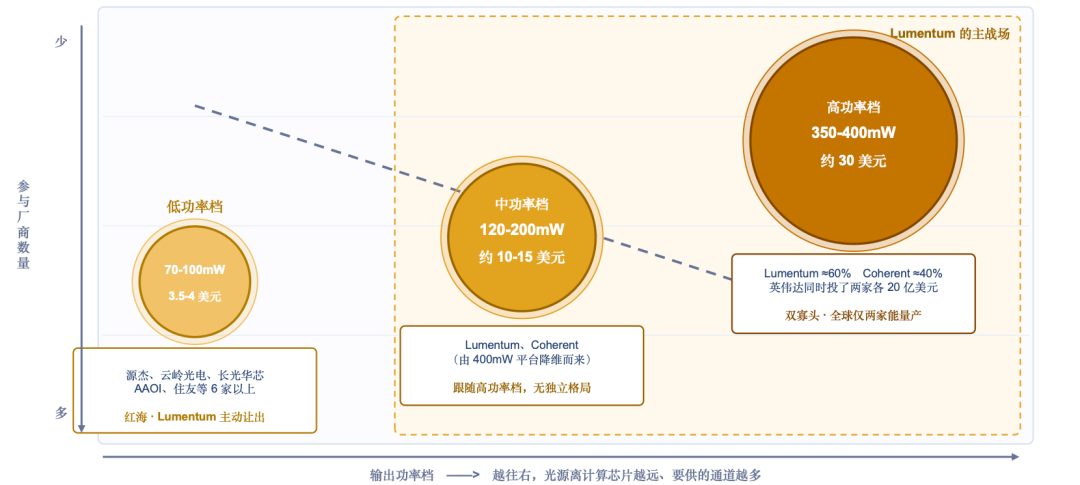
Generally, the further the light source from the silicon photonics chip, the higher the overall link loss, so the higher the required CW output power—the more demanding the process challenges (noise, heat), and the higher the value-per-chip. By power class, CW lasers cover three application scenarios:
a. 70-100mW — For scale-out silicon photonics pluggable modules
According to Yole, silicon photonics solutions now have ~30% penetration in data center optical modules and are expected to reach 60% by 2030.
For Lumentum, this is a stock market internal route switch (800G silicon photonics taking 100G-EML demand, 1.6T taking 200G-EML ).
But there's a value difference. For a 1.6T module, EML requires 8×200G EML ($15-25 each); silicon photonics needs only 4×CW ($3.5-4 each).
Switching to silicon photonics, total module light source value is clearly lower. Thus, the company explicitly says it's not that interested in this segment—module shipment growth, but per-module value and margin elasticity less than EML.
b. 120-200mW — For NPO (Near-Packaged Optics) integrated light engines (Scale up)
NPO is a transition from pluggable to CPO—putting the optical module on the PCB increases the signal transmission rate between switches and optical modules.
Compared to the 70-100mW CW of silicon photonics pluggable modules, this tier has higher standards for output power, noise suppression, and high-temp reliability—higher value and only incremental demand, without eroding EML’s existing market.
c. 350-400mW (UHP ultra-high-power CW) — for CPO/NPO external light source modules (Scale up)
ELS (External Laser Source) is the main external light source solution in the CPO architecture, enabling cabinet-level GPU high-speed direct Scale-Up interconnect.
In CPO, the silicon photonics engine and switch chip are co-packaged on the same substrate. Since lasers are the most failure-prone (and heat-sensitive) part of the optical link, if integrated, any failure means the whole photonics engine must be replaced.
Thus, the industry consensus is to use ELS—making the CW laser a pluggable module at the front of the rack, feeding light via polarization-maintaining fiber into internal silicon photonics engines.
For value, at the cabinet-level scale-up network, a typical CPO switch needs 16-18 ELS modules, each with 8 UHP CW chips, so one switch consumes 128-144 CW chips.
Currently, a single ELS module sells for about $500-600, with 8 CW chips worth ~$240 (40-50%). In other words, one ELS brings a CW vendor as much revenue as 15 silicon photonics pluggable modules.
All in all, compared to the lower two CW tiers, UHP CW’s technical barriers are highest and—since it serves the incremental demand brought by AI compute expansion (and does not cannibalize EML stock)—it is the biggest mid-term growth driver for Lumentum.
Competitively, for lower-power CWs, since indium phosphide epitaxy and chip design are mature, the challenge is low-cost, high-yield delivery—already a typical red ocean.
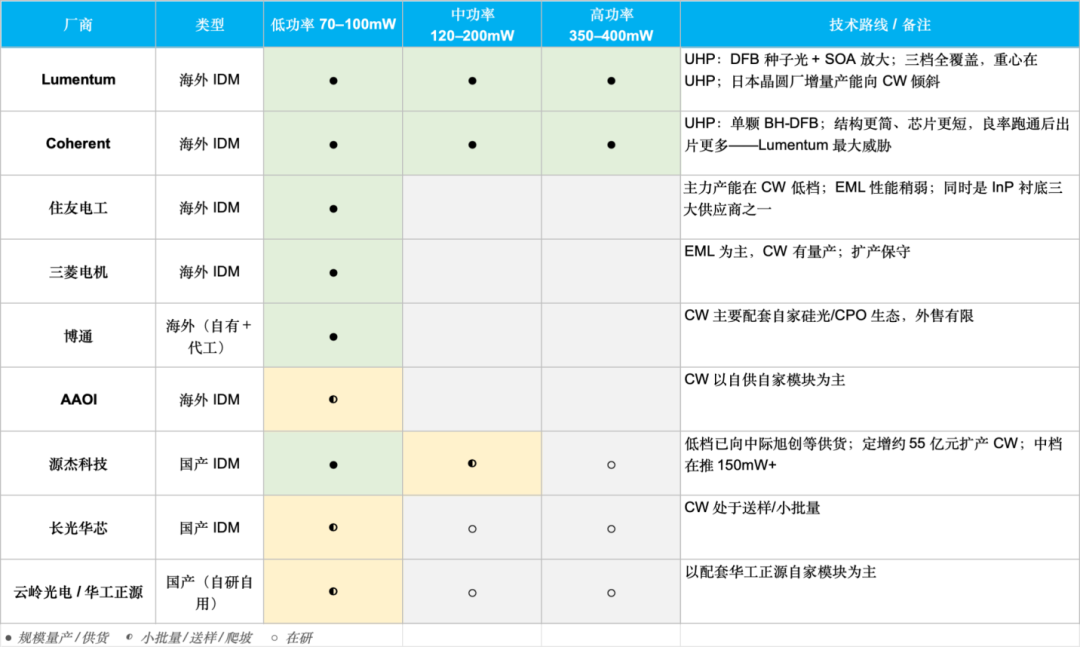
Currently, Chinese players (Yuanjie, Changguang Huaxin, Yungling Photonics, etc.) and overseas low-cost IDMs (like AAOI) are both expanding; several have passed module vendor qualification, and customers (Innolight, Eoptolink, etc.) source from multiple suppliers to drive prices down.
But for high-power (350-400mW UHP), only Lumentum and Coherent can mass-produce stably, with very different technical approaches:
Coherent: Single-chip brute-force (BH-DFB route): Like making a single large-engine, using a buried heterostructure (BH-DFB) laser to get 400mW outright.
Advantage: Extremely compact, small chip area, high die/wafer; downside: all the thermal, linewidth, and reliability stress falls on one chip, so yield ramp-up is slow.
Lumentum: Two-stage separation (DFB seed laser + SOA amplifier): Like combining a small engine + turbo. First a mature, low-power DFB for a clean "seed light," then a semiconductor optical amplifier (SOA) in series on the same chip boosting to 400mW.
This means light emission and amplification both work at mature process windows—reliability is high and the platform covers mid-power as well, boosting R&D efficiency;
The clear downside is that after integrating SOA the chip becomes much longer—wafer output plummets (from 4,000-5,000 mid-power CWs per wafer to only 400-500 UHPs, down nearly 10x).
In summary, different trade-offs: Coherent bets on ultra-low wafer cost after yield ramp, Lumentum prioritizes reliability at the cost of wafer output.
Currently, with supply tight, cloud vendors care most about delivery and reliability, and are less price-sensitive—so Lumentum’s reliability-first approach is favored (surveys show Lumentum has 60%, Coherent 40% share in external light source modules).
Longer term, once Coherent ramps yield, its cost advantage will pose strong competition to Lumentum.
For the mid-power tier, anyone making 400mW chips can easily do 150-200mW as a "byproduct".
But for Chinese and other second-tier players moving up, 150-200mW is the necessary path to the high-end. However, without breaking into high power, you miss the cost-sharing effects of wafer grading, making your mid-power cost uncompetitive against the giants’ low-cost "byproducts".
Survey data shows Lumentum's CW laser revenue is now about $50 million (2% of total), still small, mainly from early silicon photonics module demand and CPO sampling.
But as analyzed above, real performance impact depends entirely on the speed of NPO/CPO architecture rollout; when the industry migrates from pluggable to CPO, demand for CW lasers will spike exponentially. (To be quantitatively estimated in part two.)
- END -

This article wasn’t easy—please give it a “Share” to show support~
Disclaimer: The content of this article solely reflects the author's opinion and does not represent the platform in any capacity. This article is not intended to serve as a reference for making investment decisions.
You may also like
Slowing AI models may not necessarily be bearish: three structural tailwinds for traditional data centers outweigh rising interest rates
HSBC believes that the traditional growth logic of data centers is shifting from frontier model iteration to AI commercialization and diffusion. With the rise in inference demand and increased capital expenditure from cloud service providers, combined with tightening power and regulatory constraints, the supply-demand imbalance is expected to persist until 2028. Even with rising interest rates, the compound annual growth rate of AFFO per share is still expected to reach 11%–12% from 2025 to 2028, demonstrating strong earning resilience.
This time, will U.S. Treasury bonds crash U.S. stocks?
Bloomberg strategist Simon White warns that the recent rise in US Treasury yields is shifting from a "benign" increase driven by interest rate expectations to a disorderly surge fueled by expanding term premium. Market analysts note that higher long-term interest rates will simultaneously push up US stock valuation discount rates and corporate financing costs, intensifying liquidation pressure on highly leveraged assets. If interest rates above 5% become the new norm, US stock valuations will face ongoing compression pressure.
Eurosystem Launches Blockchain Platform for Tokenized Asset Settlements
Crypto prices
More


