
Treasuries break 5.1%, growth stocks step aside. These 5 names are the new defensive favorites — tap to position.
 2026/09/24 05:30
🔥 U.S. stock radar is live. 3 major themes, 6 selected names, and a 7-event calendar — where are this week’s opportunities? Tap the link for 22 trade ideas in one view →
Last night’s real driver in U.S. stocks wasn’t single-stock news. It was a repricing of rates.
The 10-year Treasury yield jumped to about 5.11%, the highest since 2007. The 2-year moved higher with it, and the market priced in a greater chance of another hike in October. Oil moved back above $100, business-activity data came in firm, and bonds were sold off hard.
The result was straightforward: the S&P 500 fell about 0.75%, and the Nasdaq dropped about 1.1%.
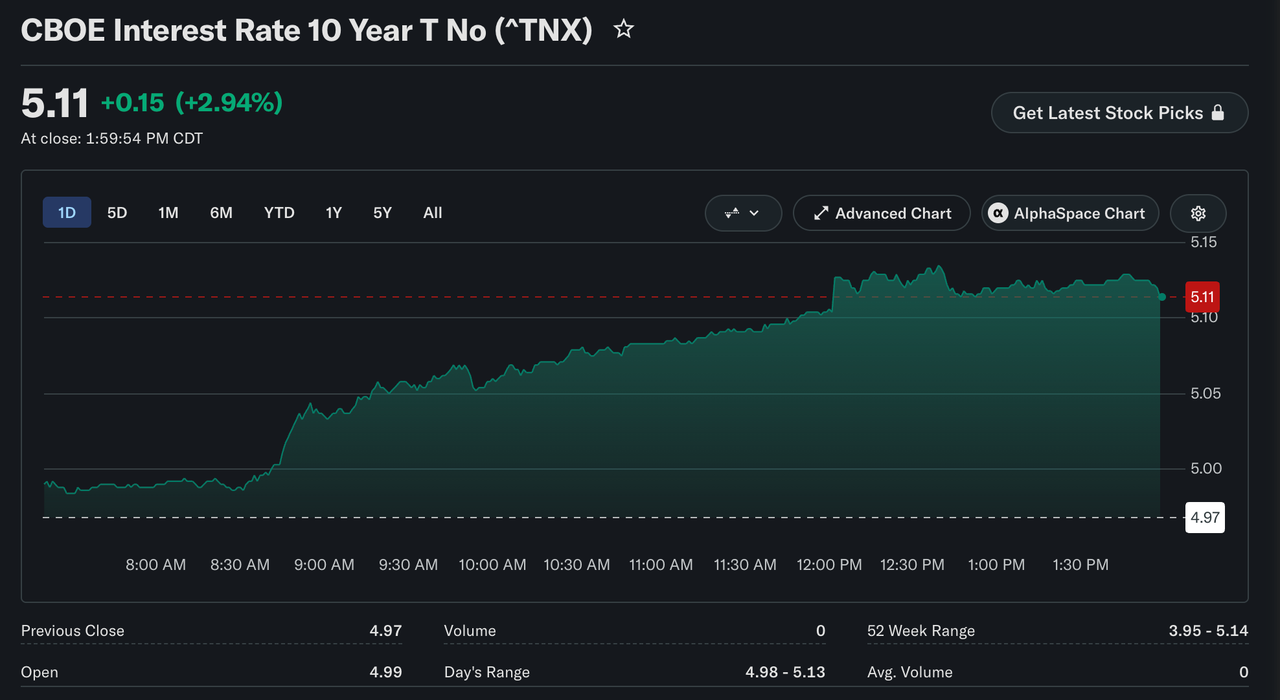
1. Market snapshot: higher rates hit valuations first
Key data:
- 10-year Treasury yield: briefly reached 5.11%, highest since 2007
- 2-year Treasury yield: also moved higher, reflecting stronger near-term hike expectations
- S&P 500: down about 0.75%
- Nasdaq: down about 1.1%
- Oil: back above $100
Growth-stock valuations depend on discounting future cash flows, and that discount rate is tied to long-term yields. Once the 10-year cleared 5%, the market marked down distant earnings more aggressively. High-multiple sectors — especially tech — were first in line.
On the same day, money started rotating out of “story stocks” and into names with contracts and more visible cash flow.
2. Data and positioning: defend against multiple compression first, then look for upside
The next hike is not locked in, and risk-off sentiment can return at any time. The upcoming data prints matter more than guessing the next dot plot.
- Tonight: initial jobless claims, new home sales, and the 7-year Treasury auction
- Next Wednesday: core PCE, the inflation gauge the Fed watches most closely
Around those releases, watch how rate expectations shift before adding or cutting risk.
In this tape, the portfolio question is no longer “what can double again.” It is “if yields keep rising, what is less likely to get its multiple cut first.”
Three ideas:
1) Power and infrastructure: hard demand + contracted cash flow
Data-center power is a core need in the AI cycle. Regulated utilities and nuclear operators have long-term supply contracts and rate pass-through, so they usually hold up better than pure software when rates rise.
- rNEE (NextEra Energy): more of a defensive core holding; utility profile, lower volatility
- rCEG (Constellation Energy): nuclear exposure plus power upside; defensive, with a little optionality
Neither is high-beta growth. Both can act as portfolio stabilizers.
2) Cybersecurity SaaS: stickier budgets + subscription revenue
Enterprise security spend is harder to cut, and subscription revenue is more visible than most application software.
- rPANW (Palo Alto Networks): up 5% last night to $393.30
- rCRWD (CrowdStrike): up nearly 5% last night to $262.49
That same-day strength shows capital already rotating from broad tech into software with steadier cash flow.
Pick one. Don’t double up inside cybersecurity.
3) Rate hedge: TLT as the offset, not a mix-and-match bond trade
- TLT (iShares 20+ Year Treasury Bond ETF): tracks Treasuries with maturities of 20 years or more
When long-end yields keep rising, TLT comes under pressure. If later data softens and hike odds fade, it becomes the most direct hedge against a growth-stock pullback.
Note: TLT is a long-duration bond holding. Don’t mix it with products designed to short bonds.
3. Position sizing: core / upside / hedge
Once the names are set, keep the structure simple: core, upside, hedge. Don’t load all five at once.
| Core | rNEE (add a little rCEG if needed) | Power contracts + utility profile; more resilient if rates keep rising | Larger weight, lower leverage |
| Upside | rPANW or rCRWD (choose one) | Security budgets are stickier; subscription revenue is visible | Medium weight; wait for a pullback |
| Hedge | TLT | Offsets a further long-end yield spike or a growth selloff | Small weight; hedge only |
Two execution notes:
- rPANW and rCRWD already rallied hard last night. Wait for a dip. Don’t chase the close with leverage.
- Around the data, manage risk by cutting size or hedging. That matters more than calling the next dot plot.
Takeaways
- The core issue in U.S. stocks has shifted from “can earnings still grow” to “how are rates being repriced.”
- After the long end cleared 5%, start with what is most exposed to multiple compression: keep contracted, cash-flow-stable names as the core, keep the upside sleeve contained, and use TLT to hedge rate risk.
Trade carefully~
Disclaimer: The content of this article solely reflects the author's opinion and does not represent the platform in any capacity. This article is not intended to serve as a reference for making investment decisions.
You may also like
Altcoin NEAR Approaches Its First Major Weekly Decision Pivot at $4.7, Can NEAR Price Continue to Pump?
Meta: Can Muse Turn AI Into Its Next Profit Engine?
Meta goes all-in on personal Agent: Muse integrates with glasses, Mac, email, connecting shopping and work
Meta announced that Muse will become the strategic core of its all-scenario "personal super intelligence." Muse not only integrates upgraded smart glasses and the portable device Charm, but also expands functionalities such as Mac control and email agent. In addition, it collaborates with retail giants like Walmart to build a shopping ecosystem, aiming to monetize through transaction commissions, demonstrating its ambition to comprehensively cultivate consumer-grade AI.
Global Bond Sell-Off Spreads! Japan 10-Year Government Bond Yield Surges to Highest Level Since 1996
Japan's 10-year government bond yield surged to 3.075%, driven by threefold pressures: US Treasury sell-off, Bank of Japan’s signals towards interest rate hikes, and concerns over fiscal expansion. The yield on 5-year US Treasury bonds breaking above 5% acted as the catalyst, while Japan's plan to raise its defense budget to 3.5% of GDP further intensified market panic. Analysts warn that as the last global anchor of low interest rates begins to shake, yen carry trades face the risk of collapsing, potentially leading to increased market volatility.
Crypto prices
More


