

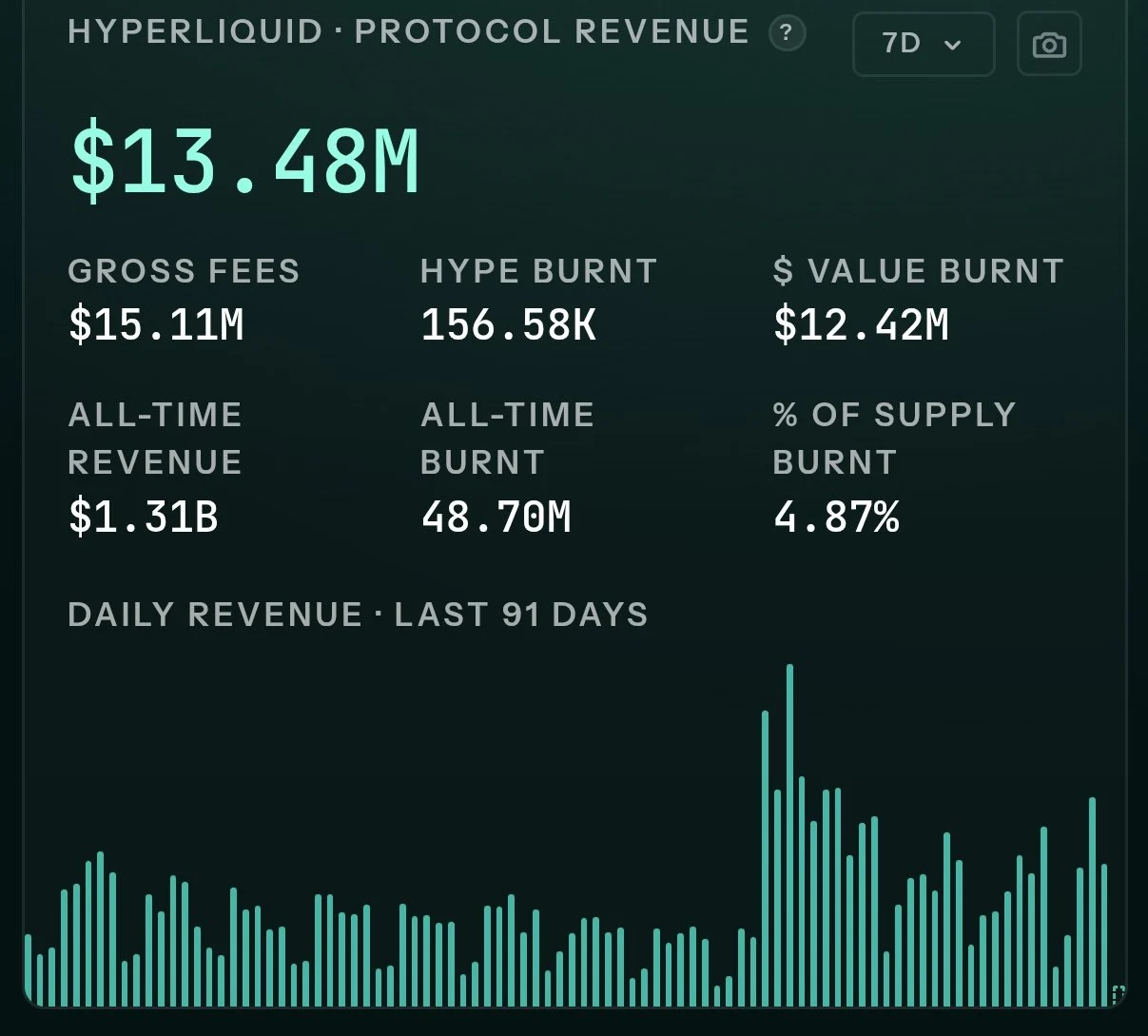
Hyperliquid’s [HYPE] trading volume continues to drive growth in its HYPE burn mechanism, linking network usage directly to supply reduction. Weekly protocol revenue reached $13.48 million, while gross fees stood at $15.11 million.
Part of that revenue was used to remove 156.58K HYPE worth around $12.42 million. The overall trend indicates that there are increasing levels of larger revenue increases occurring over time.
 Source: X
As such, cumulative revenue has now reached $1.31 billion. In addition to that 48.70 million HYPE, or approximately 4.87% of HYPE’s total supply, has been removed.
The two metrics create an inverse relationship and show how users’ desire to utilize Hyperliquid’s trading tools relates to the reduction of available HYPE.
USDC liquidity supports growth
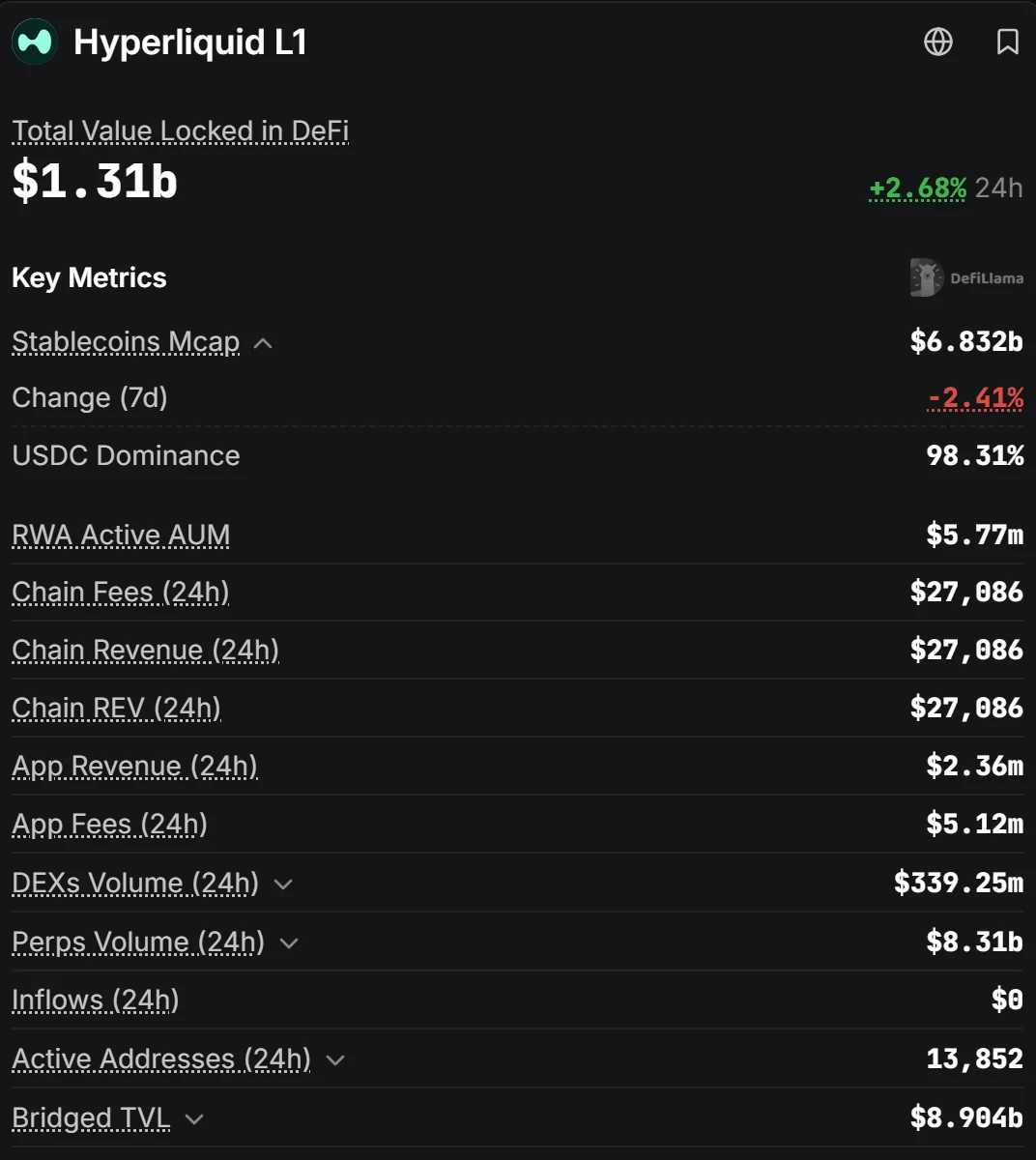
The liquidity picture shows why Hyperliquid can sustain the trading activity behind its fee engine. DeFi TVL has climbed to $1.31 billion, adding 2.68% in 24 hours, while stablecoin liquidity remains much larger at $6.83 billion.
Although that pool fell 2.41% over seven days, USD Coin [USDC] still accounts for 98.31%, keeping trading liquidity concentrated. Traders are putting that capital to work, with $8.31 billion in daily perpetual volume and $339.25 million on DEXs.
 Source: DeFiLlama
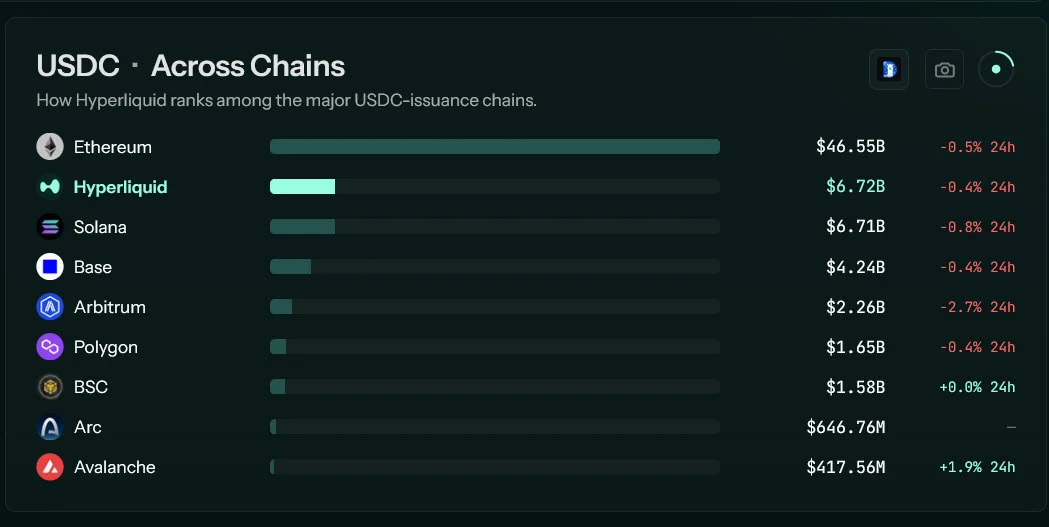
USDC holdings now stand at approximately $6.72 billion, slightly below the $6.71 billion held in Solana accounts. This marked a notable shift in the stablecoin concentration. More importantly, that capital is not simply sitting idle.
The pool generates roughly $200 million in annual yield. In turn, this creates another potential source for HYPE buyback. Meanwhile, Hyperliquid records $8.31 billion in perpetual volume, showing how deeply USDC supports market activity.
 Source: X
Although stablecoin liquidity slipped 2.41% over seven days, USDC still controls 98.31% of the pool. If yield and trading activity remain strong, Hyperliquid can reinforce a cash-flow cycle linking liquidity, revenue, buybacks, and HYPE demand.
This combination gives Hyperliquid capacity to absorb large positions and maintain activity. If liquidity holds, it can support higher volume and, ultimately, stronger fee generation.
Can HYPE sustain its burn pressure?
Liquidity enables Hyperliquid to be operational in terms of sustaining activity with regard to removing tokens from circulation.
Nevertheless, the burn cycle has yet one additional challenge in addition to sustaining trading volume. Fee growth must outpace HYPE’s price appreciation to increase token removals.
Weekly fees remain volatile, ranging between $11 million and $15 million, so burn activity will still be dependent on trading conditions. Additionally, with an increasing price of HYPE, fewer tokens will be able to be removed per dollar of fees collected.
This results in a disparity between the dollar value of burns and the actual reduction of supply within the system. Therefore, simply having stronger fees does not guarantee that the burn rate will improve.
Hyperliquid needs sustained trading growth to increase fee revenue faster than HYPE appreciates.
Ultimately, if that happens, both burn value and token removal can rise. Otherwise, the mechanism could remain active while its impact on supply gradually weakens.
Final Summary
- Hyperliquid continues linking strong trading activity to rising token burns and supply reduction.
- HYPE burn pressure will depend on fee growth staying ahead of token price appreciation.


