
Gold and silver prices rise: oil prices fall ahead of the Federal Reserve decision

Huitong Network, September 17—— During early US trading hours on Wednesday (September 16), spot gold and spot silver prices moved higher. Crude oil prices retreated, US Treasury yields eased slightly, and precious metals rebounded ahead of the Federal Reserve’s rate decision. Spot gold traded around $4352.07 per ounce, up 1.36%; spot silver was at $64.555 per ounce, up 1.41% on the day.
During early US trading hours on Wednesday (September 16), spot gold and spot silver prices climbed. Crude oil prices pulled back, US Treasury yields saw slight relief, allowing precious metals to stage a rebound ahead of the Federal Reserve policy announcement. Spot gold traded around $4352.07 per ounce, gaining 1.36%; spot silver posted $64.555 per ounce, up 1.41% on the day.
The current focus is on the Federal Reserve policy decision at 2 p.m. Eastern Time, Chairman Kevin Walsh's press conference, and the updated dot plot for rate projections. US retail sales for August rose by 1.2% month-on-month, exceeding expectations of 0.7%; the retail sales control group increased 1.4% month-on-month, indicating stronger-than-expected US consumption fundamentals. This data further supports expectations for a 25 basis point rate hike by the Fed, which the market has largely priced in, with the probability of a hike at about 90%-93%.
For gold, bigger risk lies in the rate path after this decision. If this hike is the last in the cycle, some pressure on real yields will be released; but if the Fed signals further tightening, the 10-year Treasury yield could remain near 5%, restricting upside room for these non-yielding precious metals. Before the Federal Reserve announcement, the NAHB Housing Market Index will be released at 10 a.m. ET—the last major economic data ahead of the decision.
The recent gold and silver rally is due to a temporary halt in rising oil prices and Treasury yields, not because rate hike risks have faded. Gold rebounded from the $4283 support level, challenging resistance at $4354; silver regained the $64.40 mark and is testing resistance near $65.28. The future trend of precious metals will depend greatly on Walsh’s remarks.
If the Fed characterizes this expected rate hike as a limited move to address oil-driven inflation, gold and silver may extend their rally. If the updated rate outlook hints at a prolonged tightening cycle, the dollar and Treasury yields may again dominate markets.
The Strait of Hormuz remains the major geopolitical factor impacting oil prices, inflation expectations and safe-haven buying. After US crude inventories rose by 7.1 million barrels, oil prices fell for the first time this week, but overall supply risks have not disappeared. Saudi Arabia’s key East-West pipeline remains shut; Iran-backed Houthi forces in Yemen continue attacking infrastructure and shipping; Iran also continues to target merchant vessels in the Strait of Hormuz. Brent crude trades near $105.20 per barrel, WTI around $102.02 per barrel—still well above pre-conflict levels.
The current gold market environment is full of contradictions: intraday oil price declines have eased short-term inflation pressure, but persistent risks for Gulf shipping mean safe-haven demand for gold still exists.
Major external markets: NYMEX WTI crude oil prices fell, reported around $103.70/barrel; Brent crude around $107.60/barrel. Benchmark 10-year US Treasury yields stay near 5%. The US Dollar Index shows mixed performance, generally remaining strong.
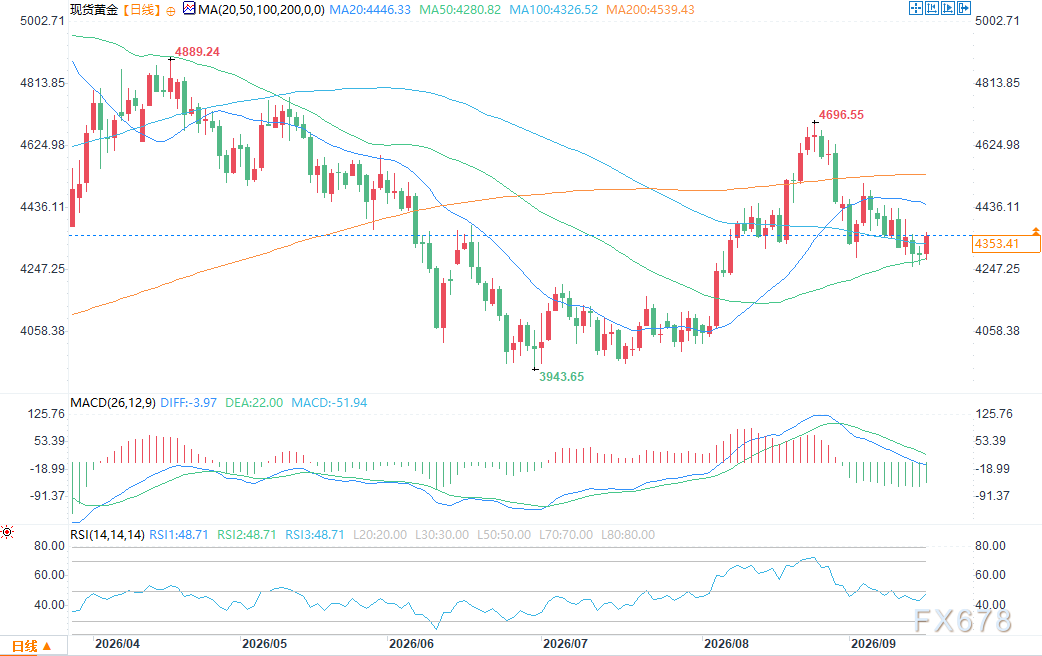
The next target for spot gold bulls is to push gold prices firmly above the $4354.00 resistance; if this is effectively breached, look further towards $4403.00, and above that $4433.00.
The short-term downside target for bears is to push the price below $4316.00; if this level is lost, the subsequent downside targets are $4283.00 and then $4256.00.
First resistance is at $4354.00, followed by $4403.00; first support is at $4316.00, followed by $4283.00.
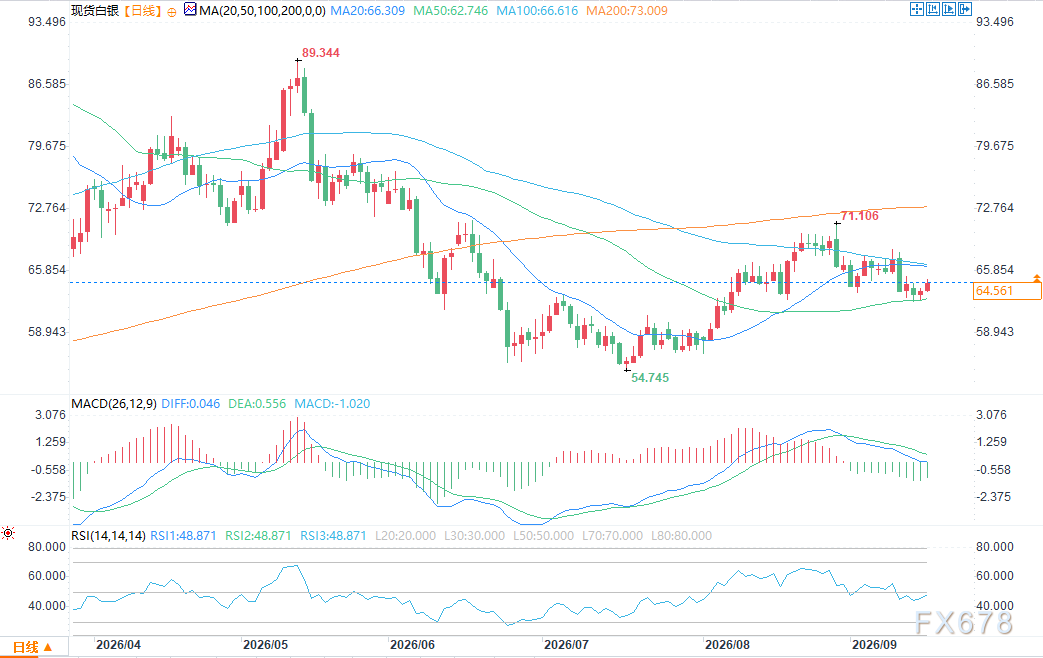
The next bullish target for spot silver is to push prices firmly above $65.28; a breakout would aim for $65.98, with a further target at $66.74.
The bearish target is to break below $64.40; if breached, next watch $63.45, and then $62.57.
First resistance at $65.28, then $65.98; first support at $64.40, then $63.45.
Disclaimer: The content of this article solely reflects the author's opinion and does not represent the platform in any capacity. This article is not intended to serve as a reference for making investment decisions.
You may also like
Nineteen out of twenty, Chair Waller again failed to deliver the Fed dot plot “assignment”
Federal Reserve Chairman Waller has twice refused to enter his interest rate forecasts on the dot plot, bluntly stating that the tool is "of no use for policy implementation." The dot plot, which has been in operation since 2011 and is published four times a year to show officials' interest rate expectations, is an important reference for the market to assess the direction of monetary policy. However, its lack of consensus, anonymity, and the participation of non-voting governors have long been criticized. Previous chairs have had varying attitudes toward the tool, but Waller's stance is the toughest.
NEAR Protocol Chain Signatures connect 30+ blockchains, skip bridges
Overnight US Stock Market | Federal Reserve Raises Interest Rates by 25 Basis Points as Expected, All Three Major Indexes Close Lower, SpaceX (SPCX.US) Rises Over 5%
At market close, the Dow Jones Industrial Average fell by 630.56 points, or 1.21%, to 51,462.55 points; the S&P 500 Index dropped 33.51 points, or 0.44%, to 7,552.22 points; and the Nasdaq Composite Index declined 3.15 points, or 0.01%, to 25,978.42 points.

Overseas investors reduced their holdings of U.S. Treasury bonds by $50.4 billion in July; both Japan and China cut holdings, while the UK increased holdings against the trend
Data released by the U.S. Treasury on Wednesday shows that in July, the amount of U.S. Treasury bonds held by overseas investors significantly decreased, dropping by $50.4 billion from June to $9.25 trillion, marking the lowest level since October last year.

Crypto prices
More


