
The real big trend of the next round of AI is something many people haven't realized yet

In the past two years, I’ve basically tried every major AI update as soon as it came out. Agents, multimodality, round after round of model iteration—to be honest, most of it doesn’t impress me much anymore. The capabilities are improving, but it all just circles around "making content more realistic", with the direction unchanged.
Until this month, when I tried Astra, Atlas, and Cosmos back-to-back, and for the first time, I truly paused.
It's not because what it generates looks better, but because for the first time I felt: AI is crossing another line—from "generating content" to "understanding the world and getting ready to take action".
I’ll cut to the conclusion: the next real wave of value transfer won’t be in the competition over model parameters, but rather—the 3D world is being rewritten as an interface that AI can read, simulate, and operate. If you still interpret this as merely “the demand for 3D content will grow,” you’ll miss the underlying logic shift entirely.
This may sound overly bold. But after working through all three steps, I can’t convince myself it’s just a coincidence.
1/ Astra: The First Collapse Is the Cost Structure
I asked GPT-6 Astra to generate an indoor residential scene. In the past, no matter how good these outputs looked, importing them into modeling software just made them useless paper—structural information was completely lost and couldn’t be used further.
This time was different. It directly produced a structurally complete asset: editable in Blender, ready for real-time roaming once imported into Unreal Engine 5.
Anyone who’s worked in 3D knows how expensive this workflow is—modeling, materials, lighting, rendering, post-processing; each step stitched together manually in professional software, with a low margin for error and high time cost.
Now? Natural language becomes the entry point.
Images and video have already gone through this script—once the cost of tools collapses, demand doesn’t shrink, it’s unleashed. Gaming, E-commerce, Architecture, Advertising, Industrial Design—they’re all queueing up. This isn’t speculation; it’s happening now.
2/ Atlas: From "Making Objects" to "Understanding Space"
If Astra got me to notice things were changing, then Atlas, released in September by World Labs, really made me realize how far this could go.
Think of the difference: to generate a cup, you only care about whether it looks right. To understand a kitchen, a model has to know where cups go, how high the counter is, what direction the hand should reach from, and what should happen in the space in the next moment.
The former is about making objects, the latter is about understanding space. The gap between them isn’t just clarity, but an entire dimension.
World Labs has a phrase I kept rereading: "3D is becoming the universal interface for space."
Text once served as the interface between humans and machines. If the third dimension becomes the medium through which humans and AI jointly generate, edit, and simulate space, then 3D stops being just a design file—it becomes a new computational carrier. This may sound far off, but my hands-on experience convinced me it’s becoming concrete.
3/ Cosmos: From "Can Understand" to "Dare to Act"
By the time I got to NVIDIA’s Cosmos, I was pretty much convinced my previous feelings weren’t an overinterpretation.
Today’s visual models can already answer "what’s in the image" with great accuracy. But with robotics and autonomous driving, the hard part has never been recognition, but rather judging “what will happen next”.
What Cosmos does is let the model first establish an internal simulation system for the world—simulate the outcomes of each action and select the optimal path. It’s like equipping AI with an internal simulator that actually runs.
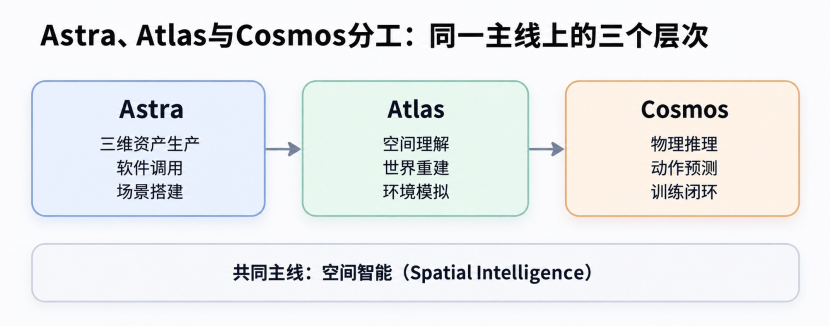
Without this, machines can only sense the present moment; with it, machines finally have the ability to “simulate a step ahead before taking action”. This leap for Physical AI, in my opinion, is no less significant than the breakthrough in reasoning that large language models once achieved.
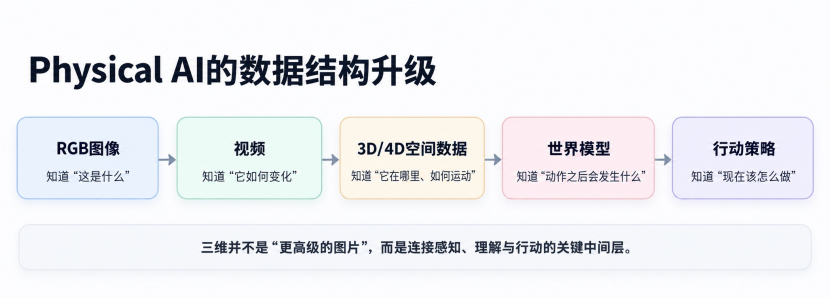
4/ The Real Trump Card: Synthetic Data
Real-world data is just too expensive.
Language models can scrape the web for massive amounts of text, but robots can’t learn to grasp a cup from a webpage; autonomous driving can’t possibly use just real-world testing to cover every extreme scenario. And the most critical training data—extreme weather, sudden accidents, rare road conditions—are, of course, the hardest to obtain.
But once 3D reconstruction and world models mature, the logic flips: you use limited real-world data to build a digital benchmark scene, then systematically alter the weather, positions, object properties, lighting in the virtual environment—basically, you grow millions of training samples from a seed dataset.
So according to US Stock Investment Network analysis, the competitive dimensions of Physical AI are shifting:
In the past the contest was about who could access more real data; moving forward it’s about—real data quality × spatial reconstruction capability × simulation accuracy × synthetic data amplification efficiency.
US Stocks Beneficiary Companies
I ranked them in four tiers by "degree of direct benefit"—the closer to the front, the more certain; the further back, the more elastic but also more concentrated:
Tier 1 · Infrastructure: NVDA
No matter which robotics or autonomous driving company wins, they’ll all need compute, simulation, synthetic data, and training platforms. NVIDIA holds GPU, Omniverse, Isaac, and Cosmos—what it sells is no longer just chips, but the complete foundation for "teaching machines to understand the real world". This is the most winner-independent position.
Tier 2 · 3D Reconstruction & Digital Twins: PTC, ADSK
For reality to become a digital world trainable by AI, someone has to first bridge together industrial-scale 3D, digital twins, and design workflows. They’re the "data entry point" for models to access the real world.
Tier 3 · Spatial Sensing: OUST, MBLY
LIDAR, machine vision—the responsibility here is to convert the physical environment into machine-readable spatial data. Without this layer, everything higher up is a castle in the air. But this is also the most competitive tier, with cost and consistency paramount.
Tier 4 · Terminal Deployment: TSLA, SYM
The ones deploying AI into reality. The most flexible tier, but also with the most concentrated risk: a model might run, but that doesn’t guarantee robots can be delivered at scale; a simulation might work, but that doesn’t ensure smooth migration into reality.
Next, don’t just be wowed by how stunning the demo videos are. Watch for these three things: does simulation actually cut real-world training? Does synthetic data significantly improve model success rates? Are customers willing to keep paying for it?
The last wave of AI revolution turned human knowledge into tokens.
The next wave might turn the entire real world into computable, simulatable, trainable data.
Language let AI understand humans; but only 3D can let AI truly enter our world.
US Stock Investment Network VIP Fully Upgraded





Disclaimer: The content of this article solely reflects the author's opinion and does not represent the platform in any capacity. This article is not intended to serve as a reference for making investment decisions.
You may also like
Metaplanet caps Series 10 option pool at 319 million shares amid Bitcoin treasury shift
Can Illumina Stock Break $220 Resistance To Hit $235 Target?
PEPE trading volume surges above $430 million amid speculation of ETF launch
Cardano supply chain verification anchors 500,000 records for Brazil exporters
Crypto prices
More


