
Patience in the bond market is gradually running out, with the 10-year US Treasury yield approaching the 5% threshold

The yield on the US 10-year Treasury bond is approaching the 5% threshold, with increasing upward pressure on long-term rates and growing market concerns over US fiscal and monetary policy risks.
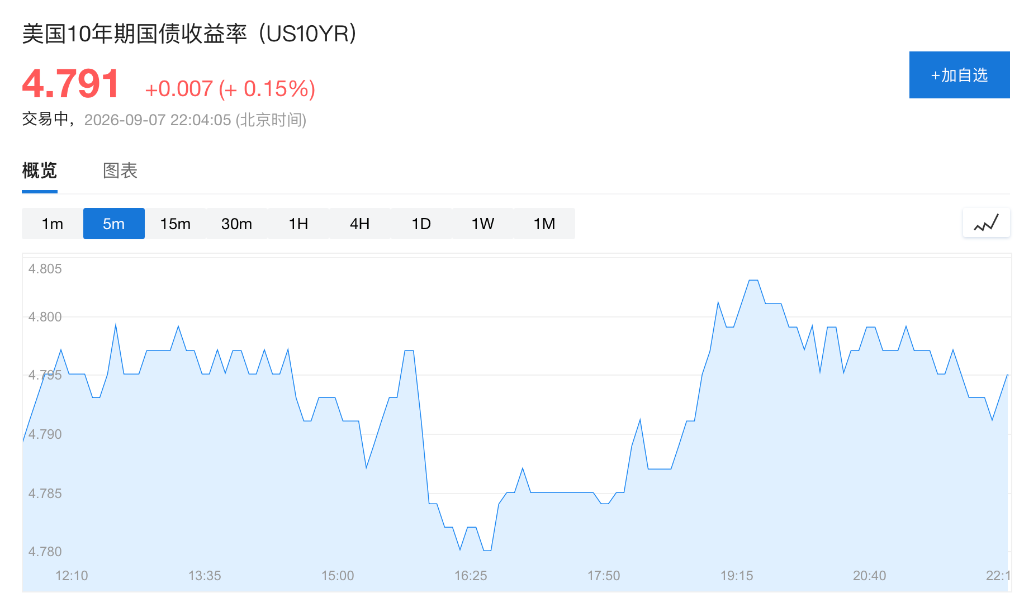
During Monday's session, the 10-year US Treasury yield was reported at 4.791%, up from 4.78% at last Friday’s close. Since the Federal Reserve initiated rate cuts last November while inflation remained high, the 10-year yield has risen about 80 basis points in total. Meanwhile, the 30-year US bond yield has already surpassed 5%, climbing to 5.24% last Friday—marking a near 20-year high.
Treasury Secretary Janet Yellen has made several attempts to push down long-term rates, but with little success.As the supply of US Treasuries continues to increase, the market demands higher yields to attract marginal buyers. Persistently rising long-term rates will further increase government financing costs and put pressure on the valuations of risk assets such as stocks and credit.
In terms of driving factors, the current long-end rates are simultaneously under the triple pressure of sticky inflation, an accommodative monetary policy stance, and expanding fiscal deficits. The real question now is not just whether the 10-year yield can break through the 5% threshold, but whether 5% will become a short-lived local high or a new rate center after such a break.
Triple Pressures Push Up Long-End Rates
The current rise in 10-year US Treasury yields is not driven by a single factor, but is the result of a combined effect of inflation, monetary policy, and fiscal supply.
On one hand, US inflation has not yet truly returned to the 2% target, but the Federal Reserve cut rates consecutively in November and December last year, keeping most financial conditions relatively loose except for real estate.As a result, the market is concerned that if monetary policy remains accommodative, inflation may persist longer, requiring higher yields on long-term bonds to compensate for this risk.
On the other hand, US fiscal policy has not been significantly tightened—with tax cuts and increased spending still ongoing. With an expanding fiscal deficit, the government needs to issue more Treasury bonds for funding.When the new supply continues to rise and market demand cannot fully absorb it, yields must move higher to attract more capital to take up the bonds.
Currently, the 10-year yield is about 115 basis points above the effective federal funds rate.This historically wide term spread already reflects market concerns about long-term inflation, fiscal deficits, and debt sustainability.
5% Is Not Unbearable—The Real Pressure Comes from Debt Size
Historically, a 10-year US Treasury yield at 5% does not mean the US economy cannot bear it.
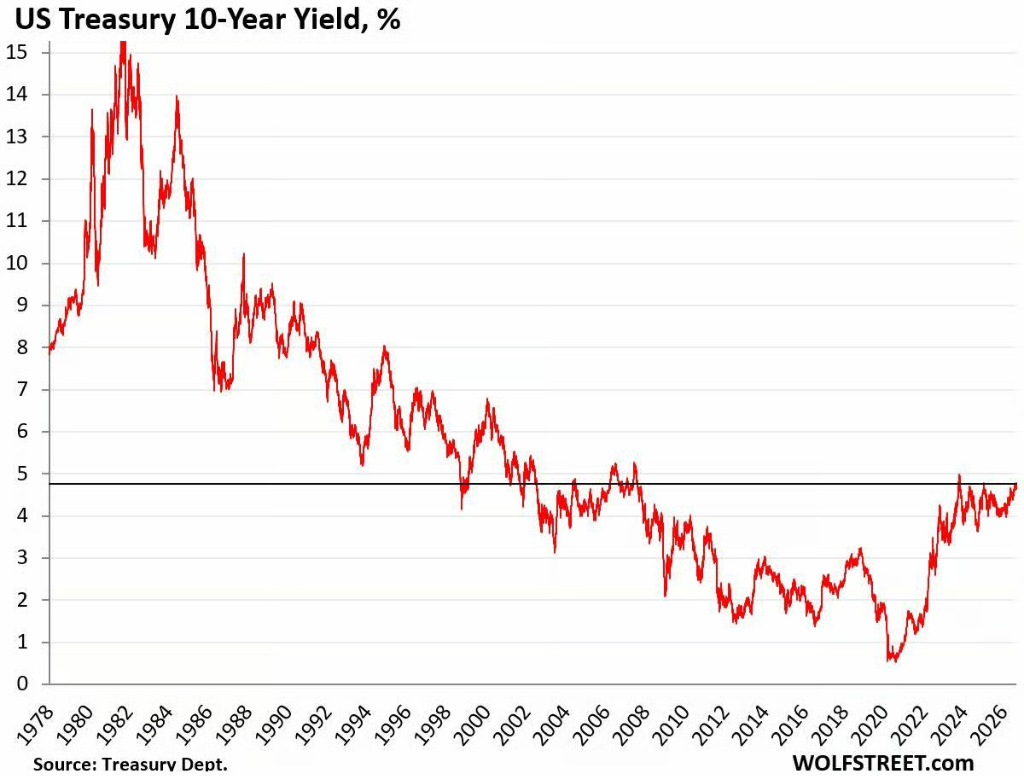
For decades before the introduction of quantitative easing in 2008, the 10-year Treasury yield stayed above 5%, reaching nearly 15% at its peak. During the US dot-com bubble, the yield was mostly between 5% and 8%, yet the US economy remained robustly growing at that time.
What is truly different now is the size of the debt. US Treasury debt outstanding has reached about $40 trillion. Even a slight rise in yields gradually pushes up government interest expenditures through debt refinancing, thereby further escalating fiscal pressure.
Between 2002 and 2006, the 10-year yield briefly fell below 5% as the Federal Reserve lowered policy rates to 1% and held them low for an extended period, fueling a sustained real estate bubble. Only after the 2008 financial crisis, when the Federal Reserve launched quantitative easing, did the 10-year yield fall further below 4%.
Therefore, 5% itself is not an unbearable level for the economy; the real issue is whether the market is still willing to continually absorb the ever-increasing US government debt at rates below 5%, given a $40 trillion debt stock.
Will the “5% Moment” of 2023 Repeat?
The market is currently more concerned about whether, once the 10-year yield breaks through 5%, the dynamics of 2023 will recur.
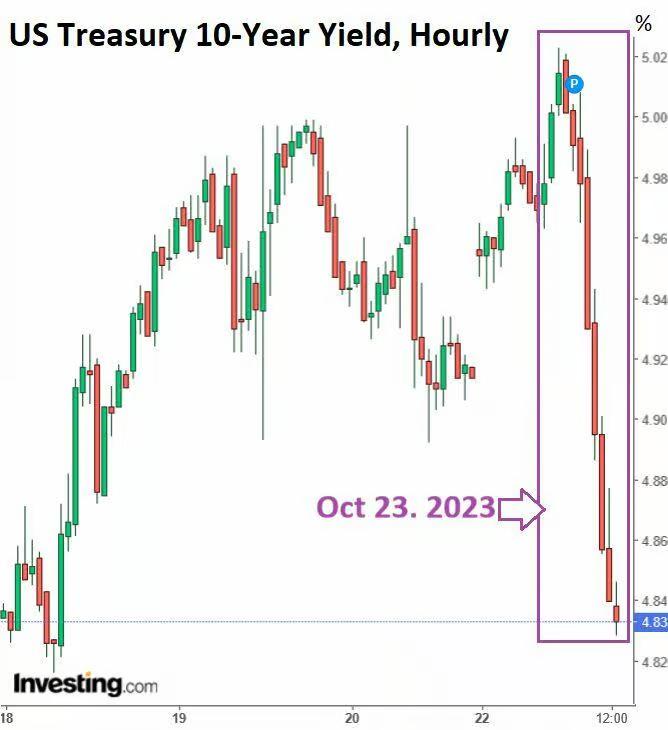
On October 23, 2023, the 10-year yield momentarily climbed above 5%, peaking at 5.02%. But the threshold quickly triggered heavy buying, causing the yield to fall 19 basis points in a single day to 4.83%, with a sustained decline over the following two months.
This time, things may be different.As the yield again approaches 5%, long-term capital may still re-enter the market, temporarily capping the yield; but if the fiscal deficit keeps widening, Treasury supply keeps increasing, and the Federal Reserve maintains a relatively loose policy stance, then 5% may no longer serve as a clear resistance level and could gradually become the new operating center.
The 30-year US Treasury has already sent a similar signal. Its yield reached 5.24% last Friday—a near 20-year high—but did not pull back rapidly after breaching 5%, as it did in October 2023.
Fiscal and Monetary Policy Will Decide Whether 5% Can Hold
Whether the 10-year US Treasury yield can hold around 5% ultimately depends on changes to US fiscal and monetary policy.
On the fiscal front, if tax cuts and increased spending continue, deficits and Treasury supply will be hard to reduce in the short term; on the monetary front, if the Federal Reserve continues signaling easing while inflation remains uncontrolled, market confidence in its inflation management may be undermined, requiring higher yields on long-term bonds to attract capital.
More importantly, expanding fiscal deficits mean increased bond supply, while relatively easy monetary policy may strengthen market concerns about long-term inflation—together pushing up the term premium; the massive debt stock will further amplify the fiscal shock from rising rates.
Therefore, unless there are fundamental changes in the fiscal deficit, debt size, or inflation risks, the rise in the 10-year Treasury yield to 5% or even higher levels may not be a one-off market shock, but part of the process of repricing the US long-term rate center.
Disclaimer: The content of this article solely reflects the author's opinion and does not represent the platform in any capacity. This article is not intended to serve as a reference for making investment decisions.
You may also like
What the Crypto CLARITY Act Means for Traders If It Passes the Senate
Top 3 Altcoins to Accumulate in September if Crypto Recovery Holds
Solana to raise maximum transaction size to 4,096 bytes this week
Satoshi-Era Bitcoin Wallet Moves 600 BTC After 16 Years
Crypto prices
More


