
Federal Reserve Report: Gold Has Not

Huitong Network, Sept 4th—— Directly comparing the global total market value of gold reserves with foreign official holdings of US Treasuries may mislead us about the actual positions of gold and US Treasuries in international reserve portfolios. This comparison mainly results from valuation effects of the gold price and the legacy gold stockpiles of a few countries. The brief overtaking of US Treasuries by the market value of gold reserves in 2025 is a book effect driven by private market increases in gold prices, not a reflection of central banks actively reallocating or abandoning US Treasuries.
Many media outlets and policy researchers, upon seeing a set of book value data, have reached the following conclusion: in 2025, the global market value of gold reserves will surpass the scale of US Treasuries officially held by countries, and gold has already replaced US Treasuries as the world’s most popular reserve asset. However, the research report published by the Federal Reserve in September 2026 points out that this judgment is inaccurate. There are obvious flaws in directly comparing the two original data sets, which do not accurately reflect the actual allocation preferences of central banks in reserve assets. By following the report’s data and facts, we can clarify the full picture.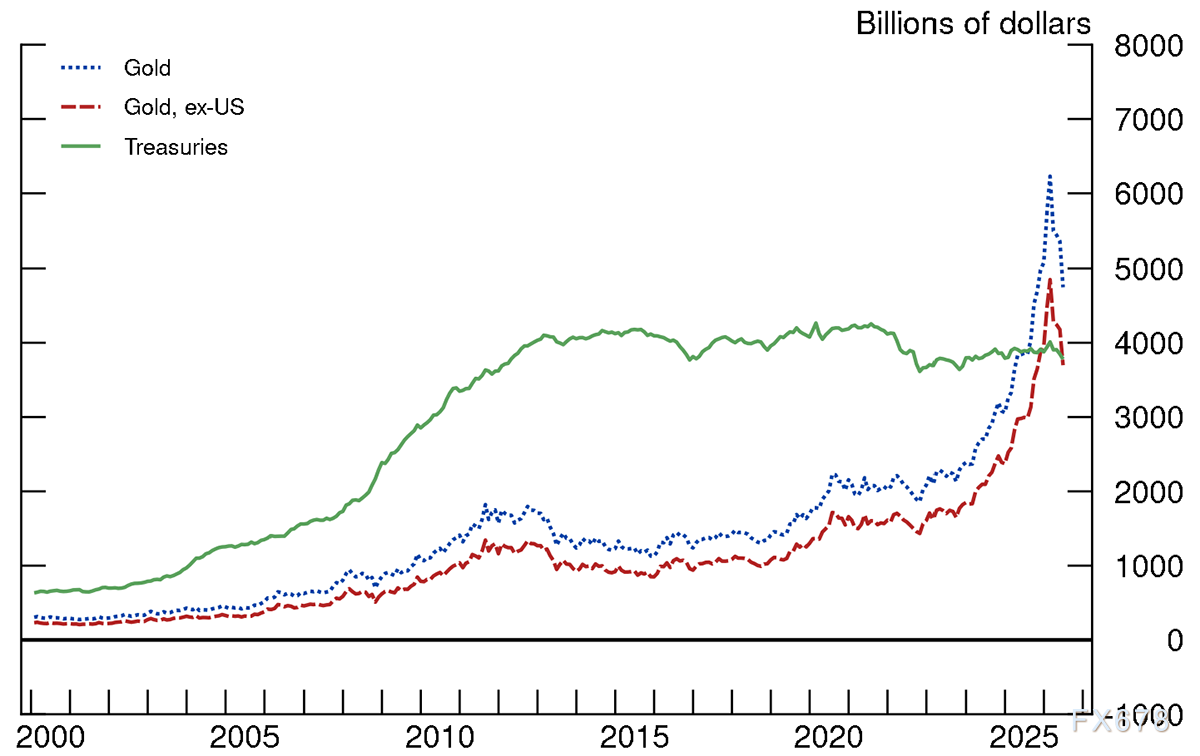
(Figure 1. Global Gold Reserves vs. Foreign Official Holdings of US Treasuries, data as of June 2026.)
After 2024, the global market value of gold reserves climbed rapidly, with the core driving force coming from surging private sector demand that pushed gold prices higher; central bank gold purchasing was not the main cause of this price spike. In terms of actual trading, central banks did indeed increase gold purchases significantly in 2022, but afterward the purchase volume stabilized at this high level and did not continue to rise. The true explosive growth came from the burst of private investor demand for gold at the end of 2024, with substantial amounts flowing into physical gold ETFs, directly boosting gold prices. In other words, the major surge in gold prices in 2025 is a result of combined demand from both private investors and central banks; if it relied on central banks alone, gold prices would not have reached current high levels.
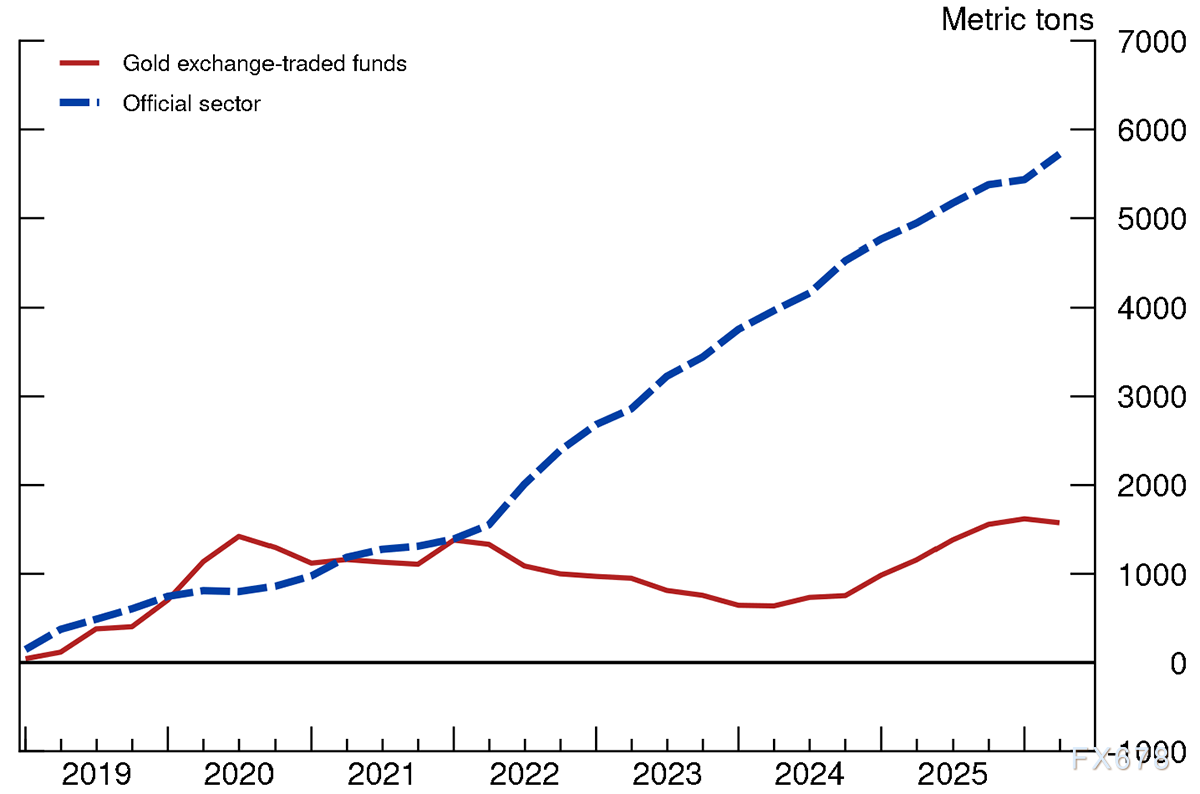
(Figure 2. Cumulative Gold Purchases, data as of Q2 2026.)
The inconsistent statistical standards between the two sets of data are the most fundamental reason for the “gold overtaking Treasuries” illusion. Foreign official US Treasury holdings only count foreign official institutions, excluding both the Federal Reserve and US domestic positions. However, global gold reserve statistics do include gold held by the US government –– and the US is the world’s largest holder of gold reserves, accounting for 22% of the global total. This massive stockpile inflates the total market value of global gold reserves and exaggerates gold’s presence among cross-border reserve assets. For most of 2025, if US gold is excluded, the total market value of global reserves immediately falls by $800–$1,100 billion. Raw book value data at the end of 2025 shows that including the US, global gold reserves totaled $5.1 trillion; excluding US holdings, the figure was $4 trillion. Both amounts were higher than the $3.9 trillion in US Treasuries held by foreign officials at that time. But this “surpassing” is essentially due to changes in gold valuation, not to persistently large additions to official gold reserves by central banks over the previous 18 months. By June 2026, even though the number of physical gold ounces was growing slightly, global gold reserves (measured in US dollars and excluding US gold) were once again overtaken by foreign official holdings of US Treasuries.
A large portion of the world’s gold reserves are historical stockpiles dating back to the Bretton Woods system era and are qualitatively different from recently accumulated reserve assets. While a number of emerging market central banks have consistently bought gold since 2008, the overwhelming majority of global gold reserves were accumulated before the practical end of the Bretton Woods system in 1971. In contrast, most foreign official US Treasury holdings have been acquired since 2000. Furthermore, the group of large gold reserve holders is not the same as the group of large foreign exchange reserve holders. At present, the countries actively balancing between gold and Treasuries only account for a tiny fraction of global gold stocks. The top five gold reserve holders — the US, Germany, Italy, France, and the IMF — together hold 52% of the world’s gold reserves. Since the 1970s, these five institutions have almost never made significant additional gold purchases. At the same time, the US, Germany, France, and Italy themselves have not amassed large foreign exchange reserves; at current prices, gold already makes up more than 80% of their international reserves. If we exclude these five entities and observe the reserve structures of the remaining countries, US Treasuries remain clearly larger than gold in reserve portfolios.
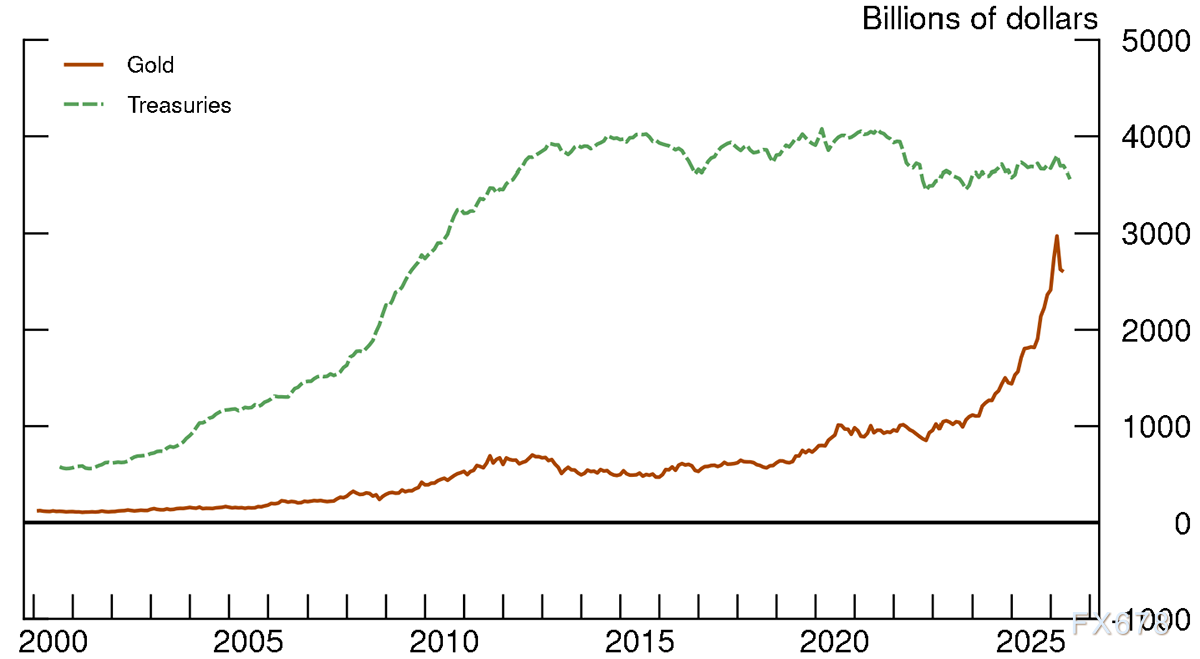
(Figure 3. Adjusted Global Gold Reserves and Foreign Holdings of US Treasuries, excluding the US, Germany, France, Italy, and the IMF)
As of June 2026, after removing the entities above, the size of foreign official holdings of US Treasuries was about $1 trillion higher than the value of gold reserves. However, this figure has some margin for error and may either overstate or understate the difference. On one hand, the IMF has not comprehensively recorded all official gold purchases after 2021. The World Gold Council’s estimates of official gold buying are significantly higher than the IMF’s reported increase in global gold reserves, meaning some official gold buys have not been reported. On the other hand, some foreign official investors store Treasuries with custodians outside the US, so the real level of foreign official US Treasury holdings is likely higher than US TIC data indicate. Even if we include all unreported official gold purchases estimated by the World Gold Council since 2022, excluding the US, Germany, France, Italy, and the IMF, foreign official holdings of Treasuries are still roughly $60 billion higher than official gold holdings. There is no “gold has replaced Treasuries” phenomenon; rather, for the vast majority of countries, US Treasuries remain the core reserve asset.
Central Banks Are Gradually Increasing Gold Allocations, But Never Abandoning US Treasuries
The report also does not deny the trend of official institutions continuously increasing gold allocations: since 2008, global official sectors have been net buyers of gold, with the pace accelerating notably after 2022. Part of these purchases are for reasons related to geopolitical considerations, such as financial sanctions and international relations, serving to diversify reserve risks. Yet even after 2021, when several major foreign exchange reserve holders sold off hundreds of billions of dollars in reserves to stabilize their own currencies, foreign official investors still made net purchases of nearly $200 billion in US Treasuries from 2022 to April 2026, fully demonstrating that US Treasuries remain a very core asset in reserve portfolios worldwide.
Direct comparison of the global total market value of gold reserves with foreign official holdings of US Treasuries may mislead us about the true status of gold and Treasuries in reserve portfolios. To a large extent, the comparison is distorted by gold price valuation effects and old legacy stocks held by a few countries. The temporary overtaking of Treasuries by the market value of gold reserves in 2025 is a book value effect triggered by the private market’s push of gold prices, not by central banks proactively reallocating or dumping US Treasuries. The world’s established gold-rich countries have not added much gold for decades, while emerging countries still use US Treasuries as the core reserves, with gold serving mainly as a risk-diversification supplement. Central banks are indeed steadily increasing allocations to gold and diversifying risks, but US Treasuries remain the backbone of the global reserve system, and have not been replaced.
Global gold reserve data comes from the IMF International Financial Statistics, while foreign official US Treasury holdings are based on the US Treasury Department’s TIC International Capital statistics. For the estimate of foreign official US Treasury holdings excluding the five major gold holders, the method was to first subtract the securities-type foreign exchange reserves of France, Germany, and Italy (from the IMF’s International Reserves and Foreign Currency Liquidity database) from the total foreign official US Treasury holdings, and then subtract the Treasuries held by various international and regional organizations (from TIC data). This estimation can be viewed as the lower bound for foreign official US Treasury holdings after excluding the US, Germany, France, Italy, and the IMF. In addition, sovereign wealth funds and similar official investors are not required to report their gold holdings as part of national official reserves but also invest in gold. This is another reason why official statistics may underestimate actual official gold purchases.
Disclaimer: The content of this article solely reflects the author's opinion and does not represent the platform in any capacity. This article is not intended to serve as a reference for making investment decisions.
You may also like
Ripple co-founder Chris Larsen says XRP was engineered as a better Bitcoin
Federal Reserve now expected to raise interest rates by 25 bps after jobs surge
U.S. Treasury sanctions Turkish bank targeting Iran’s oil cash-out covert channels, Bensent hints at further action next week, experts call it just “marginal pressure”
The U.S. Treasury Department has accused Turkish investment bank Golden Global of acting as a key intermediary in Iran's shadow banking network, assisting in transferring Iranian oil revenue to Turkey and exchanging it for cash and gold. As a result, the bank has been placed on the "blacklist," effectively severing its ties to the U.S. dollar financial system. Sanctions experts have warned that this move may provoke retaliation from Iran.
Uneven Investor Sentiment Toward Hardline Retailers Could Persist Amid Macro Headwinds, UBS Says
Crypto prices
More


