
Institutions Say: It’s Time to Return to the Gold Market, Long-Term Bullish Foundations Remain Intact

Huitong News, September 4—— Gold prices are surging towards the key resistance of $4,500, with Société Générale backing a return to the market at this time. The bank points out that the market has already priced in the Federal Reserve’s hawkish expectations. Combined with central bank gold purchasing, de-dollarization, and inflation concerns, gold prices have a solid bottom. Despite facing headwinds from interest rates and the US dollar, structural support and a rebound in demand are significantly optimizing the risk-reward ratio for gold, highlighting its value for strategic allocation and consolidating the foundation for a long-term bull market.
Recently, the gold market has demonstrated strong resilience, as gold prices approach the key initial resistance of $4,500 per ounce once again.
After months of deep correction, Société Générale, a heavyweight international investment bank, has keenly captured the shift in market sentiment and firmly believes that now is an excellent time for investors to reposition. The bank points out that, although gold still faces dual pressure from interest rates and the dollar, market risk appetite is being reshaped, and gold, as a core asset for hedging uncertainty, is once again highlighting its value in strategic allocation.
Imminent Breakout of Resistance, Clear Signals of Warming Market Sentiment
Analysts at Société Générale mention in their latest market report that after a reduction in holdings during the first half of the year, gold’s investment appeal as a precious metal is making a strong comeback. Analysts note that after a sharp correction triggered by the Israel-US-Iran conflict and the rise of expectations for Fed rate hikes, gold prices have rebounded rapidly and are approaching the $4,500/oz threshold.
Meanwhile, positive signals are being released from the market’s microstructure: volatility has returned to normal, speculative positioning has recovered above the two-year average, and the put/call ratio of the world's largest gold ETF, GLD, has dropped to a six-month low. Analysts emphasize that this series of indicators
Pressure Fully Released, Risk-Reward Ratio Significantly Improved
Although the gold market continues to face the ongoing suppression from high interest rates and a strong US dollar, Société Générale believes that the financial markets have largely priced in most of the Fed’s hawkish policy reassessment. This means the risk-reward profile for gold has fundamentally improved, presenting a more favorable allocation pattern.
The bank’s analysts further point out that since 2022, the logic of the gold market has undergone profound changes. Even in the context of persistently positive real yields, gold prices have remained near historical highs, completely breaking free from the shackles of traditional pricing models. Analysts believe that continued central bank gold purchases, the wave of de-dollarization, geopolitical uncertainties, and concerns over sovereign debt as structural factors have jointly built an unbreakable bottom for gold prices, greatly weakening the negative impact of high real yields and effectively capping the downside risk for gold.
Limited Rate Hike Expectations, Inflation Risks as a Solid Backing for Gold
The market’s expectations for the Fed’s rate hike path are undergoing subtle changes. Société Générale points out that since mid-last year, market pricing logic has shifted from expecting additional monetary easing to debating whether the Fed will raise rates one or two more times. This shift has pushed up short-term US Treasury yields and supported the dollar, but has not toppled gold prices; in fact, it has highlighted gold’s resilience.
Analysts state that triggering another major re-pricing in the rates market would require a much larger inflation shock and more aggressive measures from the Fed. For now, the market has essentially completed a hawkish adjustment, and the downside risk for gold has become increasingly limited. In addition, the bank’s economists expect that in the baseline scenario, interest rates will remain unchanged until 2027. Even if persistent inflation forces the Fed to hike once this year, it will hardly undermine gold’s strategic role.
More importantly, the new round of US tariff policies, the acceleration of investment in artificial intelligence and infrastructure, energy price fluctuations, and the large fiscal deficits of developed economies are all brewing an inflation environment more severe than the market anticipates. Analysts believe that inflation risk is still underestimated, which is precisely the core reason investors should maintain strategic exposure to gold.
Demand Structure Reshaped, Central Bank Gold Purchases Form the Market Foundation
In addition to improvements in the macro environment, gold’s underlying demand structure is also undergoing qualitative changes, providing lasting support for gold prices. Although gold ETF inflows have slowed somewhat this year, net inflows remain. More importantly, the decrease in market volatility is making gold more attractive to long-term reserve managers, rather than being confined only to short-term trend traders. This shift is expected to build a more stable and lasting foundation for the market.
At the official reserves level, major Asian countries are steadily increasing their gold holdings, and many emerging market central banks have made diversifying reserves and reducing reliance on traditional assets a long-term structural priority. Analysts point out that as speculative demand gradually recedes, official sector purchasing power is increasingly becoming the anchor of stability for the gold market. Continuous, strong central bank gold purchases not only provide firm bottom support to prices, but are also historically validated as important buy signals, signaling the arrival of a market upcycle led by official sector demand.
Conclusion
In summary, Société Générale’s optimistic outlook on gold is not based on short-term speculative sentiment, but on deep insights into structural changes in the market. Against a backdrop of limited Fed rate hike expectations, underestimated inflation risks, and continuous strong demand for gold purchases by central banks, gold is gradually shaking off traditional negative factors and showing strong asset resilience. As the risk-reward ratio continues to be optimized and bottom support is reinforced, gold has not only successfully withstood short-term volatility, but is also likely to continue to serve as a core ballast in asset allocation amid rising macro uncertainties, ushering in a new round of steady upward movement.
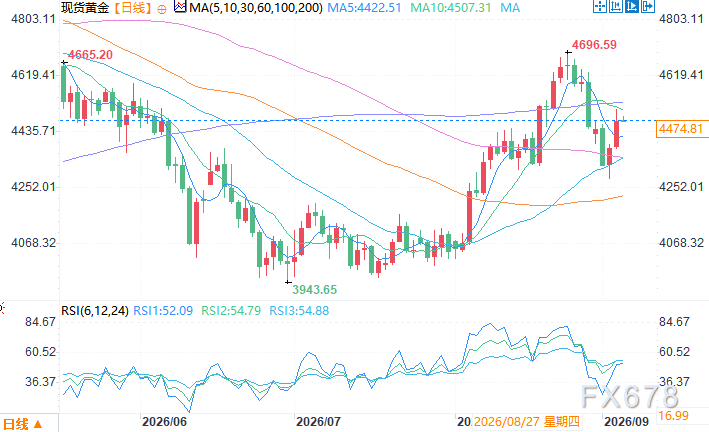
Spot gold daily chart Source: EasyForex
GMT+8, September 4, 13:25 Spot gold quoted at $4,470.81/oz
Disclaimer: The content of this article solely reflects the author's opinion and does not represent the platform in any capacity. This article is not intended to serve as a reference for making investment decisions.
You may also like
Gold crosses a historic milestone, Fed says 'Yeah, but...'
PEPE surges 13%, targets $0.00000431 as whale activity and ETF speculation rise
Nonfarm Payrolls “Scare Off” US Stock Market, But AI Hardware Soars Against the Trend! Semiconductor Index Jumps Over 3%, SanDisk Surges 12%
The prospect of a Federal Reserve interest rate hike is suppressing overall valuations and some software growth stocks, but the industrial logic behind the demand for AI computing power, storage, and data center interconnectivity has not yet been affected by rate expectations. Storage chip stock SK Hynix closed up over 8%, while optical communication stock Coherent rose 6.6%. According to market participants, the strong performance of chip stocks on Friday had "zero correlation" with the nonfarm payroll data and was mainly due to the ongoing rotation between semiconductor and software stocks.
Crypto prices
More


