
Beige Book shows the US economy is relying on AI infrastructure to survive; can the interest rate hike paradox boost gold prices?

Huitong Network, September 3—— Employment and inflation tightly bound with AI, rate hike probability slightly falls, closely watching tomorrow's Nonfarm Payrolls data.
On September 2, 2026, the Federal Reserve released the latest Beige Book, summarizing frontline economic research data from all 12 regional Feds in the U.S. as of August 24, and providing a panoramic view of the U.S. economy's core features: "weak recovery, strong segmentation, and tight binding with AI."
The report comes just before the Fed's September 15-16 policy meeting, and, combined with earlier hawkish remarks by Fed Chair Walsh at the Jackson Hole Symposium, clearly reveals the real background of current U.S. growth, inflation, and employment, while highlighting the dual reshaping effect of the AI data center infrastructure boom on the U.S. macroeconomy, which brings many contradictions with the current hawkish market expectations.
Meanwhile, facing domestic U.S. inflation, Bessent called on other countries' central banks to actively raise interest rates, absorbing excess liquidity from the market, suppressing global inflation, and at the same time stabilizing various domestic currencies such as Japan's to prevent mass dumping of U.S. Treasuries by other countries in response to currency depreciation.
Overall Economy: Modest expansion nationwide, growth highly dependent on AI computing power infrastructure
The Beige Book data show that as of late August, overall U.S. economic activity achieved only a slight uptick, with growth in most traditional sectors continuing to slow and overall recovery momentum remaining weak.
In sharp contrast to the sluggishness of traditional industries, data center and AI infrastructure investments led by tech giants such as Amazon and Microsoft have become the core pillars supporting overall U.S. demand and underpinning the manufacturing and construction sectors, fully elevating from a single tech sector trend to a core variable shaping the trajectory of the entire U.S. macroeconomy.
The structural dependence of current U.S. economic growth is extremely pronounced, with significant regional and sectoral segmentation.
In districts like Cleveland, overall end-user demand remains weak, but thanks to the order windfall from data center construction, local manufacturing is thriving against the trend; Minneapolis and other regions have also seen revival in employment and industry demand driven by AI infrastructure projects.
Conversely, stripping out data center-related investments, economic growth has sharply slowed in several regions. Non-residential construction has notably cooled in the St. Louis district, and the Chicago Fed bluntly stated: without data centers, U.S. construction would fall into recession.
This phenomenon means the resilience of the U.S. real economy’s recovery is highly tied to global tech giants’ computing power capital expenditure, with a singular and vulnerable growth structure.
From a long-term investment perspective, this wave of AI infrastructure is unprecedented in scale. PwC forecasts that from 2026 to 2050, global AI infrastructure capital expenditures will total $31.6 trillion, with annual data center investment rising from $800 billion in 2026 to $1.8 trillion in 2050.
Of this, the U.S. will account for $15.1 trillion in investment, with the Asia-Pacific region close behind at $8.2 trillion. According to further analysis by Morgan Stanley, global data center construction costs for 2026-2028 will reach $2.9 trillion, with AI-related investment in 2026 alone contributing 25% of U.S. GDP growth, making it the primary growth engine of the U.S. economy. At the same time, capital expenditures by tech giants are expected to continue expanding, rising from $805 billion in 2026 to $1.1 trillion in 2027, providing ongoing economic support.
Inflation Structure: Prices rise nationwide, multiple pressures lift expectations for policy tightening
This Beige Book underscores Fed Chair Walsh’s core judgment: the main risk to the current U.S. economy is inflation rather than unemployment, and fighting inflation has become the Fed’s top policy priority.
Data show that prices are rising across all 12 Federal Reserve districts, with most districts showing moderate inflation, some showing significant inflation, and inflationary pressure spreading nationwide.
The core drivers of inflation are clear and persistent, mainly across three dimensions. First, ongoing geopolitical conflicts continue to disturb energy prices, with persistent instability in Iran exacerbating global energy supply uncertainty, pushing up U.S. fuel and electricity costs to become the main cost pressure for businesses and households.
Second, tariffs, raw material, and logistics costs continue to climb, directly squeezing the profits of manufacturing and construction, with import price pressure especially prominent in metals, petrochemicals, and transportation sectors.
Third, insurance and medical service costs are rising rigidly, generating persistent service-sector inflationary pressure and further anchoring sticky inflation.
Notably, current inflation transmission shows differentiated features—most businesses are facing cost pressure increases, but end-market consumption price sensitivity has risen sharply. Many firms choose to compress profit margins and postpone price hikes to avoid losing customers, meaning inflationary pressure is temporarily hidden upstream in production, with upside risk for future prices remaining.
At the same time, the data center infrastructure boom further intensifies inflationary contradictions: large-scale computing power construction is continuously competing for electricity, industrial raw materials, equipment, and capital, driving up input costs for the construction and manufacturing sectors and becoming an important source of new inflationary pressure.
Labor Market: Overall resilience and stability, structural shortages and differentiation coexist
Compared to high inflationary pressure, the U.S. job market remains overall robust, with no large-scale unemployment recession, serving as a stable foundation for the economy.
Surveys show that in seven Federal Reserve districts, employment achieved modest growth, with employment levels steady in the other five districts, and overall a marginal increase in jobs, pushing the market into a pattern of "low hiring, low layoffs."
However, there is significant structural segmentation within the labor market, both by sector and region.
On one hand, in districts like Richmond where data centers are concentrated, skilled labor in construction and high-end manufacturing is in extreme short supply, and the AI infrastructure boom is continuously siphoning top talent, leading companies to raise salaries sharply. For instance, a construction company in Maryland hiked wages by 35% to combat worker shortages.
In manufacturing and AI infrastructure-related services, labor demand is strong and wages are steadily rising.
On the other hand, higher education continues to lay off employees and some universities have hiring freezes, with employment stagnating in finance and healthcare, and job opportunities contracting in regions such as Minneapolis.
Looking at job structure, the AI industry’s dual impact on labor is becoming increasingly evident: it creates large numbers of infrastructure and tech support roles but also substitutes for traditional jobs.
The employment environment for new college graduates is slightly better than last year, but job supply is still far below demand, so youth employment pressure remains.
Overall, over the next six months, companies are cautiously optimistic about their hiring outlook, with the labor market expected to remain stable but somewhat tight.
Consumption and Industries: K-shaped differentiation intensifies, economic uncertainty continues to rise
The U.S. consumption market is growing slightly overall, but structural cracks are widening, presenting a typical K-shaped divergence pattern.
High-end consumption remains resilient, with luxury goods and premium services popular in districts like New York;
However, as oil prices and energy expenditure increase, middle- and low-income groups are seeing reduced disposable income, resulting in "consumption downgrading and prioritization of cost-effectiveness," with consumers in Atlanta, Chicago, New York, and other districts choosing to abandon high-end goods and shift toward affordable products and services.
Regional differences in consumption are also notable: Boston saw a summer boom in dining and retail thanks to the World Cup and festive events in July and August, while at Cape Cod, high temperatures and rising accommodation costs led to a slight dip in spending. Cleveland, Richmond, and St. Louis all experienced overall consumption declines.
Businesses are generally concerned that continued Middle East geopolitical tensions and higher energy costs during the winter heating season will further squeeze residents' consumption power.
On the industry side, manufacturing has seen a mild rebound overall, with data center and defense-related orders forming the core support. However, some end-user consumer sectors are soft, and tariff uncertainty is dampening expansion willingness for some companies. Non-financial service revenue grew slightly, with professional services performing well, but higher education continues to shrink.
Bank credit expanded modestly, with differentiated loan demand, while lending standards remained stable overall with some tightening. Financial institutions are generally worried about the impact of inflation, high interest rates, and tariffs on borrowing by households and companies.
With multiple factors in play, market rate hike expectations continue to warm. According to CME FedWatch data, the probability of a Fed rate hike at the September meeting has slightly fallen to 60.2%, while the probability of holding rates steady has risen to 40%.
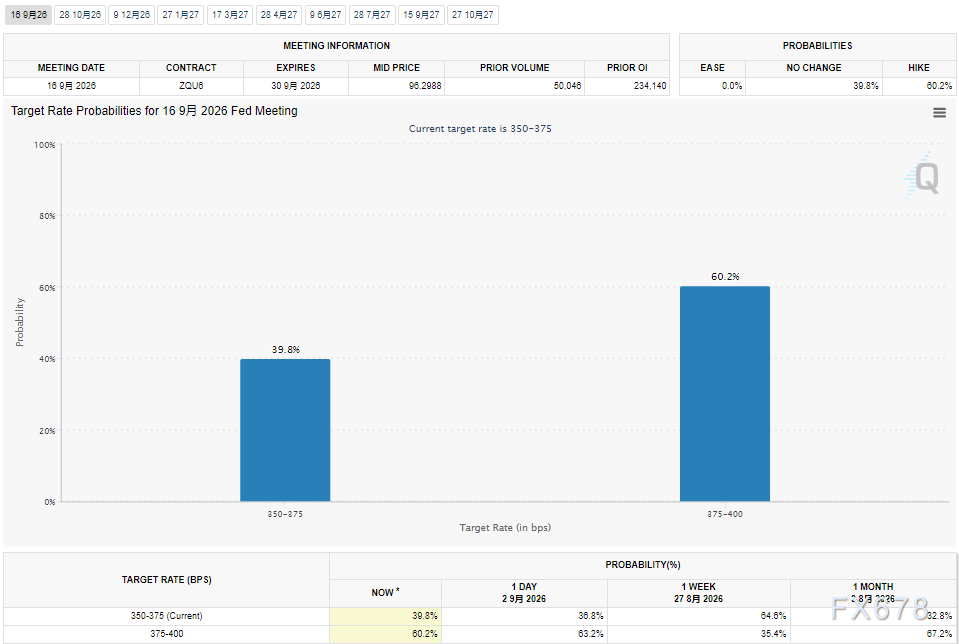
(FedWatch Interest Rate Futures, Source: CME Group)
Core Summary: AI Infrastructure as a double-edged sword, rate decisions affect U.S. and global growth
This Beige Book fully outlines the complex state of the U.S. economy: traditional drivers are weak and recovery is sluggish, with manufacturing and construction propped up solely by AI data center infrastructure, supporting the basic overall growth.
However, the computing power investment boom is not an unqualified positive; it actually intensifies supply and demand tensions for energy, labor, capital, and raw materials, further increasing inflationary stickiness and forming a dual effect where "growth depends on AI, inflation stems from AI."
Currently, Fed policy is in a key balancing period: a rate hike in September would be a blunt tool to suppress total demand, but is largely ineffective against supply-side or structural inflation driven by technological revolution.
Rate hikes can’t stop big tech buying chips or fix shipping bottlenecks in the Strait of Hormuz, but will raise financing costs throughout the AI supply chain, ultimately leading to a scenario where "tech giants grit their teeth and continue spending, while traditional industries and leveraged infrastructure get hurt by higher rates," making it harder for small and midsize businesses to raise capital. In the end, inflation won’t be tamed, but traditional industries might collapse first.
Therefore, considering Bessent’s recent calls for global rate hikes, the U.S. may ultimately refrain from raising rates. We are closely watching subsequent Nonfarm Payrolls and CPI data, which will have a significant impact on gold and other markets, since these data essentially reflect Fed policy direction. If Fed rate hike expectations are weakened again, gold prices are likely to rise.
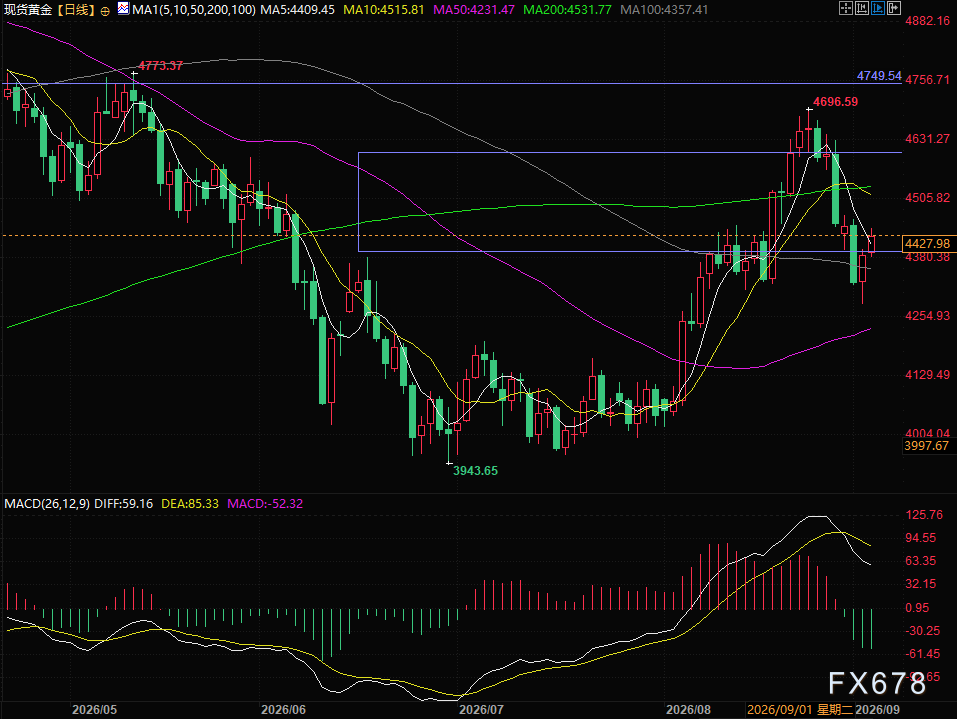
(Spot Gold Daily Chart, Source: EasyHuitong)
At 18:06 (UTC+8) in East Eighth District, spot gold is quoted at $4,429/ounce.
Disclaimer: The content of this article solely reflects the author's opinion and does not represent the platform in any capacity. This article is not intended to serve as a reference for making investment decisions.
You may also like
Bessent isn’t stalling? He really wants to save America’s trillion-dollar debt

AI "Capital Game": When Big Companies' Operating Cash Flow Is Not Enough to Burn

Crypto prices
More


