
Miniso: Both Major Growth Drivers Slowing Down


MINISO recently released its Q2 2026 financial report, recording a total operating income of 11.5 billion yuan (RMB) in the first half of the year, a year-on-year increase of 22.4%; gross margin was 44.3%, and net profit was 960 million yuan, a year-on-year increase of 5.6%. (The financial highlights are shown below, unit: 100 million yuan; data comes from Wind, the same below.)
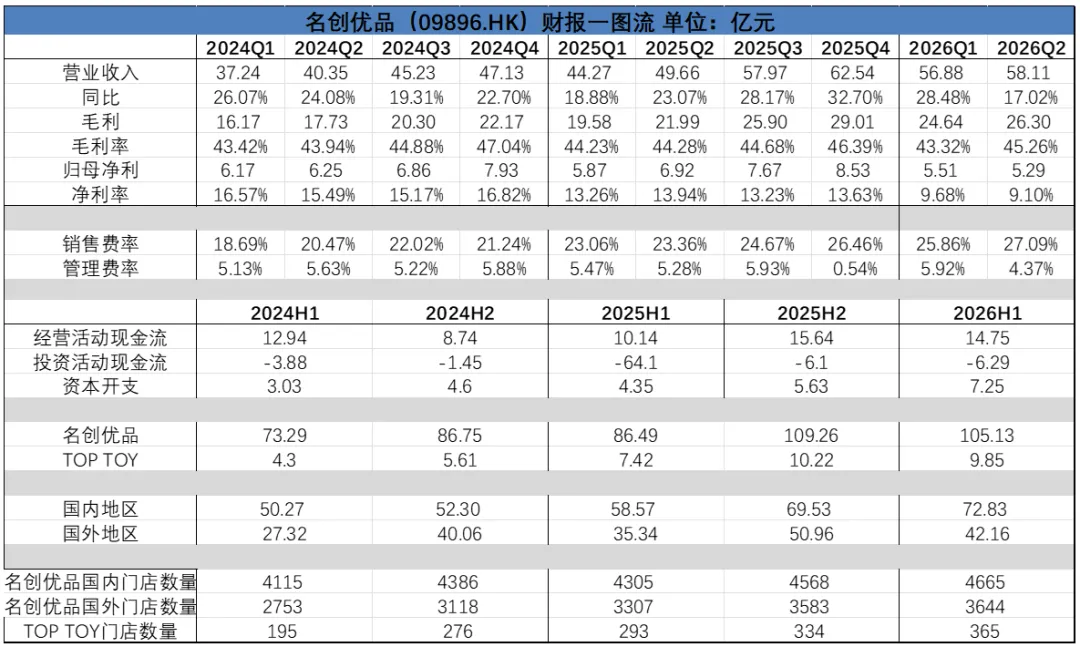
On the surface, MINISO continues to maintain a rare high-momentum expansion in the consumption downturn, but the capital market’s response was the exact opposite—cool reception.
Beneath the growth on paper lies MINISO’s current predicament: revenue is rising but profits are not following.
Our key takeaways are as follows:
1. MINISO’s revenue growth does have real fundamentals, with overseas expansion and TOP TOY as the two main engines. However, the high cost of overseas direct operations is eating into profits.
2. The IP strategy is a double-edged sword—licensed IPs contribute to sales, but licensing and marketing fees are rapidly eroding profit margins.
3. The in-house IP YOYO is a key move as MINISO shifts from just “carrying over” other products to becoming an “originator,” but for now, it remains a cost center that needs ongoing financial support from the parent company.
4. Looking back over the past two years, management was clearly seeking to hedge economic cycles by chasing consumption trends. However, now, being too aggressive in this pursuit may not be a good thing.
01
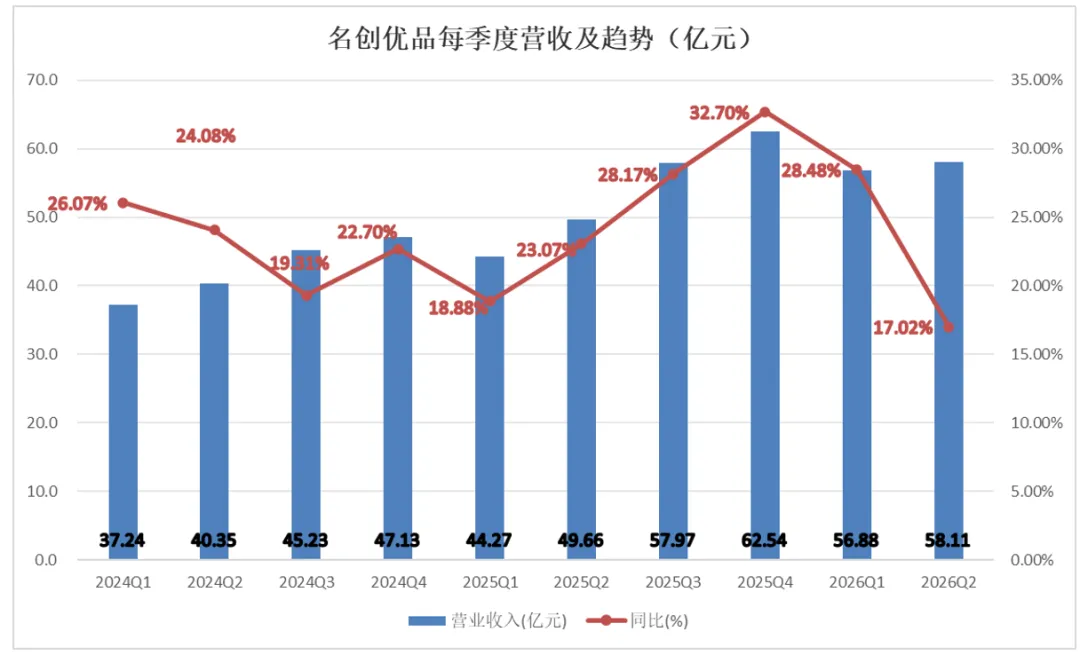
Both Growth Engines Are Slowing, Revenue Growth Hits Three-Year Low
In Q2 2026, MINISO reported single-quarter revenue of 5.811 billion yuan, up 17% year-on-year, with revenue growth falling below 20%—a new low in the past three years.
For the first half overall, domestic revenue was 7.28 billion yuan, up 24.4% year-on-year; overseas revenue was 4.22 billion yuan, up 19.3% year-on-year, with the overseas growth rate declining more noticeably.
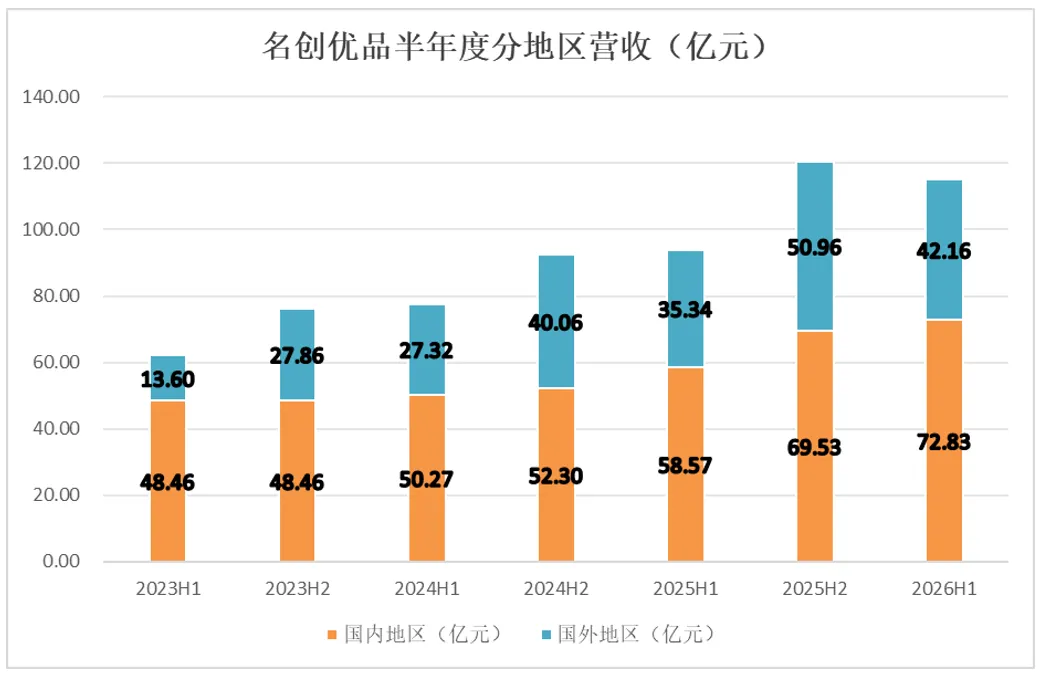
In the second half of last year, by collaborating with world-class IPs like Disney and Marvel and localizing offerings—such as robes and pocket tissues for the Middle East and slippers for Southeast Asia—MINISO’s overseas share once approached 42.3%. However, since this year, overseas revenue contribution has fallen to 36.7%, lagging behind domestic growth.
By brand, TOP TOY performed fairly well. This trendy toy brand aiming directly at POP MART reported 990 million yuan in revenue in the first half, up 32.7% year-on-year, with store count rising to 365. Within the MINISO ecosystem, TOP TOY is the fastest-growing business line and offers the most room for imagination. However, compared to last year’s nearly doubled growth, it has also slowed.
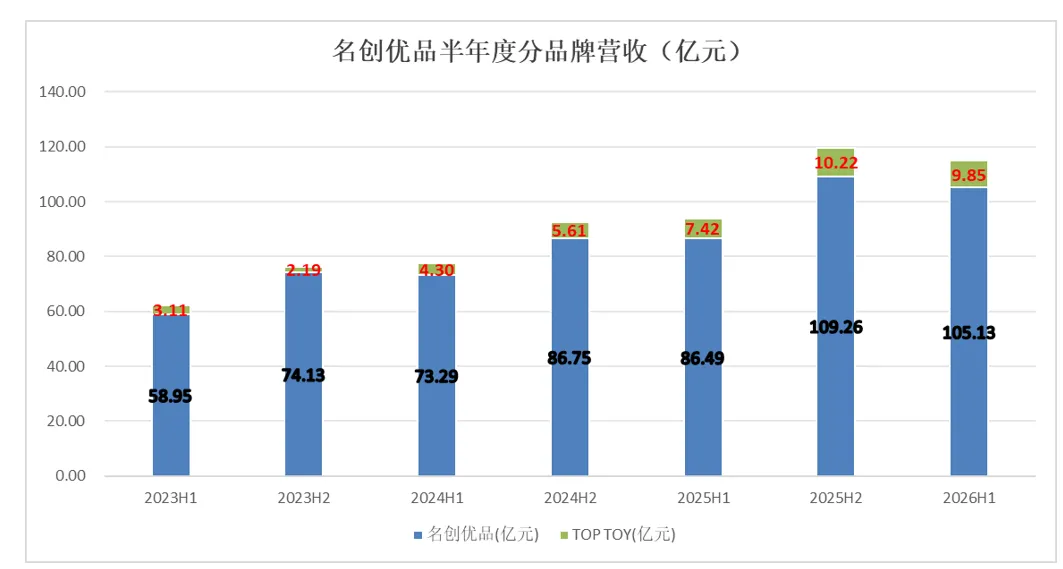
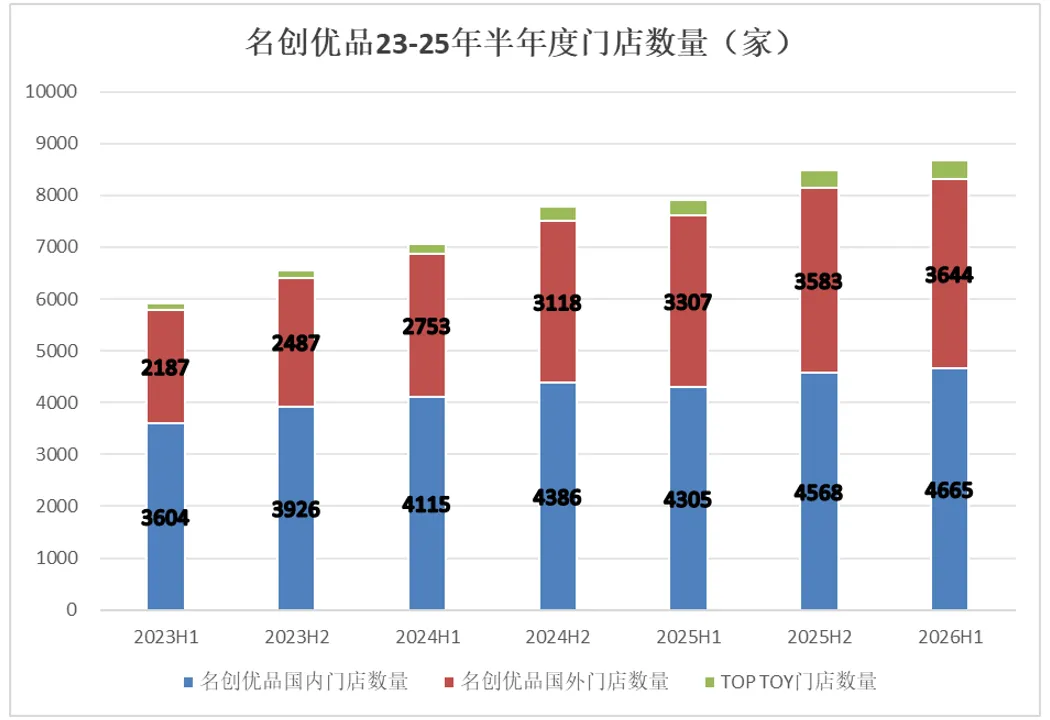
Both growth engines have hit the brakes to some degree, slowing MINISO’s overall growth rate. The root cause for the slowdown is the decline in core operational efficiency.
In fact, overseas high growth in the past year has masked the sluggishness in same-store sales:
On the one hand, overseas growth—while very fast—lacks quality. In Q1 and Q2 2026, direct store-related expenses clearly outpaced overseas revenue growth. According to management’s statement at the performance meeting, overseas stores currently contribute only 10%-15% of profits, while revenue contribution is 35%-45%. That means the more MINISO opens overseas, the thinner its profit margins.
On the other hand, expansion efficiency for domestic locations is also decreasing. In the first half, the number of new domestic stores was 97—a clear drop from the expansion pace of last year’s second half.
02
IP Premium Not Realized, Costs and Expenses Already Biting
In Q2 2026, MINISO’s gross margin rebounded to 45.26%, up 98bp year-on-year.
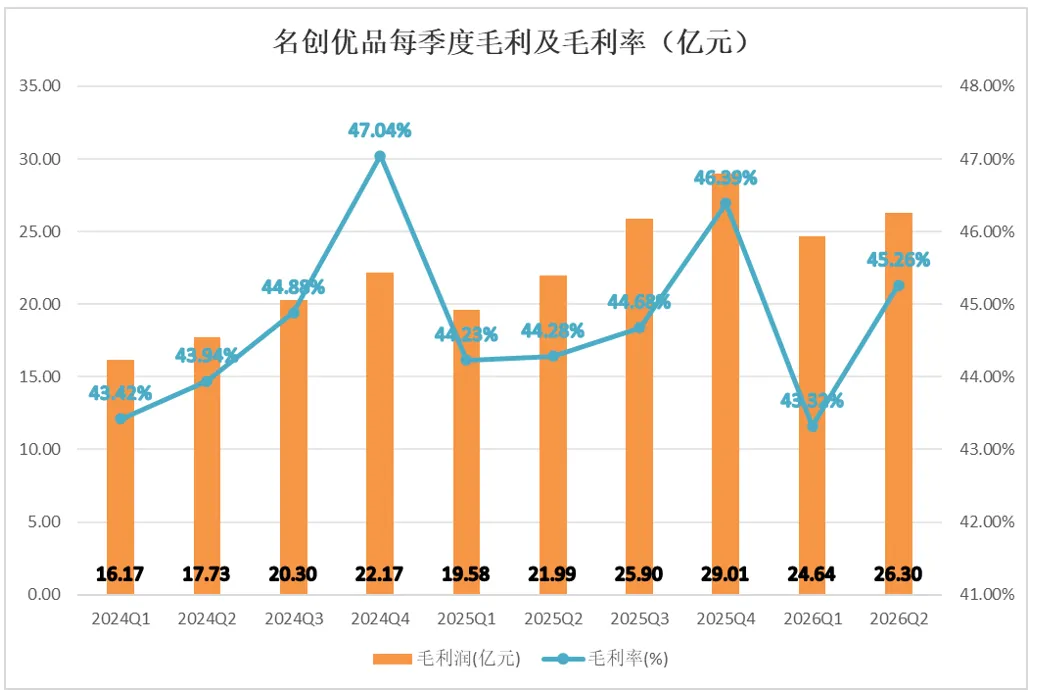
But the real bleeding point lies on the expense side: Sales and distribution expenses for Q2 2026 reached 1.57 billion yuan, a 36% year-on-year increase, with the expense ratio up 373bp. For the first half in total: direct store rents increased 100bp, promotion and advertising costs up 50bp, IP licensing fees up 50bp, and equity-based salary expenses up 40bp.
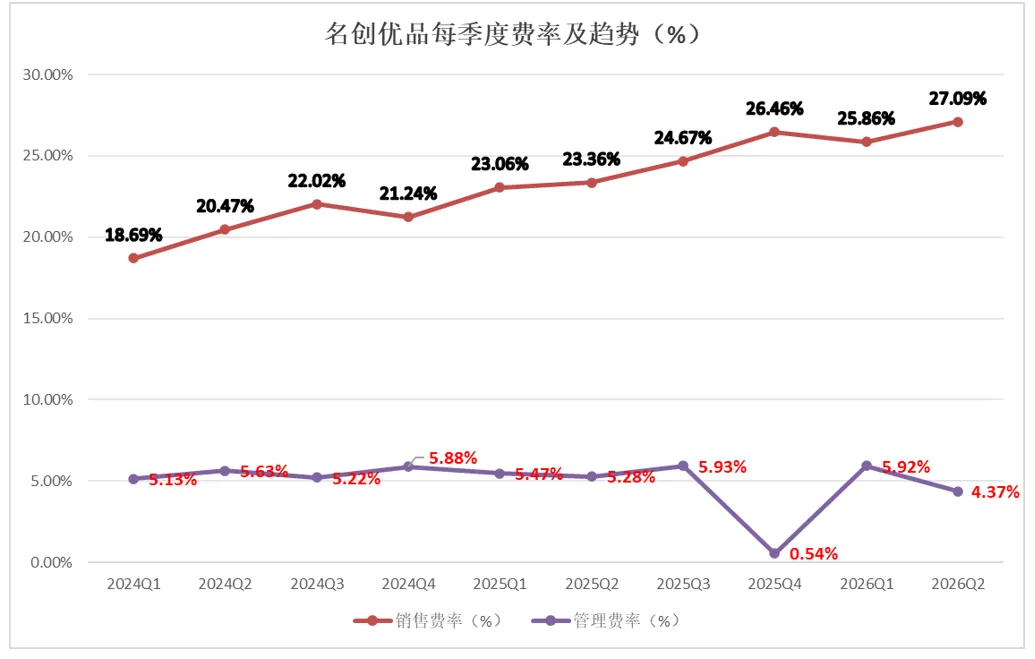
Among these, IP licensing fees are the most rigid expense. Historical data shows that in all of 2024, the total was 421 million yuan; just the first half of 2025 saw another 241 million yuan spent—a 31.7% year-on-year increase. In Q1 2026, licensing fees rose 42% year-on-year, accounting for about 2.6% of revenue.
MINISO has partnered with over 180 global IPs. In MINISO stores, 90% of IP products are licensed from the likes of Disney, Sanrio, and Harry Potter. Every co-branded product sold comes with a “passage fee”—the hotter the IP, the pricier the license. The more MINISO sells, the more it pays to the copyright holder.
MINISO essentially acts as a “porter” for the IP side. Compared to POP MART, the contrast is stark.
POP MART’s 2025 revenue was 37.12 billion yuan, up 184.7% year-on-year, with a gross margin of 72.1%. The THE MONSTERS series (with the LABUBU character) alone earned 14.16 billion yuan annually. MINISO’s gross margin of 45% is 27 percentage points lower than POP MART’s. The reason is that POP MART sells its own IPs and keeps most of the margin itself, while MINISO sells others’ IPs and only earns as a distribution channel.
MINISO puts forward a product philosophy of “good-looking, fun, and practical.” This logic makes sense for inexpensive daily goods, but in the context of IP retail, it’s the first two qualities that truly attract young people. Whether or not a product is practical becomes secondary to the power of the IP.
This illustrates the central issue: consumers come for the IP, not for MINISO itself. The IP’s popularity determines store traffic; the IP licensor determines profit margin; MINISO, in the entire value chain, is merely an executer.
MINISO is currently conducting a radical store-type transformation. From the ultra-premium MINISO SPACE in luxury malls to the large-scale, immersive “MINISO LAND” stores, then to MINISO FRIENDS targeting Gen Z, as well as Super MINISO, flagship, conventional, and pop-up stores—a total of seven tiers with descending levels of IP concentration.
Higher-tier stores get prioritized exclusive releases and limited editions, with a stronger IP presence. Regular consumers must go to the top three tiers to get rare IP editions; for everyday items, the basic stores suffice. While this tiered logic sounds clear, there's a fundamental dilemma at play:
The mega-store model has altered MINISO’s traditional high-turnover model. MINISO LAND’s global flagship in Shanghai’s Nanjing East Road surpassed 100 million yuan in sales after nine months and is expected to achieve annual GMV of over 150 million yuan—impressive on its face. But such stores require 2,000 square meters of space in core business districts and entail high rent and staffing costs, another reason for soaring marketing expenses this year.
As the company plans to expand park-style stores from the current 65 to 200 by the end of 2026, it actually undermines MINISO’s retail essence of “small stores, high turnover, rapid entry and exit.” Large stores bring more experience per customer, but extend customer dwell time and increase inventory turnover days.
03
YOYO Is Not Yet the Cure
MINISO is clearly aware of the limitations of “helping others sell.” That’s why it launched YOYO.
YOYO is MINISO’s first original artist IP, with its inaugural product line launched in June 2025. YOYO achieved sales of 165 million yuan in Q1 2026, and in June 2026, monthly sales in China surpassed 100 million yuan. The domestic annual target is 600 million yuan, and with overseas markets, may reach 1 billion yuan. Within a year of launch, YOYO has appeared at the Met Gala, Paris Fashion Week, and the CCTV Spring Festival Gala. According to Ye Guofu, it's “currently the fastest IP product to achieve over 100-million-yuan sales in the domestic market.”
The speed is indeed quick, but fast does not always mean good.
It largely relies on marketing blitzes and viral products: marketing and ad expenses jumped 36% year-on-year in Q2 2026. Adjusted net profit was only 529 million yuan, with the adjusted net profit margin dropping from 13.94% to 9.1% year-on-year.
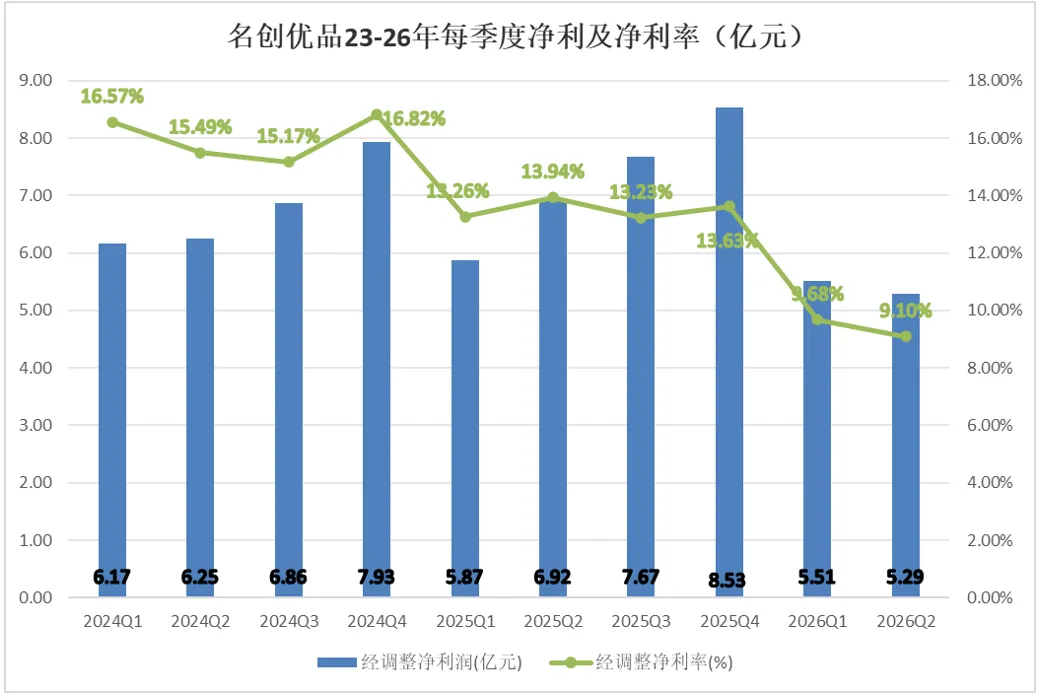
Evidently, in-house IPs are not yet self-sustaining and remain cost centers requiring ongoing support from the parent company.
Ye Guofu has his own methodology for IP operations: “Step 1, sign exclusive IP or incubate self-owned IP; Step 2, develop products; Step 3, place on store shelves while tracking data; Step 4, promote IPs that perform well in the data.”
The essence of this method is retail viral logic: data screening, concentrated promotion, horse-race mechanism. It’s like growing cabbage instead of trees—using retail-like efficiency to run an IP. Cabbage grows fast; trees take time. IP requires users to linger, discover, understand, and imbue with personal meaning—a process that cannot be rushed. LABUBU at POP MART took five whole years to go from licensing to explosion in popularity.
Currently, YOYO is experiencing a classic “overexposure syndrome.” When a desktop plaything for users gets paraded on the Met Gala red carpet, users shift from participants to mere spectators. On Xianyu (a second-hand marketplace), YOYO blind boxes are now down to 50-60% of their original price with free shipping. When enthusiasm is built up by marketing, it recedes just as fast.
What’s more, MINISO currently has 16 in-house IPs, but only two or three are genuinely hot. The whole IP transformation thus rests on a possibly peaking IP. If MINISO cannot incubate another IP of YOYO’s caliber before YOYO fades, its IP strategy will break down.
04
Haste Makes Waste
It’s obvious that—in the past two years—Ye Guofu has been in a hurry.
Acquiring Yonghui, investing in an AI company, rapidly expanding overseas direct stores, pushing in-house IP YOYO, rolling out MINISO LAND large stores—each of these makes sense on its own, but taken together, they reveal just one thing: the decision-maker is anxious, seeking incremental growth and hoping to offset consumer volatility with speed.
In September 2024, MINISO spent 6.27 billion yuan acquiring 29.4% of Yonghui Superstores. From Ye Guofu’s site visit to Fat Donglai in late July to the official announcement on September 23, it took less than two months; the transaction was completed in Q1 2025, with Yonghui consolidated into MINISO’s reports by Q2 2025 using the equity method.
A year later, the first results came in: Yonghui reported a net loss of 2.552 billion yuan in 2025. Based on MINISO’s shareholding, it recognized an investment loss of 813 million yuan. Net profit was halved from 2.635 billion to 1.21 billion yuan, with Yonghui accounting for 57% of the drop.
Yonghui improved in 2026—with a profit of 253 million yuan—but revenues fell by nearly 20%.
MINISO and Yonghui are fundamentally different: one is a light-asset retailer selling IP-derived products, the other a heavy-asset supermarket selling fresh produce. There is little overlap in supply chain, business logic, or user base. To date, no clear path to synergy is evident.
Another AI investment, in MiniMax, likewise brought MINISO a nearly 600 million yuan floating loss.
Meanwhile, MINISO’s asset-liability ratio jumped from 42.85% at the end of 2024 to 65.6% in the 2026 interim report. Diversification beyond its core business is increasing the company’s financial leverage.
Emulating POP MART, Fat Donglai, and investing in AI—MINISO is trying to replicate success formulas in every hot field. But there’s no such thing as “copy-paste” success in business.
MINISO is also becoming more aware of its problems. At the mid-year results meeting, management deeply reflected on the deceleration of its overseas business and made a clear commitment to adjust the pace of expansion and improve the profitability of single-store models.
Ultimately, MINISO’s success depends on “supply chain efficiency” and “value-for-money positioning.” If it chases areas it is not good at and loses its supply chain and cost advantages, it’s putting the cart before the horse.
People in a hurry may run quickly, but not necessarily far. (Author: Suiyu)

Disclaimer: The content of this article solely reflects the author's opinion and does not represent the platform in any capacity. This article is not intended to serve as a reference for making investment decisions.
You may also like
X Financial (XYF.US) Q2 2026 Financial Report: Driving AI Empowerment for Quality Improvement and Building Operational Resilience
On August 24, China's leading fintech company Xiaoying Technology (XYF.US) released its unaudited financial results for the second quarter ended June 30, 2026.

British Pound drops as US Dollar strengthens on rising US yields, higher oil prices
British Pound softens to near 1.3500 as US, Iran escalate attacks
Strive’s SATA funds nine straight days of Bitcoin buys as sector demand fades
Crypto prices
More


