
Ark Invest + Glassnode: The Decentralization Spectrum

Where does a blockchain really sit between decentralized and centralized? The two labels are often treated as binary alternatives, but the reality is more nuanced: every design choice — from block size to staking model — places a network somewhere along a spectrum, and every position on that spectrum comes with tradeoffs.
The Decentralization Spectrum is a new joint report by ARK Invest and Glassnode. It examines the three largest blockchain networks — Bitcoin, Ethereum, and Solana — through four design features: auditability, security, governance, and ownership. It then quantifies each network's position with a six-dimension scoring framework built on data from Glassnode and a wide range of network sources.
One Spectrum, Four Design Features
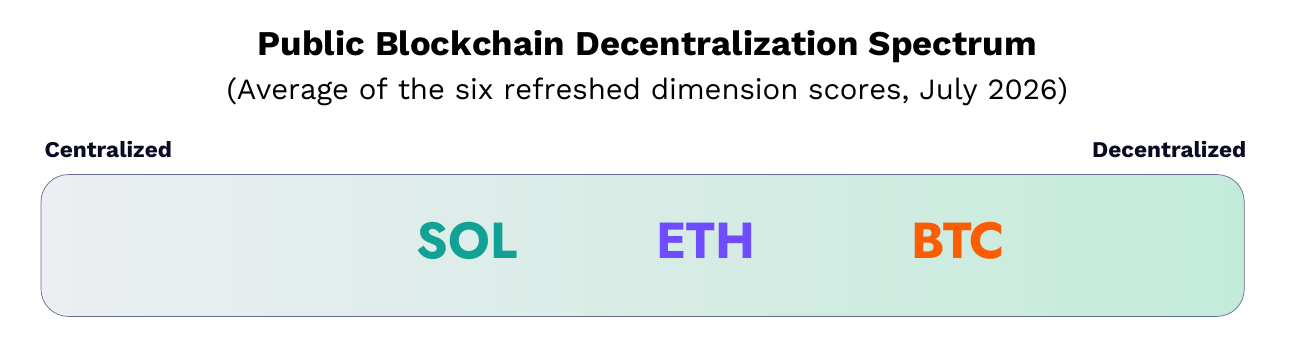
Decentralized and centralized architectures weight the four design features very differently. A fully auditable network lets anyone verify the ledger by running a full node. Distributed consensus raises the real-world cost of coordination an adversary must bear. Community-driven governance precludes unilateral upgrades, and widely dispersed ownership prevents any insider group from dominating decision making. Averaging the report's six dimension scores places the Big Three in a clear order:
 Source: ARK Investment Management LLC and Glassnode, 2026
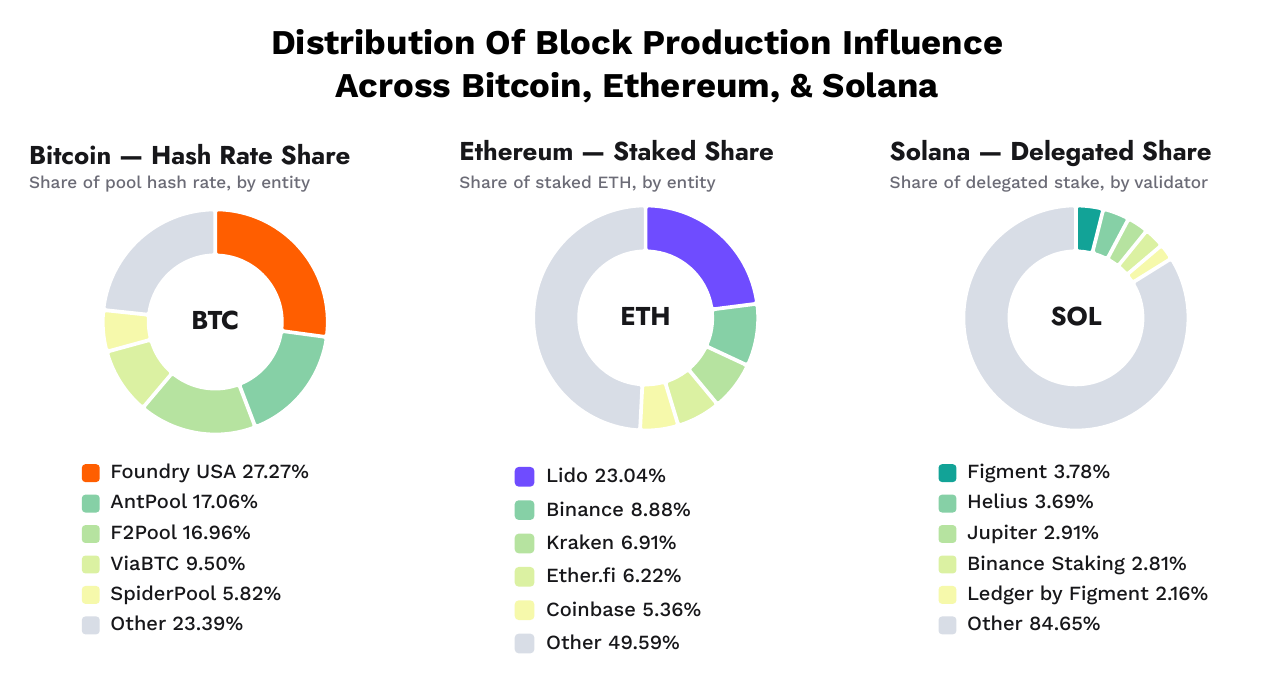
Who Really Controls Block Production?
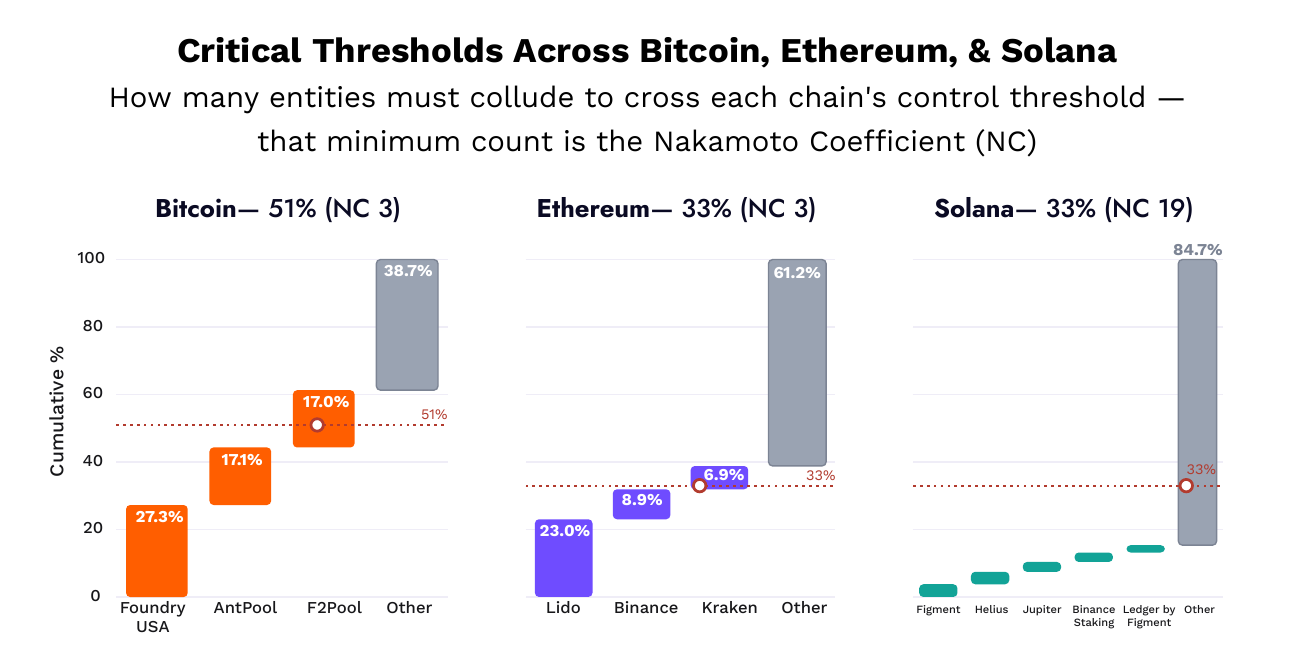
Security ultimately asks a simple question: how many independent parties would need to collude to alter the ledger? The report measures the concentration of hash rate and stake, the capital required to acquire 1% of each network, exit fluidity, and client diversity. Some of the findings will surprise: Bitcoin and Ethereum cross their critical control thresholds with just three entities each, while Solana requires 19 — though pools and delegation nuance that picture considerably. And while a Bitcoin miner can exit a 1% position in roughly 30 seconds by switching off hardware, unstaking the equivalent on Ethereum can take weeks under stress.
 Source: ARK Investment Management LLC and Glassnode, 2026
 Source: ARK Investment Management LLC and Glassnode, 2026
The Geography of Decentralization
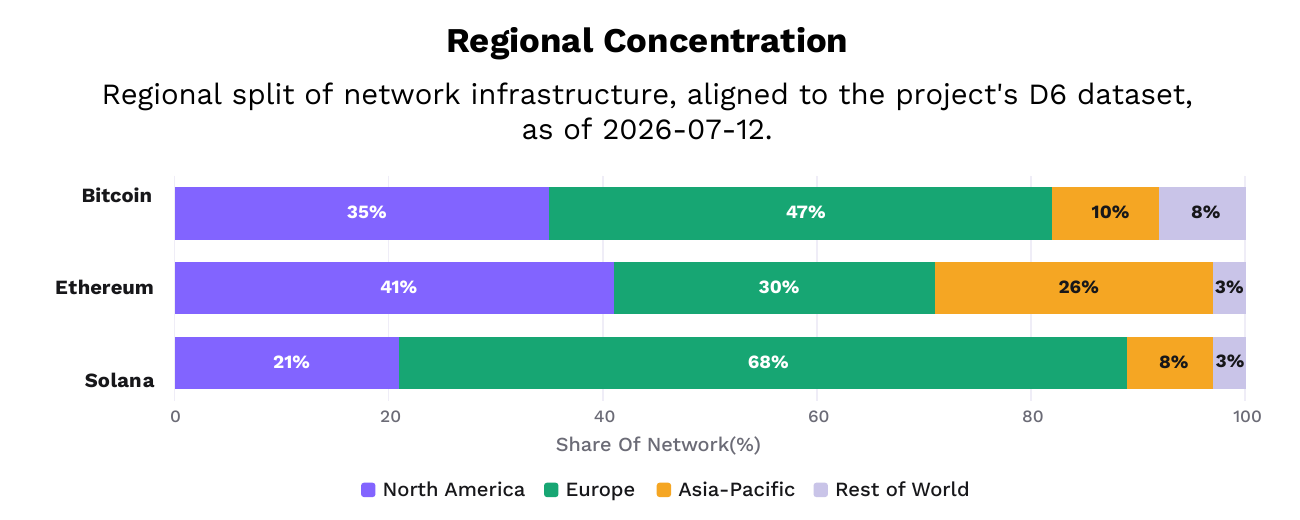
Where infrastructure physically lives shapes how resilient a network is against coordinated coercion. Bitcoin's node footprint is the most evenly spread — and 63% of its nodes operate behind Tor. Ethereum leans on cloud providers, with AWS alone hosting roughly 20% of its nodes. Solana runs essentially all of its infrastructure in data centers, by design. The report maps regions, hosting environments, and provider concentration for all three networks.
 Source: ARK Investment Management LLC and Glassnode, 2026
Six Dimensions, One Scorecard
The quantitative core of the report scores each network across six dimensions: ownership distribution, exit fluidity, network verification overhead, critical resilience threshold, blockchain reconstruction overhead, and geographic & provider resilience. No network leads on every dimension. Bitcoin scores strongest on auditability, ownership distribution, and geographic resilience; Ethereum balances the middle ground; Solana trades decentralization for performance and coordination speed. A full methodology appendix documents the math behind every score.
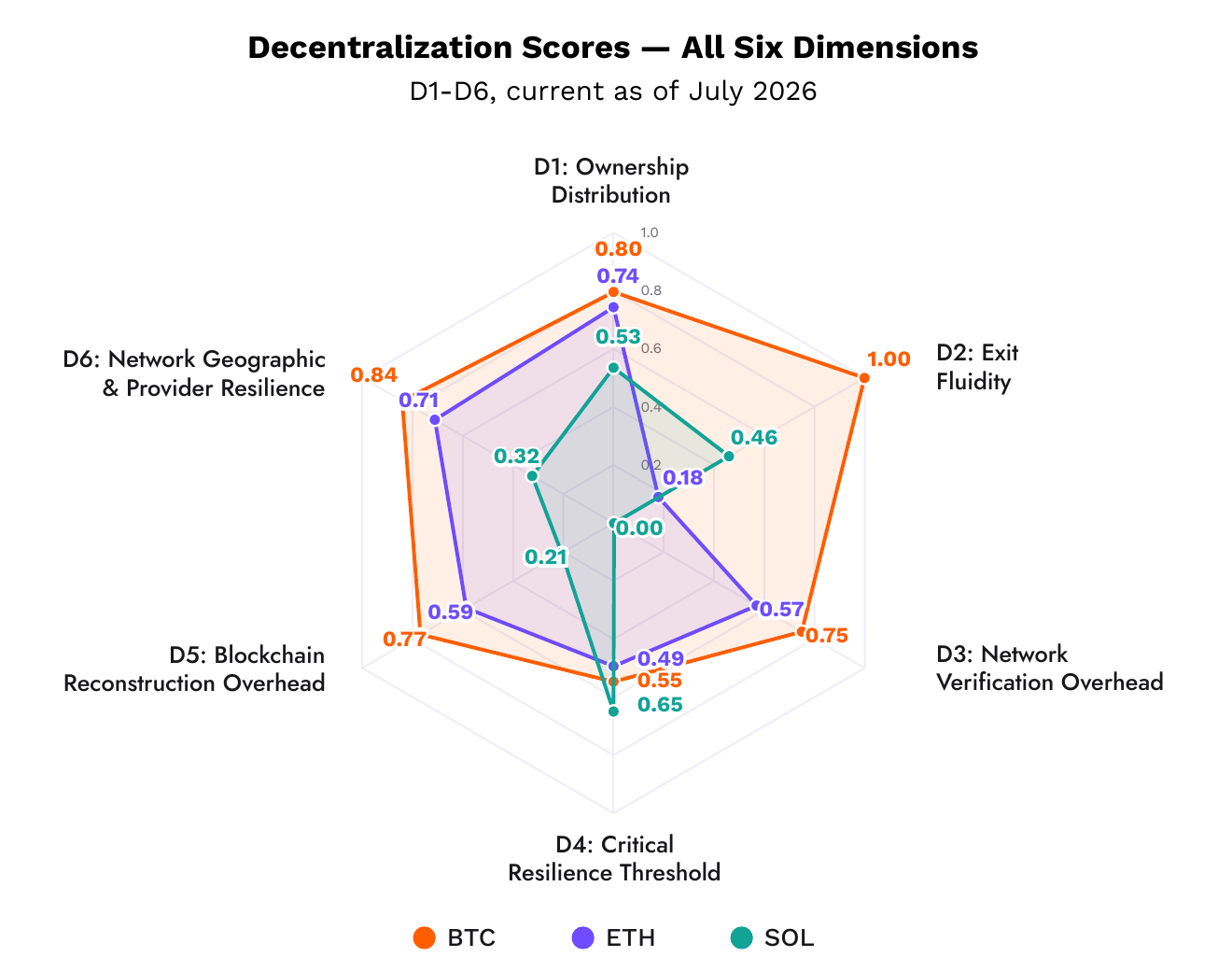 Source: ARK Investment Management LLC and Glassnode, 2026
Read the Full Report
Different use cases tolerate different risk profiles — a high-throughput payment network and a settlement layer for high-value institutional assets sit at different points of the spectrum on purpose. The full report walks through every design feature and all six quantitative dimensions, including node economics, governance case studies from Bitcoin's SegWit to Solana's SIMD-228, and supply distribution data for all three networks.
Disclaimer: The content of this article solely reflects the author's opinion and does not represent the platform in any capacity. This article is not intended to serve as a reference for making investment decisions.
You may also like
XRP Delivers 13% Average Gains in September: Will History Repeat?
Solana’s 7% Pullback Isn’t Slowing Demand: Here’s the $150 Setup
United States Treasury yields read Iran strikes as inflation
Crypto prices
More


