
The gold price rally dream cools down! Prediction markets bet that a rapid return to 4700 is no longer a high-probability scenario

After recording a nearly 10% rise in August, international spot gold quickly turned downward, and market confidence in its continued rally has visibly cooled. Prediction markets are swiftly reducing their bets that gold will break through key price levels by the end of the year, signaling a retreat from previously high levels of optimism.
According to the latest data from Polymarket, the probability that gold touches $5,000/ounce before year-end is just slightly above 50%, while the likelihood of reaching $4,500 is nearly certain. In contrast, the probability of hitting $6,000 has already dropped to about 13%—a target that was previously favored by JPMorgan and other Wall Street institutions for the end of the year.
An even clearer reflection of short-term sentiment shifts is that Polymarket's short-term contracts on gold rebounding back near $4,700 currently have a probability of less than one-third. In other words, after August’s strong rise, prediction market participants are no longer broadly betting that gold will quickly recover its previous high.
This cooling of optimism coincides with gold’s rapid price correction. International spot gold previously climbed to around $4,697/ounce, then quickly declined. Under the pressure of rising US Treasury yields and oil prices, it dropped nearly 1.8% on Tuesday to around $4,370/ounce, hitting its lowest level since August 19.
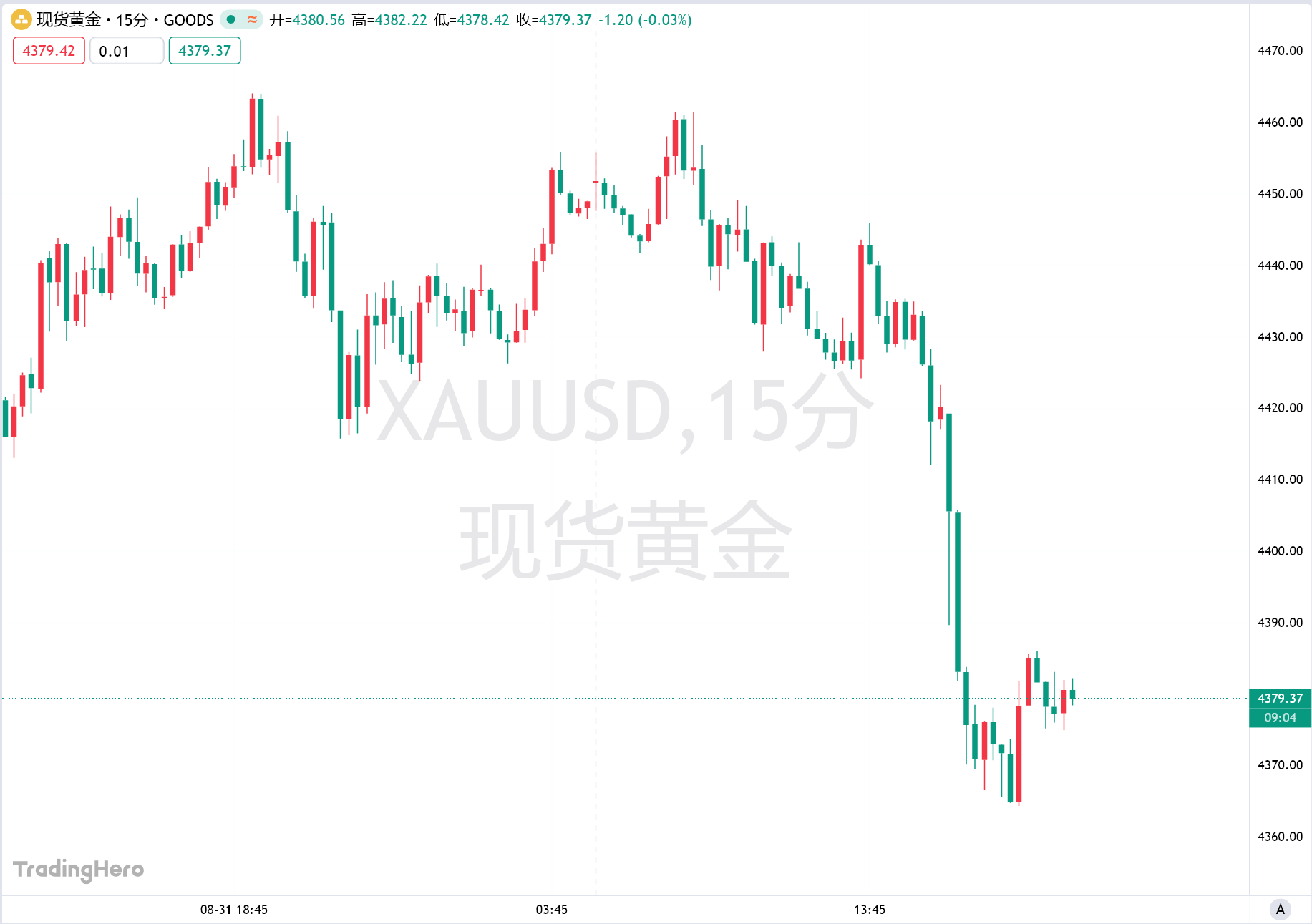
The direct shock came from Federal Reserve Chair Powell’s hawkish remarks at the Jackson Hole annual meeting. He emphasized that returning inflation to the 2% target is still not fast enough and that the Fed “has more work to do.” After his speech, markets quickly increased bets on a September rate hike, with the probability now around 66%, notably higher than before his remarks.
This has changed what was previously the most favorable macro environment for gold. Gold itself produces no interest; if expectations for rate hikes return, the yield advantage for cash and bonds expands, increasing the opportunity cost of holding gold. Meanwhile, the yield on the US 10-year Treasury has risen to about 4.78%, further pressuring gold.
Rising oil prices further amplify this pressure. After renewed military conflict between the US and Iran, Brent crude surpassed $91/barrel. Higher energy prices may drive up inflation and force the Fed to maintain tighter monetary policy.
The bullish logic has not disappeared, but expectations for a rapid rise are “cooling down”
The major driver of gold’s recent rebound has been the “currency debasement trade.” US fiscal deficits, expanding government debt, and the Treasury’s larger long-term bond buybacks have sparked concerns over the dollar’s purchasing power and sovereign debt risk, giving gold renewed appeal for shelter and hedging.
This is also the greatest uncertainty in today's gold market: the Fed is suppressing gold prices through increasingly hawkish policy expectations, while fiscal expansion and debt concerns are reinforcing gold's long-term allocation logic.
Therefore, the market is not entirely turning bearish on gold, but is reassessing previously over-optimistic expectations of a rise. Citi still expects gold to reach $5,000 in the next 6 to 12 months and has raised its short-term target to $4,800; some Wall Street institutions even continue to maintain the $6,000 target.
However, in the short term, the prediction markets have already sounded the warning: for gold to quickly return to $4,700 and further break through $5,000 following the recent correction is no longer seen as a high-probability event by the market.
Looking ahead, upcoming US employment and inflation data will be key to deciding whether these expectations can reignite. If employment weakens significantly, and rate hike expectations drop, US Treasury yields and the dollar retreat, gold may regain upward momentum. Conversely, if employment remains resilient and oil prices continue to drive inflation higher, expectations of further Fed rate hikes will heat up, and gold bulls may continue to retreat.
Disclaimer: The content of this article solely reflects the author's opinion and does not represent the platform in any capacity. This article is not intended to serve as a reference for making investment decisions.
You may also like
The US ISM Manufacturing Index for August slightly declined, falling short of expectations, but remains near a four-year high.
U.S. manufacturing expanded for the eighth consecutive month in August, with the ISM index falling to 54.6, below expectations of 55.2, but still the second highest since 2022. The new orders index dropped to 53.7, the weakest since March; factory employment increased for the second month in a row, although the growth rate slowed; the prices index remained unchanged at 71.1, matching the lowest level since February. The manufacturing sector reported growth, while the lumber and chemical products industries reported contraction.
Chaince Digital files Form 3 initial beneficial ownership statement for director Li Jialin
Cathie Wood’s ARK Invest buys $40.8M in crypto stocks
Chipotle's Shift to Licensed Growth to Lift Margins Despite Slower Revenue, BofA Says
Crypto prices
More


