
Probability of Rate Hike Rises to 66.4%, Gold Price Overshoots, Market Begins to Experience Cash Shortage

Huitong Network, September 1 — The Federal Reserve’s hawkish tone, combined with a decline in US Treasury purchases, has led to higher interest rates suppressing gold prices, with gold quickly dropping to new short-term lows.
On Tuesday (September 1), during the Asia-Europe session, gold prices continued to fall, currently down more than 1.7%, trading around 4373.
The Federal Reserve has released a hawkish signal which tightens liquidity expectations. Gold is a non-yielding asset, and with overseas investors reducing US Treasury holdings and pushing the interest rate center higher, these combined forces have raised the opportunity cost of holding gold. The risk of gold price retracement has increased, and gold ETFs are concurrently under pressure.
Jackson Hole Sends Hawkish Signal: Monetary Policy Tightening Expectations Suppress Gold Prices
Federal Reserve Chairman Kevin Walsh delivered a hawkish speech at the Jackson Hole meeting, becoming the direct trigger in suppressing gold recently.
Walsh stated that US inflation has not shown credible signs of easing; both PCE and CPI inflation remain above the 2% policy target. Current financial conditions are insufficiently tight to combat high inflation, and the Federal Reserve does not rule out further rate hikes, making price stability the policy priority over supporting economic growth.
This has significantly raised market expectations for further rate hikes in September and December.
Strengthened rate hike expectations benefit the US dollar, while gold itself generates no interest income. As returns on US Treasuries rise, gold's relative attractiveness diminishes, and expectations for tighter monetary liquidity directly pressure gold prices downward.
Major Changes in US Treasury Investor Structure: Overseas Capital Exit Pushes Rate Center Higher
Aside from Federal Reserve policy, structural changes are occurring in the Treasury market. These, combined with higher rate hike expectations, are driving market-wide interest rates up even further.
The proportion of US marketable Treasuries held by overseas investors has dropped to 40%, lower than the pre-2008 crisis peak of 50%.
In the past, the main buyers of US Treasuries were central banks from countries like China and Japan; now, holdings by overseas private investors are nearly double those of official creditors.
Private capital is more sensitive to macro shocks and shifts in risk sentiment, amplifying fluctuations in US Treasury prices and yields.
Over the past 12 months, China continued to cut its reserves of US Treasuries by 13% while Japan's holdings remained steady; there has been net buying from European financial centers like the UK, Belgium, Luxembourg, and Ireland, with much of the increase coming from global private investors.
The US fiscal deficit now stands at 6% of GDP. Combined with international policy factors, many institutions believe their allocation to US dollar assets is already too high, so they are actively reducing their exposure to US Treasuries.
The exit of overseas funds is not a panic-driven stampede, but rather a slow outflow of positions.
However, weaker foreign demand will push up US Treasury term premium, raising the overall rate center.
Even if the Federal Reserve does not raise rates, higher Treasury yields will also increase the opportunity cost of holding non-yielding gold, suppressing gold prices.
The market also contains hedging elements: The liquidity of bonds from other developed economies cannot easily replace US Treasuries, and global long-term liability institutions still rely heavily on US Treasuries as a duration management tool;
The US Treasury Department’s bond buybacks may also mitigate upward pressure on long-term yields, but it is difficult to fully offset the upward momentum caused by private investor reductions in the short term.
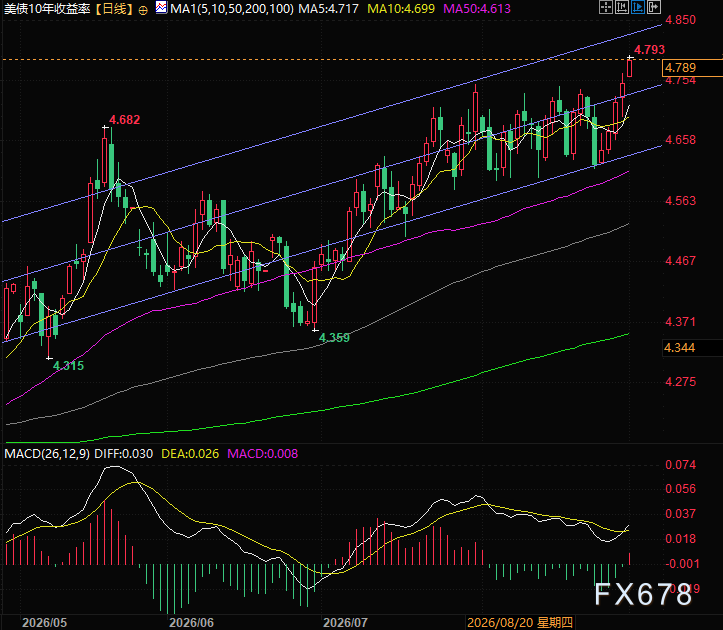
(US 10-year Treasury Yield Daily Chart, source: Yihuitong)
Trading Volume Soars as Gold Enters a Wide Volatility Range
Bart Melek, Head of Commodity Strategy at TD Securities, forecasts that by the end of this year, gold is likely to retreat and fluctuate in the $4200–$4700 range.
Research institutions tracked the ETF holdings of 13 investment institutions. Over the past three months, five increased their positions while eight reduced them, reflecting a cautious and divided outlook among professional investors regarding gold’s prospects.
COT’s gold position report shows that recently both institutional and retail positions in gold have increased, with both longs and shorts reaching near-term highs. This indicates a larger disagreement after a sharp increase in gold prices, making price surges or drops more likely to be amplified.
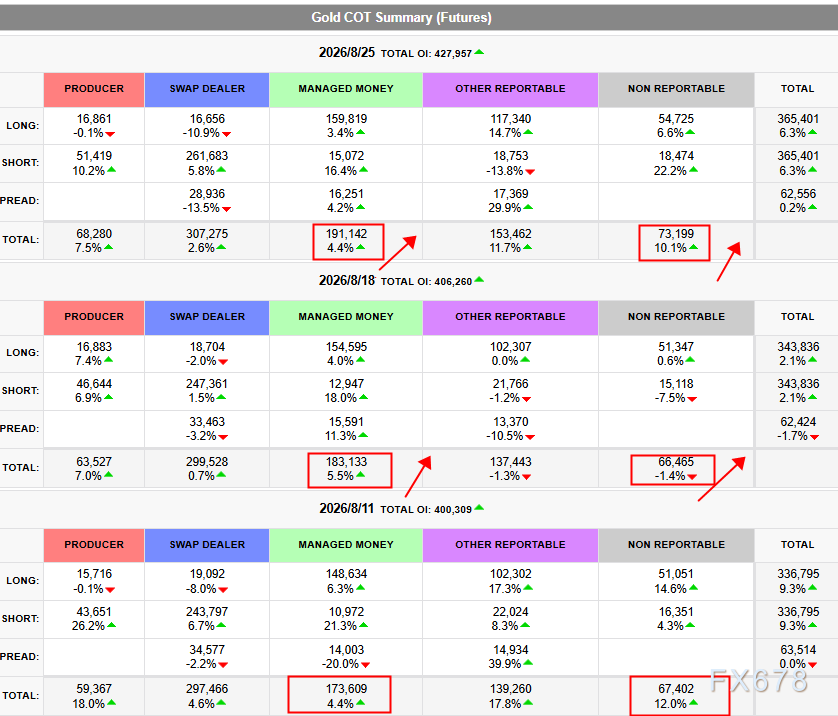
(CFTC Gold Position Table, source: CME Group)
Summary of Logic: Short-term Rate Suppression Dominates, US Dollar Credit Narrative Yields to Real Opportunity Cost
The Federal Reserve’s hawkish signals have created expectations for tightened monetary liquidity;
Foreign demand for US Treasuries is shrinking, pushing the interest rate center higher, and resulting in a significant increase in real interest rates.
Both factors raise the opportunity cost of holding non-yielding gold. However, excessively high rates will drag on global governments and normal economic activities, so rates cannot rise without limit. In fact, a short-term spike in rates could help gold quickly reach a stage bottom.
In the long term, continuous foreign reduction in US Treasuries implies a weakening of the US dollar’s credit, which is bullish for gold. But due to increased capital expenditure on AI, the market remains chronically short on funds, resulting in tighter liquidity that is bearish for gold prices.
From a technical perspective, spot gold has recently undergone a significant adjustment, breaking below the lower range of its box pattern. This likely indicates an overreaction in the short term; the latest price center should be around 4428, and this level should be closely watched as the near-term dividing line between bulls and bears.
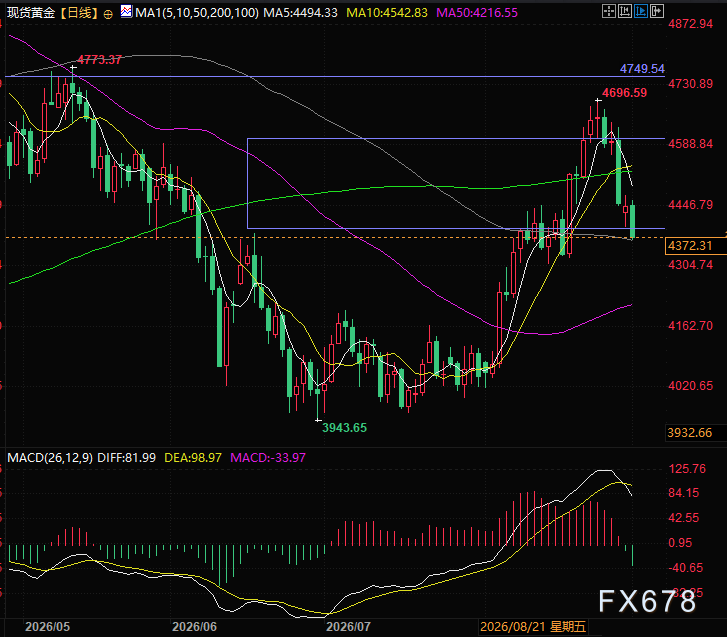
(Spot Gold Daily Chart, source: Yihuitong)
As of 17:51 Beijing time, spot gold was quoted at $4369 per ounce.
Disclaimer: The content of this article solely reflects the author's opinion and does not represent the platform in any capacity. This article is not intended to serve as a reference for making investment decisions.
You may also like
XRP analyst sets $15, $27, and $50 targets, highlights impact of Clarity Act
Shiba Inu Price Prediction September 2026: Can SHIB Repeat Its 2024 September Surge?
XRP price targets split: Analyst sees $2.20 and $4 highs, bearish outlook warns of $0.18
PONS crypto up 46% as market cap crosses $300M – Is a $1B valuation next?
Crypto prices
More


