
JPMorgan Trading Desk "Changes Again" with the "Most Accurate 2026 Forecast": Ends Bullish Stance Since June, Turns "Tactically Cautious" on US Stocks

J.P. Morgan’s Market Intelligence trading desk has garnered significant attention this year for its series of precise market inflection point calls. Now, the desk has once again adjusted its stance—shifting from bullish to “tactically cautious/neutral” due to increased uncertainty about the Federal Reserve’s policy path, crowded market positioning, seasonal pressures, and a sharp reversal in momentum factors.
In its latest morning report, the team noted that while equity market fundamentals remain robust overall, the confluence of multiple short-term variables over the next 2 to 3 weeks is likely to push the market into a sideways trading pattern. Although a major pullback at the index level is not anticipated, “further turbulence at the sub-index and individual stock level would not be surprising.”
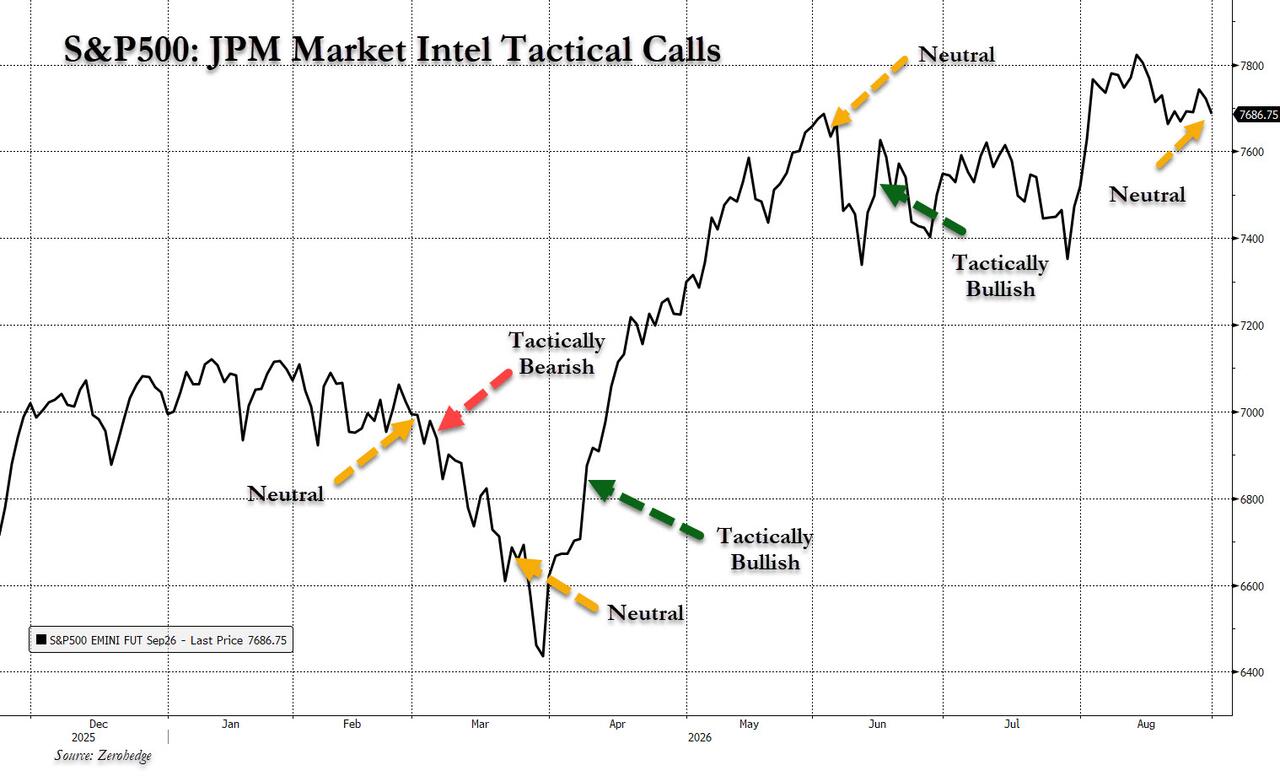
J.P. Morgan’s Market Intel trading desk, led by Andrew Tyler, focuses on institutional client services and differs from the bank’s traditional sell-side research division. According to ZeroHedge, the desk's market timing record in 2026 has been remarkable: it was resolutely bullish at the start of the year, turned “tactically cautious” or even bearish promptly after the US-Iran conflict triggered a commodities surge, closed short positions and shifted to neutral before the March lows, switched back to bullish during the sharp April-June rally, and returned to neutral near the top; after a small pullback in mid-June, it once again turned tactically bullish.
This is another major stance shift by the team this year, and the first downgrade since their mid-June bullish call.
Federal Reserve Policy Path Is Now the Biggest Variable
The primary factor prompting the team’s shift is the repricing of expectations for Federal Reserve policy. Per their interpretation of Fed Chair Powell’s speech at Jackson Hole, the core signals are: the labor market has reached full employment, inflation remains elevated, the Fed will use PCE as the inflation metric, interest rates—not balance sheet reduction—will be the tool to fight inflation, and current financial conditions are not restrictive.
These remarks make the September FOMC meeting a “live meeting.” The implied probability of a rate hike in September as seen in the bond market has risen from about 35% to around 58%. The team noted that this week’s nonfarm payrolls (NFP) and next week’s September 11 CPI data will be key inputs, with the latter carrying more weight.
Six Reasons Supporting Tactical Rotation
In addition to the Fed factor, the team listed five other reasons driving this adjustment in their stance.
Market Positioning: The J.P. Morgan positioning intelligence team warns that current signals are not clear, and historical experience suggests the market will trade sideways over the next 3 to 4 weeks, making a swift rebound in momentum factors unlikely.
Credit Spreads: The two weeks following Labor Day have historically seen a peak in credit bond issuance, widening spreads and adding pressure to equities. Recently, AI-related trades have been weighed down by wider CDS spreads, making this risk worth monitoring.
Seasonality: September is historically the worst month for S&P 500 performance. In midterm election years, the typical pattern is pre-election weakness followed by a strong post-election rebound—since 1990, average gains for the S&P 500 in the three, six, nine, and twelve months following the midterm election are 5.4%, 11.4%, 12.5%, and 14.7%, respectively, with win rates between 78% and 100%.
Momentum Factor Pullback: J.P. Morgan’s JPMPURE momentum index has fallen more than 21% from its June all-time high, while the “classic” momentum index JPPQMO is down nearly 34%, both exceeding the typical correction range of 10% to 15%.
AVGO Earnings: The team believes that even with impressive results, it may be difficult for AVGO to drive tangible stock price gains in the AI, storage, and semiconductor sectors.
Go Long Nasdaq, Short Russell, Focus on Large Banks
In terms of specific strategies, the team recommends starting with a long position in the Nasdaq 100 (NDX) and a short in the Russell 2000 (RTY). Within technology, given weak buy-side interest in AI, storage, and semiconductors, the “Magnificent Seven” (Mag7) are currently the preferred picks; the software sector remains attractive, especially in the scenario where semiconductors continue to decline. Small and mid-caps (SMID-caps) are likely to underperform under this tactical adjustment.
In cyclicals, if this week’s ISM data beats expectations, some cyclical sectors could still perform, especially large banks which benefit from an economic growth narrative and easy financial conditions; consumer discretionary also looks attractive if energy prices decline. In defensive sectors, healthcare historically outperforms ahead of midterm elections.
For hedges, the team favors shorting credit ETFs and buying VIX products. The “USD depreciation” trade may face resistance ahead of the September 16 Fed meeting, so shifting cash positions to derivatives is recommended. In addition, the team highlights two external risks to watch: first, whether the US and Iran can reach an agreement or if a new event triggers a surge in oil prices; second, whether the US-Canada trade dispute escalates further.
Disclaimer: The content of this article solely reflects the author's opinion and does not represent the platform in any capacity. This article is not intended to serve as a reference for making investment decisions.
You may also like
China's August RatingDog Manufacturing PMI rises to 51.5, hitting a two-month high; export new orders grow at the fastest pace in six months, factory gate prices decline for the first time this year
RatingDog founder Yao Yu stated that the manufacturing sector continued to strengthen overall in August, with demand, output, and exports all accelerating. "The faster growth of new orders and strong expansion in exports are positive signals, while the first decline in factory-gate prices within 2026 indicates that competitive pressure still exists."
Helium crypto surges 36% – Why HNT’s rally could face a reversal
British Pound softens to near 1.3550 on geopolitical tensions, hawkish Fed bets
Crypto prices
More


