
Using Salesforce as an Example, AI is Changing Software “Pricing Models”

Artificial intelligence is disrupting the subscription-based pricing model that has defined the software industry for over two decades. Enterprise software giants such as Salesforce are being forced to shift from charging fixed subscription fees per user to adopting usage-based or even results-based pricing—a transition that presents both opportunities and uncertainties.
According to technology media outlet The Information on August 30, Salesforce CEO Marc Benioff stated on an investor call last week that the company is now allowing enterprise clients to choose how they pay for its AI product Agentforce, including options such as custom contracts, charging based on the additional revenue generated by AI-assisted sales, or billing according to the savings created by automated customer service.
"Customers want to buy and price in different ways, and that's something I've come to deeply understand recently," Benioff said. This statement highlights the profound uncertainty surrounding software pricing models in the era of AI.
This shift has already triggered a chain reaction within the industry. It is reported that, according to people familiar with the matter, OpenAI has begun offering some large clients the option of paying only when tasks are completed by AI in recent months; customer management startups Sierra and Fin (the latter is being acquired by Salesforce for $3.6 billion) have similarly adopted a model of charging only upon task completion; and AI coding assistant Cognition promises up to $10 million in credits if it fails to deliver engineering outcomes at least equal to the fees paid by enterprise clients.
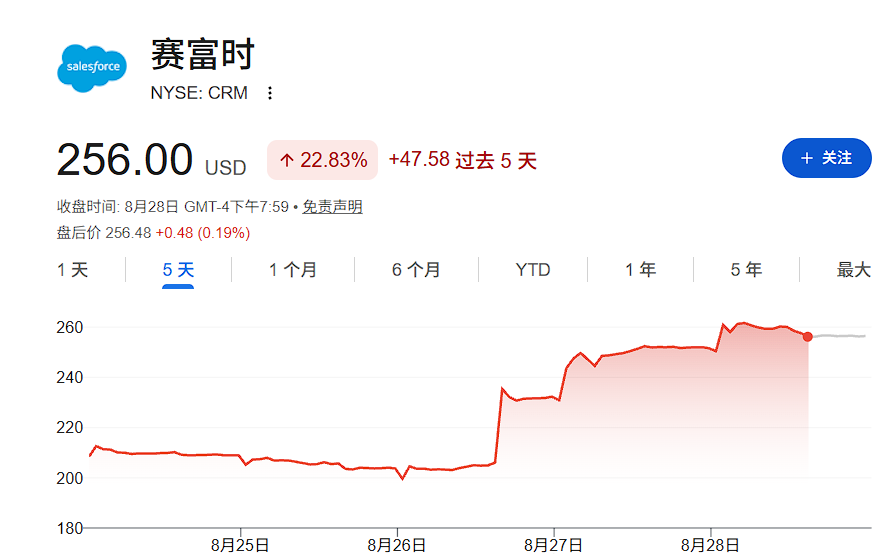
Salesforce’s share price has risen about 23% since its earnings report was released last week.
The End of the Subscription Model
Salesforce’s transformation marks a fundamental challenge to the software-as-a-service (SaaS) business model it pioneered.
Twenty-five years ago, Salesforce led the industry’s historic transition from one-time software licensing to subscription fees based on employee headcount. This model reduced upfront costs for SMEs and shifted the burden of software upgrades and maintenance to vendors, kickstarting a two-decade SaaS boom cycle.
However, the rise of AI is turning this logic upside down. As enterprises increasingly use advanced AI agents like Anthropic’s Claude to handle complex tasks involving Salesforce and other applications, the frequency of direct employee interaction with these applications decreases, undermining the foundation of per-user subscription pricing.
Benioff admits that software pricing is entering a period filled with uncertainty and that Salesforce is following in the footsteps of startups rather than leading the transformation.
Embracing "Results-Based Pricing"
The new model that Salesforce is currently exploring closely resembles the approach long used by data analytics company Palantir.
Palantir signs highly customized contracts with enterprise clients, combining fixed fees with usage-based and results-based charges. Benioff noted that this flexible pricing model has enabled Salesforce to "close some very large deals," pointing out that vendors can "command extremely high prices" for their products under this model—Palantir’s sharp increase in revenue over the past year confirms this assessment.
Benioff further elaborated on his understanding of "results-based pricing":
"We don’t just want to say, ‘We made this many phone calls, so we charge $2.’ We want to say, ‘We helped you increase this much revenue, so we charge $2, because we helped you earn $20 or $40.’"
This means Salesforce aims to deeply align its profits with client business outcomes, rather than just measuring fees at the task level.
Claudeforce: A New Initiative on a New Battlefield
Facing competitive pressure from AI-native players like Anthropic, Salesforce launched Claudeforce last week—a service that allows clients to complete numerous Salesforce-related tasks directly via Claude, without having to interact with the applications themselves.
It is reported that, according to sources, Salesforce plans to build a monetization mechanism through Claudeforce: every time a third-party AI accesses data within a Salesforce application, Salesforce can profit from it; clients are required to upgrade to a higher subscription tier to activate this functionality.
The strategic intention here is to ensure that even if users no longer directly interact with Salesforce’s interface, the company can still maintain a core position in the AI ecosystem at the data layer, converting the risk of user attrition into a new revenue stream.
The Attribution Debate: Potential Pitfalls of the New Model
Reports indicate that while results-based pricing is attractive in theory, it could trigger complex attribution disputes in practice.
Payment service provider Stripe has issued guidance clarifying that sales conversions or other business outcomes "may be driven by product changes, marketing campaigns, or seasonal factors," rather than the software alone.
"Unless attribution rules are clearly defined, clients may contest whether outcomes should be credited to the software vendor," Stripe stated.
This risk is not without precedent. Software monitoring company Splunk experienced a temporary dip in revenue during its transition from license-based to subscription models. Analysts believe the outcome of the current pricing model experiments will, to a significant degree, determine whether established enterprise software companies like Salesforce can reinvent themselves amid the surge of AI.
Disclaimer: The content of this article solely reflects the author's opinion and does not represent the platform in any capacity. This article is not intended to serve as a reference for making investment decisions.
You may also like
Yen breaks 160 again as Washington refuses to release further intervention signals; Yen trading focus shifts to September central bank meeting
U.S. Treasury Secretary Scott Besant stated that the recent movement of the yen is "quite manageable," indicating that the latest decline of the yen is not seen as the kind of disorderly fluctuation that prompted the rare joint intervention by Japan and the U.S. last month.

Gold drifts lower below $4,450 as hawkish Warsh remarks lift Fed hike bets
US Stocks Weekly Macro Preview (Aug 31–Sep 4)
"The US does whatever it wants"! At the Jackson Hole Symposium, the ECB grows increasingly uneasy about the stability of US-EU financial cooperation
According to multiple informed sources, after exchanging views with their U.S. counterparts at the annual central bank meeting, European Central Bank officials were far from reassured. They are concerned that the longstanding conventions of global cooperation have been disrupted, and worry that the already tense relationship between the U.S. and Europe may face further challenges in the future.

Crypto prices
More


