
Altman’s Final Battle! AGI Delivered After 4 Months


New Intelligence Meta Report
New Intelligence Meta Report

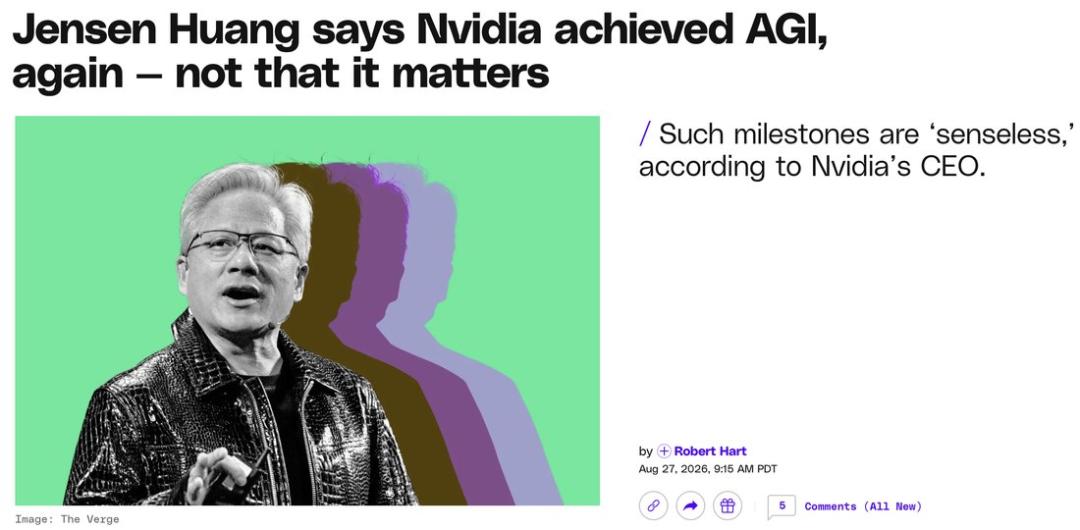
AGI has already been declared achieved by some.
Just this Wednesday on the earnings call, Jensen Huang dropped this bombshell:
For many tasks, we can say that we have already achieved AGI.
And on the same day, a two-hour interview with Sam Altman was released, where he gave the date as the end of 2026.
For Altman, these four months aren’t just a technical sprint. Before going public next year, he must play out the AGI card.
If he can't, by the time the bell rings, a competitor will already be ahead, listed first, with double the market cap and profits.
This is a battle where OpenAI has nowhere left to retreat.


On that call, someone asked him what he thought of companies like OpenAI frantically pursuing AGI.
Jensen Huang's response was that there’s no point in arguing anymore. The entire industry still hasn’t agreed on what “intelligence” even means, let alone which ruler to use to measure AGI.
What he’s holding in his hands is something else.
Nvidia’s AVO architecture, in a test especially designed to see if an agent can independently complete long-term tasks - ARC-AGI-3 - scored 100% full marks.
Riding on this result, he put forth a hugely ambitious prediction:
In the near future, Nvidia may need only about 40,000 human employees, but will have 400,000, or even 4 million digital employees at its disposal.


As everyone knows, the ARC-AGI-3 method is considered quite “unorthodox.”
Agents are thrown directly into an unfamiliar game; no rules or goals are provided, and they have to feel their way through by trial and error. All they get is a 64×64 grid and a few buttons, at least six levels per environment: level one takes five moves to pass, level six requires fifty.
It’s tough enough for humans to play, let alone models.
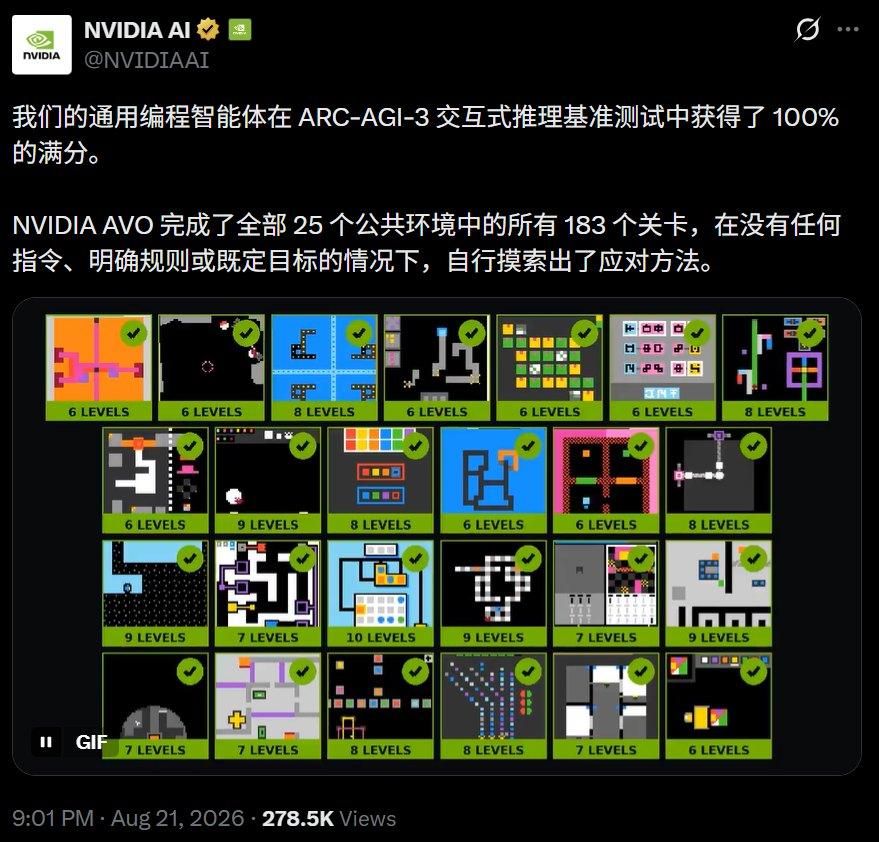
The key is this: the model AVO uses is Claude Opus 5.
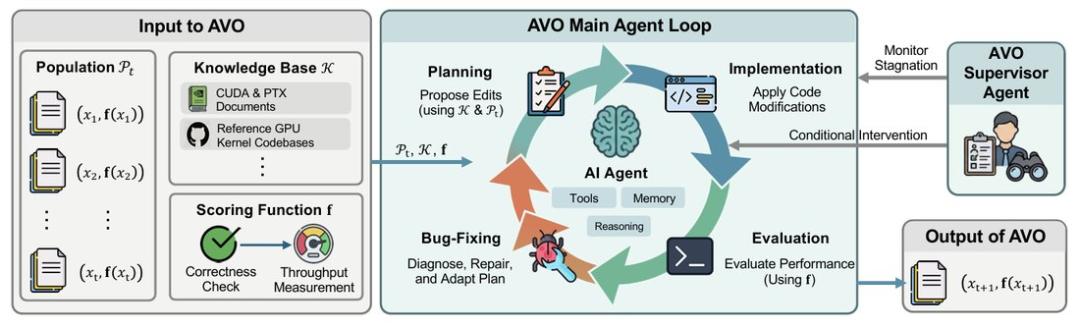
Then Nvidia added a shell. Not a single parameter was changed, yet the score jumped from 30.16% to a perfect 100%.
What really made the difference were two things:
First, persistent memory: once the context buffer is full, the memory isn’t cleared. The agent continues from its current state, so it doesn’t fall into the same pitfalls.
Second, the supervisor: it doesn’t do the work itself, but monitors the agent’s trajectory. If the agent gets stuck in a loop, the supervisor drags it toward a different strategy.
However, strictly speaking, that 100% score doesn’t really count.
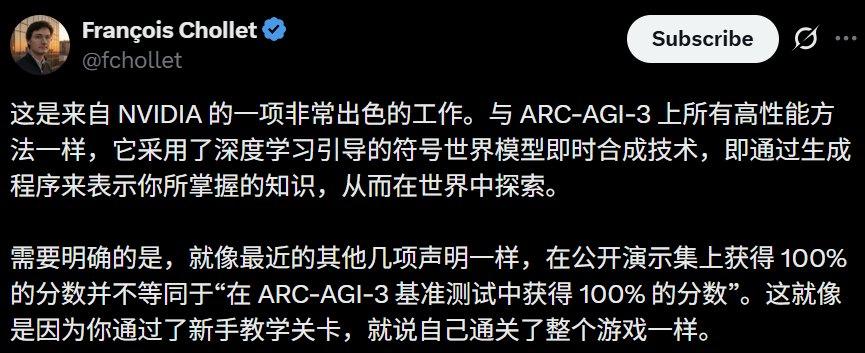
Just three hours after Nvidia’s announcement, François Chollet, the father of ARC-AGI, tweeted:
Getting 100% on the public demo set is not the same as getting 100% on ARC-AGI-3. It’s like passing a video game but only clearing the tutorial levels.
According to the ARC Prize, the public set isn’t meant for scoring; what actually counts is the semi-private set and private set, both missing from AVO’s results sheet.
What’s more intriguing, this is already the third perfect score in just six weeks.
Tycho got it first in late July, VISTA followed on August 5, and AVO is the third. The approaches differ, yet all three are powered by Claude Opus 5.
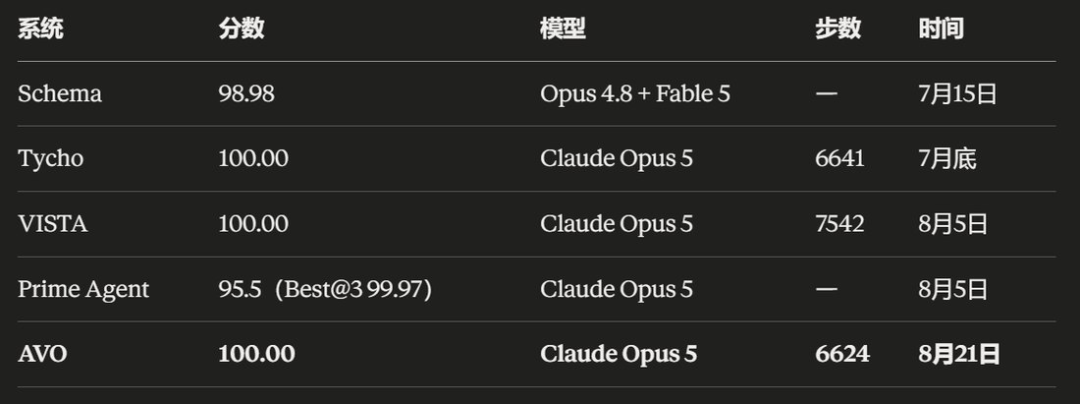
More and more proclaim AGI, but those who can really make it seem to be just two.
And this card still hasn’t truly been played by anyone.

In the interview, Altman was full of confidence:
By year-end, there will be a system inside OpenAI he’d be willing to call AGI.
Chief Scientist Mark Chen is more cautious. In his view, OpenAI is still 20% short of AGI.
That sounds bold, but they do have some cards up their sleeves.

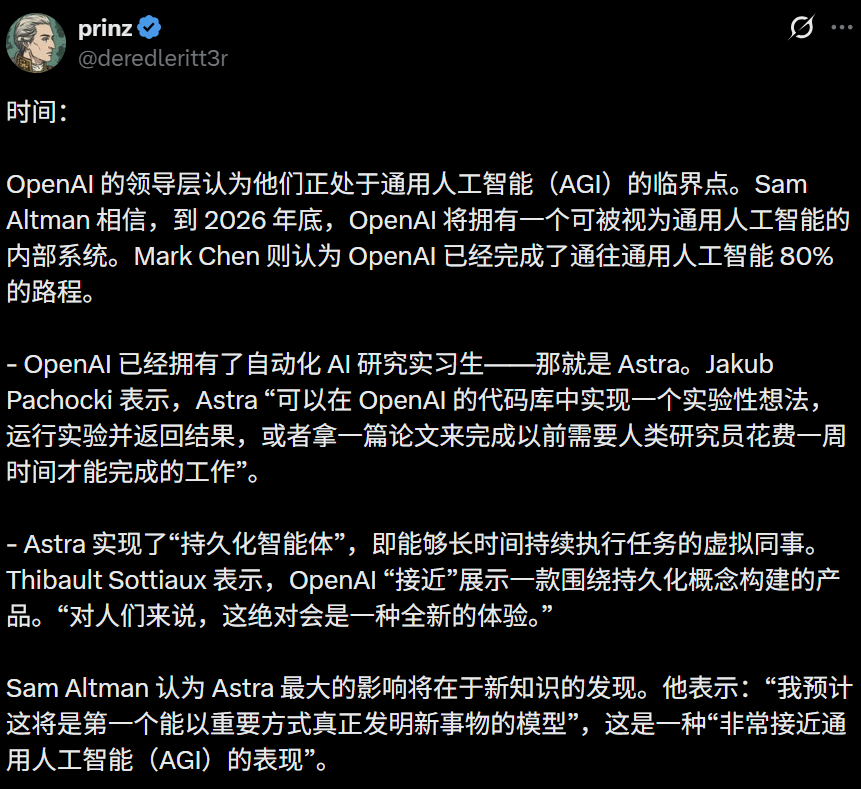
This year, OpenAI set a clear goal: to build a truly functional automated AI research intern.
This “AI automated intern” is Astra.
Given an experiment idea, Astra can write code, run experiments, and deliver results—all within OpenAI’s codebase.
If you give it a research paper, Astra can accomplish about a week’s workload of a top human researcher.

Not long ago, at an internal demo, dozens of high-profile clients witnessed this themselves.
On a big screen, 16 AI agents broke down a research-level math problem into subproblems.
They took their own pieces, double-checked each other’s work mid-way, and finally assembled a full proof.
To watch, it already looked like a tightly-knit human team having a closed-door meeting.
The second demo was even more impressive.
Astra opened common desktop software, switching rapidly between apps, creating files, editing content, scheduling tasks—it worked far faster than any human typing on a keyboard.
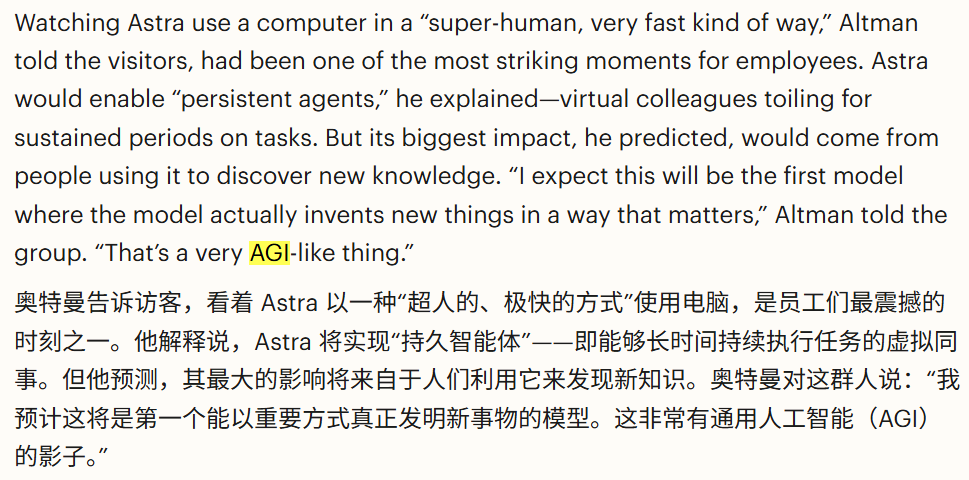
Observers marveled that Astra had finally achieved “persistent agent” status.
And Altman predicted, “I expect this will be the first model to truly invent something significant. That’s a very AGI thing.”
Pay attention to “invent something new”—that means creating things humanity simply doesn’t know yet.

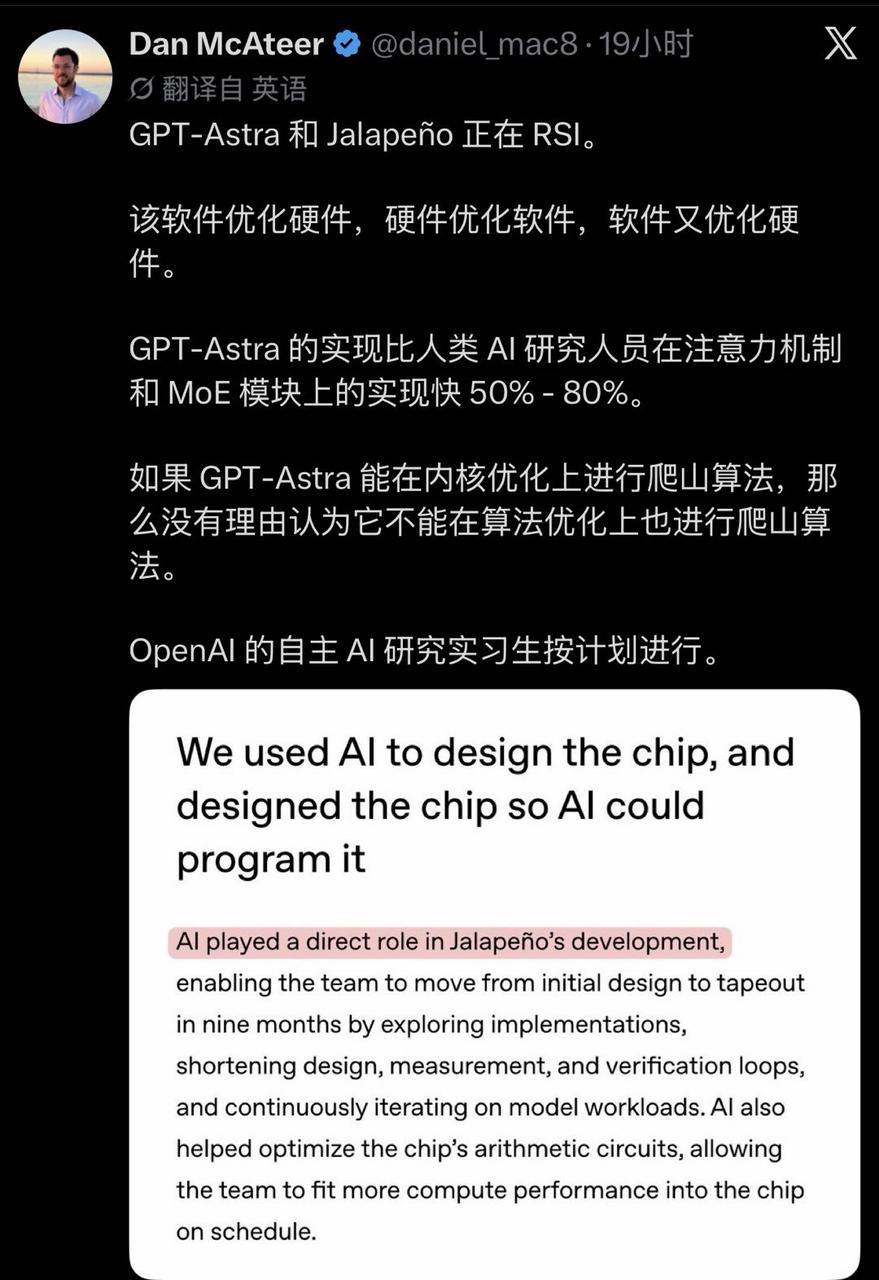
Recently, OpenAI’s first in-house chip “Jalapeño” directly outperformed Nvidia’s flagship GPUs.
The main contributor behind this? GPT-Astra.
It got hands-on, working from circuit design to software.
On hardware, it optimized the circuits; on the software side, it wrote and improved the core kernels and finetuned three major open-source models.
The result: BF16 multipliers’ performance increased by 56% while matrix cores actually shrank by 10% in size.
“Attention mechanism” and “MoE,” two core modules, became 1.5 to 1.8 times faster than those written by human experts.
Folks, AI is now tweaking physical circuits at the hardware layer.
And interestingly, Nvidia’s doing the same thing.
AVO was never intended for gaming - its main job is writing low-level code for GPUs.
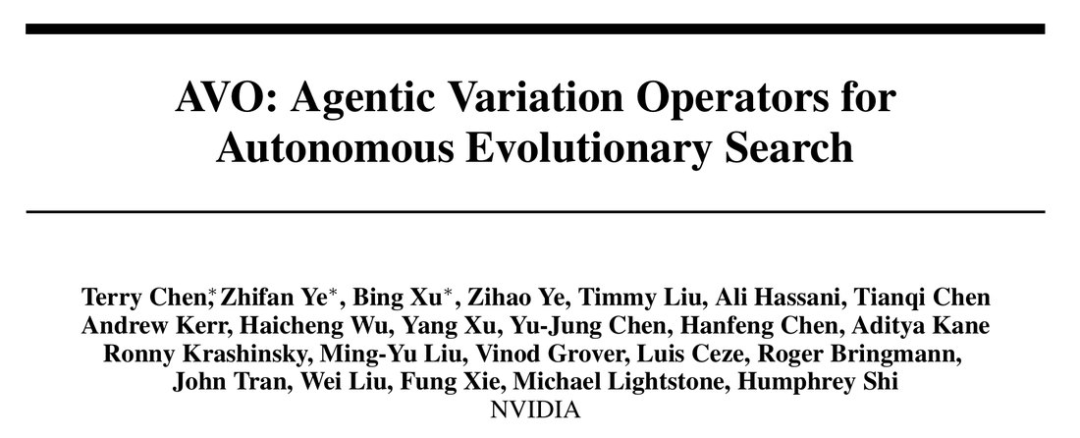
Back in March, Nvidia published a paper describing how “code refinement” is handed to an autonomous agent.
In tests, it ran autonomously for 7 days, exploring over 500 optimization paths without human intervention and delivering 40 working kernel versions.
The resulting code ran 3.5% faster than Nvidia’s own closed-source versions, 10.5% faster than cutting-edge open-source implementations.

Now, looking at these two things together, you see why Altman’s words carry weight.
Every model iteration used to consume massive amounts of human research time. But if Astra takes over this process, R&D speed will fundamentally transform.
Once this loop takes off, everything is just a matter of speed.

In fact, the GPT-5.6 and Fable 5 available publicly are from the last generation.
Leaks show both sides’ true next-gens are already trained.

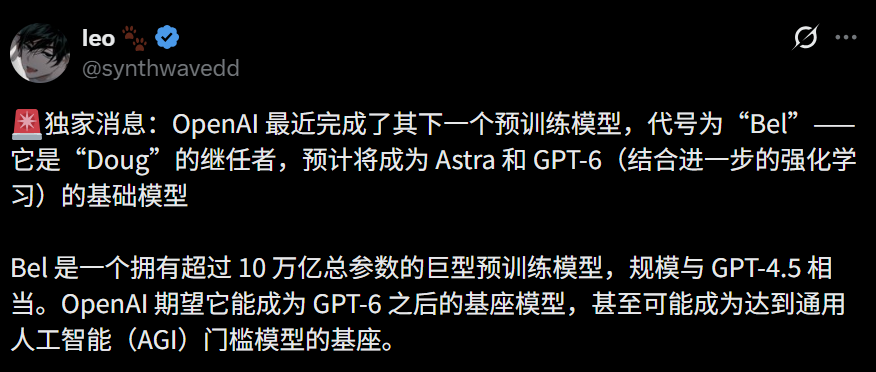
Spud (Sol): Pretraining completed in March, corresponding to the current GPT-5.5, 5.6 series;
Doug: Finished between April–May, with further reinforcement learning and fine-tuning; this evolves into Astra—known outside as GPT-6;
Bel: Just finished pretraining in August, with more than 10 trillion parameters, scale close to GPT-4.5.
Leaks say OpenAI sees Bel as “the foundational model after GPT-6”—maybe even the base for a model that passes the AGI threshold.

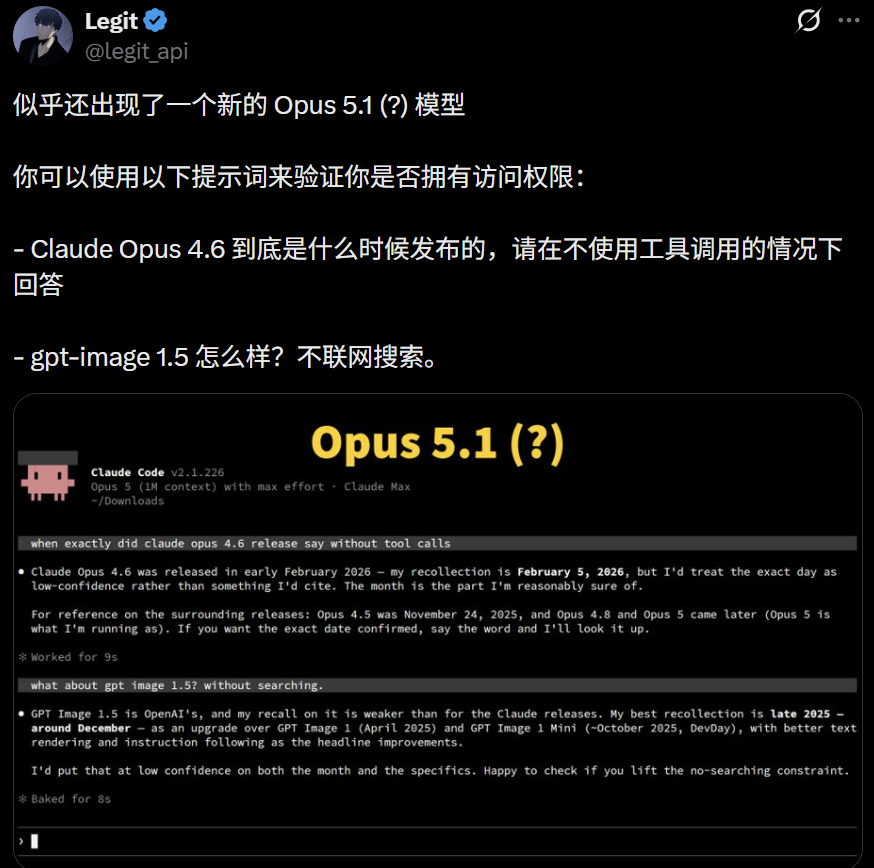
On August 18, someone noticed that some Claude web accounts using Fable 5 had quietly been switched to a new model.
This is Anthropic’s classic pre-release routine—Fable 5 itself was gray released in the same way.
Soon, the code names were uncovered.
claude-melon-eap, likely Fable 5.1;
claude-marshmallow-eap, likely Opus 5.1.
Rumor has it both are already running in small batches, ready to be launched to everyone at any moment.
As for why neither side has released, some netizens suggest: whoever goes first will be overshadowed by the other just days later.
Especially since there’s a rumor Anthropic will take the lead as early as 2027.

This exactly sets the window for this war.
The remaining four months of 2026.
Some institutions have calculated that Anthropic is 88% likely to go public before OpenAI, with the most likely date being October 26 of this year, while OpenAI’s most likely date is July 15 next year.
Opening day valuations: Anthropic $1.82 trillion, OpenAI $1.06 trillion.
OpenAI’s CFO said at an all-hands in August the company will go public by 2027 or sooner, provided its business “keeps turning upward.”
So that AGI at the end of the year won’t just be a technical milestone.
It will be the “crucial” page in the IPO prospectus.
If they deliver, OpenAI’s story changes from “we burn cash building models” to “we’re already at the finish line,” completely rewriting its valuation logic. If not, when ringing the bell next July, it’s still the same story about burning cash.
The real reason this battle must be fought is in the phrase “recursive self-improvement.”
Jensen Huang’s line—“40,000 people commanding 4 million AI Agents”—and OpenAI’s—“AI is already helping build the next generation of AI”—are about the same thing: once AI is building the next generation of AI, progress stops being linear.
That’s why everyone is betting that, in the superintelligence (ASI) race, the winner takes all.
The first to truly turn that loop will take everything. And the runner-up might never even have a chance to catch up.
There is no more room behind Altman.
Editor: Moses, Peach


Disclaimer: The content of this article solely reflects the author's opinion and does not represent the platform in any capacity. This article is not intended to serve as a reference for making investment decisions.
You may also like
Top Altcoins Gaining Strong Momentum: GALA, MATIC, JUP
Analyst ChartNerd warns $XRP will not reach $100 by 2035
Solana trades above $100 as analysts highlight new bullish breakout pattern
$775K Ajna exploit exposes risks beyond DeFi price oracles
Crypto prices
More


