
Why is an AI ring valued at $16 billion?

Show original
By:爱范儿
Bitget offers one-stop trading for cryptocurrencies, stocks, and gold. Trade now!
A welcome pack worth 6200 USDT for new users! Sign up now!

A ring with no screen, mainly used for recording sleep and health status, is trying to support a listed company valued at over $16 billion.
According to reports from Bloomberg and other media outlets, smart ring manufacturer Oura is preparing for an IPO in the US as soon as September this year, aiming to raise up to $3 billion, corresponding to a valuation that could exceed $16 billion. As early as May this year, there were leaks saying Oura had already submitted a confidential draft registration statement to the US Securities and Exchange Commission to prepare for the IPO.
If the listing goes smoothly, it is expected to become the world's first listed company with smart rings as its core business—winning the title of "the first smart ring stock".
This is a smart ring company coming out of Finland. In the consumer electronics market, it's far less prominent than Apple or Samsung, but its business scale is already quite significant.
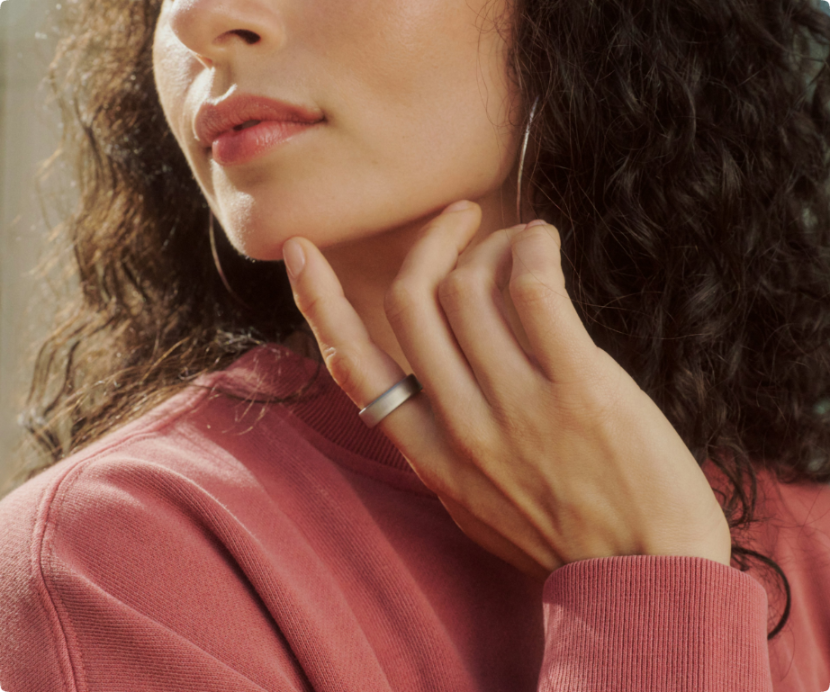
Image|Oura
In 2024, the company generated over $500 million in revenue and continues to grow rapidly. By September 2025, Oura will have sold more than 5.5 million rings in total. This May, the company estimated that paid memberships would surpass 5 million for the season.
A ring company from Finland is about to have as many paid members as the entire population of Finland.
Looking at the smart ring market as a whole, Omdia estimates that global shipments of smart rings will only reach 1.8 million units in 2024, with 1.6 million units in the first half of 2025. According to IDC, 161 million smartwatches were sold globally in 2023—a nearly two orders of magnitude difference in scale.
It's a market that hasn't truly become mainstream yet, and already a ten-billion-dollar company has emerged. Clearly, the capital is betting on much more than just the "ring" itself.
A ring, helping AI understand your body
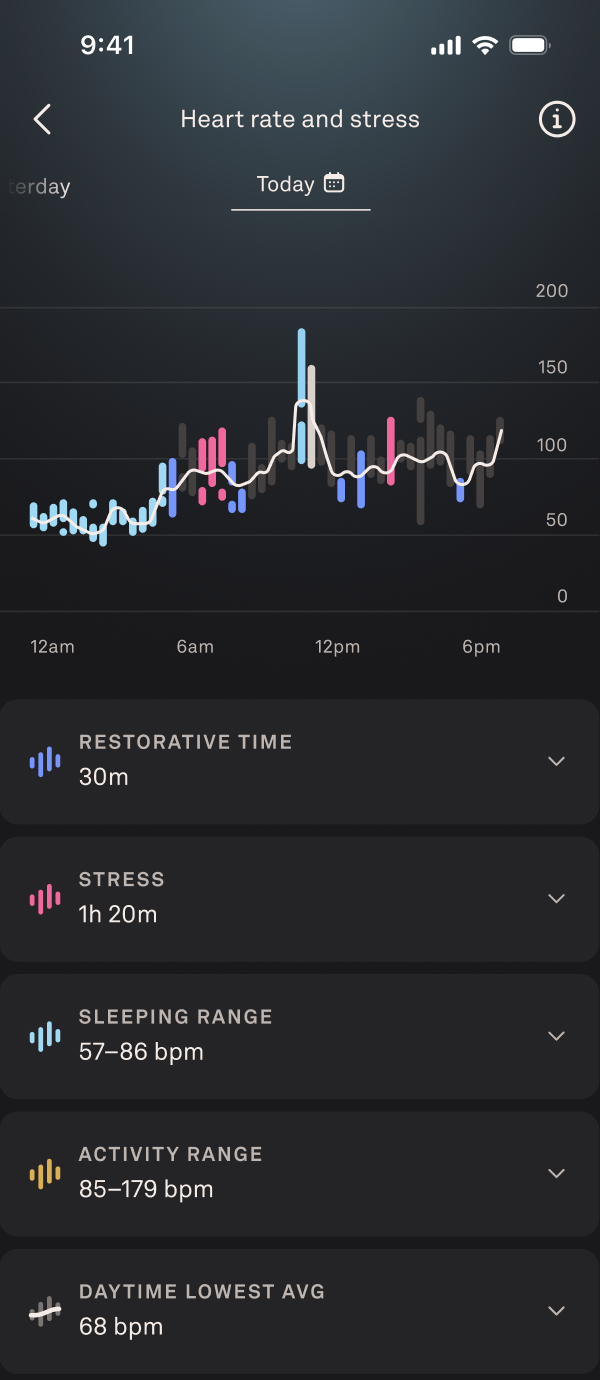
Optical sensors, temperature sensors, and accelerometers are all installed inside the ring, so they stay close to the finger day and night, continuously recording sleep, heart rate, activity, and recovery status.
Most people find it difficult to directly interpret these physiological signals, so they're converted into a few intuitive scores. With a quick glance in the morning, users can roughly judge their recovery: is today suitable for regular training, or should they practice less and rest more?
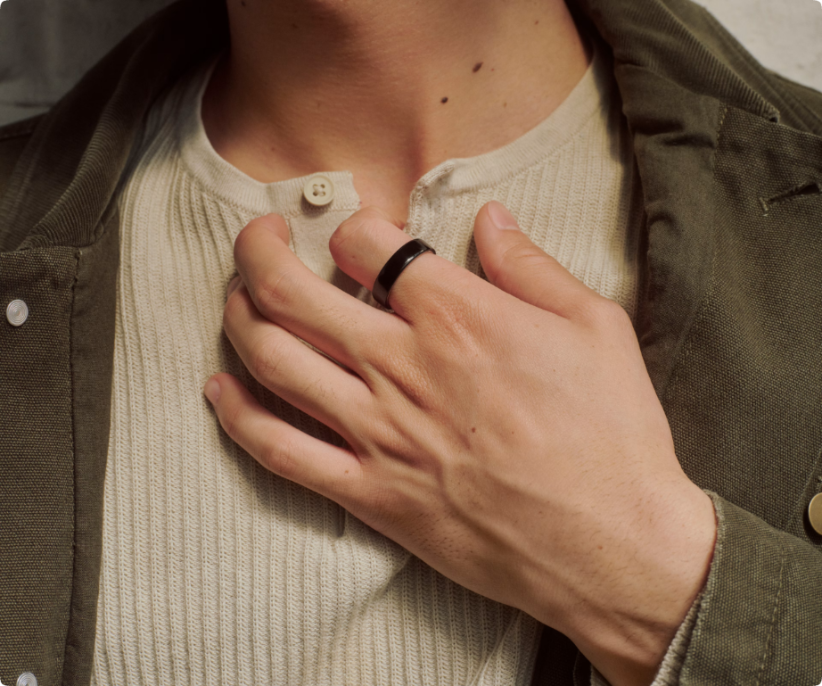
But in the era of AI, the problem changes: models know a lot, but not much about the person using them.
AI can check if it's going to rain in Beijing tomorrow, and knows you have a meeting at 10:00 am (UTC+8), but doesn't know you only slept for four hours last night. It reminds you to go jogging at 7:00 pm (UTC+8), but can't see your abnormally high resting heart rate and that your body hasn't recovered.
This type of information is collectively known as "personal context".
Emails, calendars, chat logs, and browsing history make up someone's digital context; sleep, heart rate, body temperature, exercise, stress, and recovery status form another, more physical context.
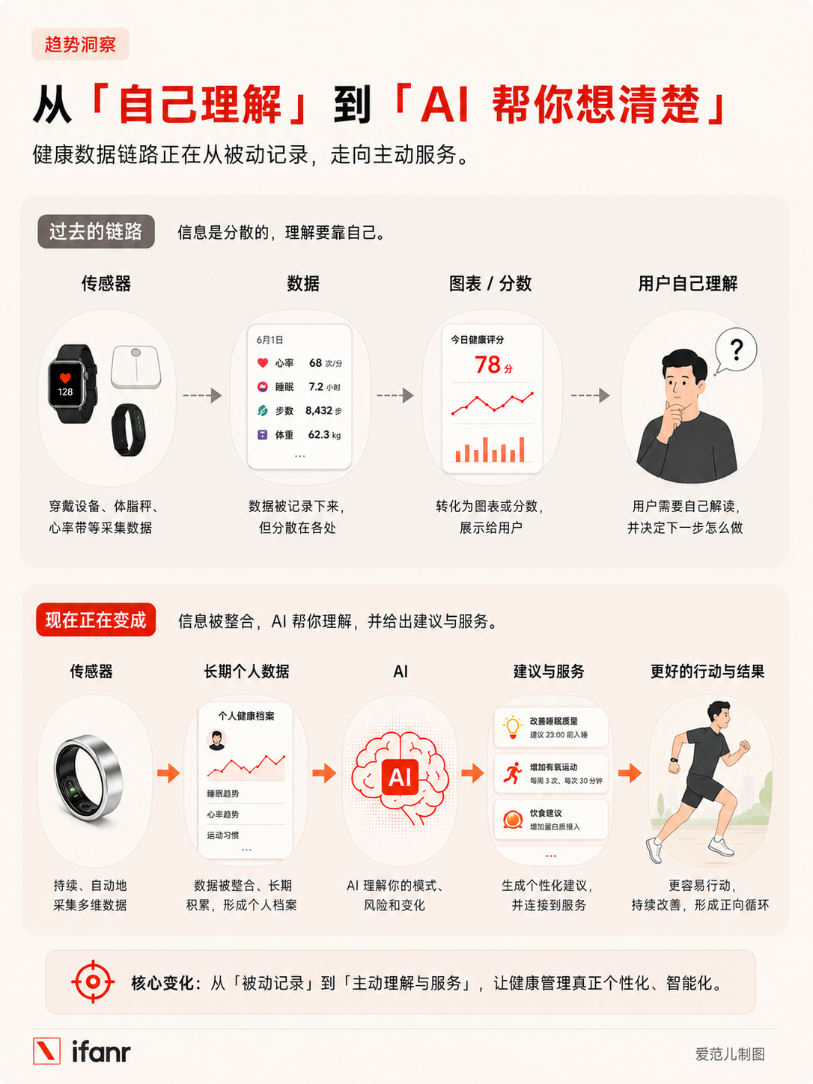
Previously, much of the data collected by wearables stayed in health apps. Now, AI can continue reading these data and provide explanations with reference to someone's long-term trends.
Oura is already doing this.
Oura Advisor combines health monitoring algorithms with large language models. It can read users' various scores, activity data, profiles, and past conversations with the Advisor, then answer questions based on both context and physiological indicators. In June 2026, Oura also added conversation history and "memory" to Advisor, allowing it to retain user-shared information.
This April, Oura also released its first in-house AI model dedicated to women's health. It places current physiological data into longer-term trends, seeking to interpret bodily changes from the menstrual cycle, pregnancy, and menopause.
This extends Oura’s business beyond hardware. After buying the ring, users can pay $5.99 a month to subscribe to more comprehensive data analysis. The longer the ring is worn, the more stable the personal baseline becomes; if you switch to another device, the new system often needs to relearn your sleep habits and physical state. The long-accumulated records increase switching costs.
In other words, Oura has already staked out a valuable entry point: millions of users are willing to wear a silent sensor for the long term, continuously deliver their body data, and pay for the interpretation of that data.
In recent years, model developers have often talked about parameters, context windows, and world knowledge. As the gap between foundational models shrinks, the next battle for AI to truly become a user's daily personal assistant will likely be about: Who understands you better.
The best AI sensor is the one that makes you forget it’s there
By 2026, AI will have a wide variety of hardware options. Smart glasses can see the user's field of vision, headphones are closer to sound, watches have screens and can house larger batteries. These devices gather richer information, making it easier for users to give commands at any time.
Compared to them, rings are more restrained. Their size limits the number of sensors they can house, and complex interactions are difficult. But when it comes to continuously recording bodily changes, a small size and minimal interaction actually lessen the wearing burden.
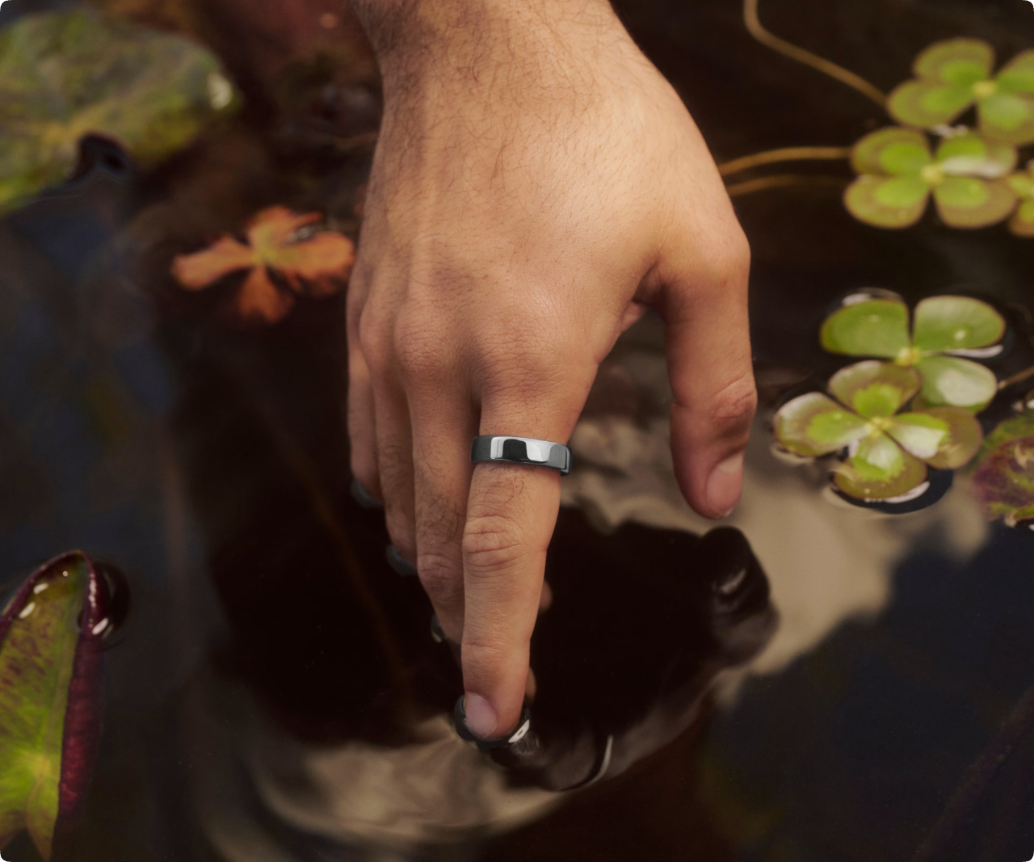
Watches are more suitable for exercise and instant operation, while rings are more convenient for sleeping. They're lightweight, screenless, and you don't have to worry about a crown digging into your wrist as you turn over. The Oura Ring 5 lasts six to nine days on a single charge, so you rarely need to take it off. The more continuously you wear it, the more complete the data it collects.
Fingers are also well-suited for measuring certain physiological signals. The optical sensor inside the ring is close to the skin, often less susceptible to interference than wrist-worn devices. A 2024 study compared Oura, Apple Watch, and Fitbit Sense using polysomnography as the reference. In four-stage sleep classification, Oura performed best.
The ring quietly records sleep, heart rate, and temperature changes, while complex analytics and feedback are handled by the AI in your phone. Users don’t have to read reports on the ring or learn a new interface.
This is quite the opposite of most past consumer electronics.
Smartphones and smartwatches are fighting for your attention, hoping you'll keep lighting up the screen and opening apps; but for a device devoted to collecting personal context, the ideal state may be letting the user forget it exists .
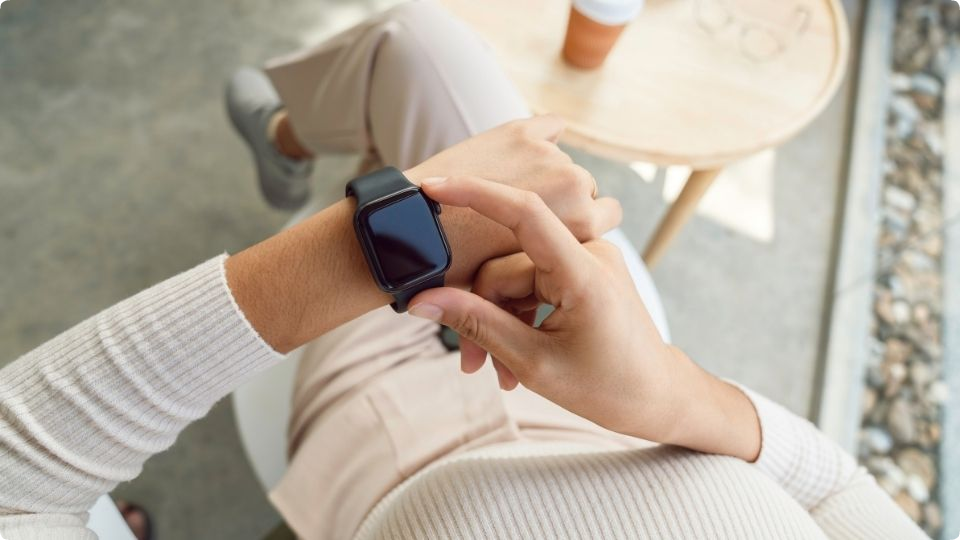
Image|Zingala
Being "unnoticeable" determines whether a ring can be worn continuously, while its accessory attributes determine whether users are willing to integrate it into their lives.
How many daily scenarios users are willing to wear it in determines how much continuous data the device can acquire. Rings are already part of daily wear and do not interfere with the use of watches or headphones. For meetings, dining, or formal events, as long as the material, color, and size are right, it fits seamlessly with clothing and other jewelry.
A device with ten sensors but worn only three hours a day may be less valuable than a simpler device worn for more than twenty hours straight.
Beyond Oura, many manufacturers are already exploring smart rings, albeit in different directions. Samsung's Galaxy Ring focuses on health and fitness, while Sandbar and Pebble want to bring microphones and voice recording to the finger. A ring can be a health sensor, or a portable voice interface.
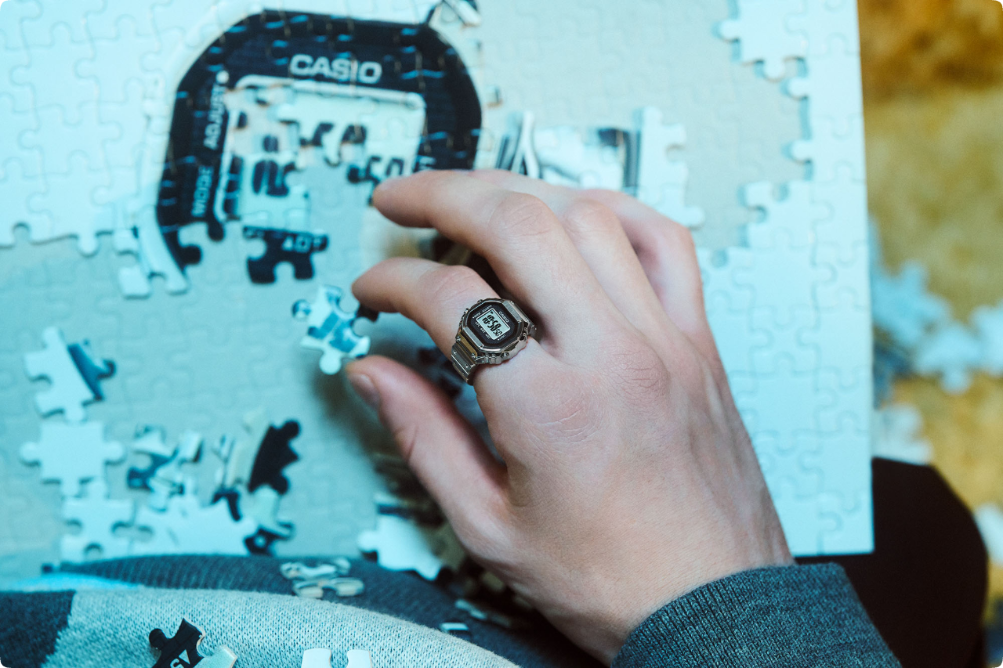
Casio’s CRW-H001 is particularly interesting. It integrates a digital display, buttons, and basic activity tracking into a full-metal ring, looking like a shrunken digital watch for the finger. However, this is clearly experimental, and Casio has thoughtfully considered its accessory aspect.
After all, a ring is worn outside. Whether its features fit is important—but just as important is whether users are willing to keep it on their hands.
Image|Yahoo
The business of AI rings faces plenty of rivals
If you put smart rings into the "personal context sensor" framework, the competition is fiercer than ever before.
When users only need a low-intrusion sensor that can be worn all day to continuously capture body data, a ring becomes just one of many options.
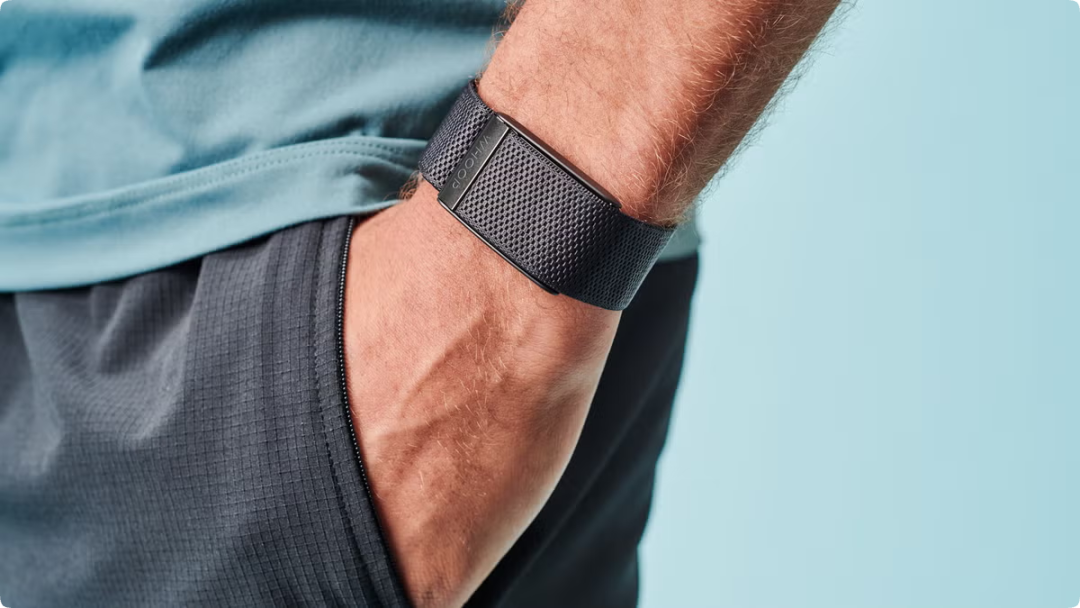
Screen-less bands are the strongest competitors to smart rings.
WHOOP has long stuck to this form, with its latest official battery life reaching 14 days and the ability to charge while wearing. Bands can house larger batteries and can also be worn on the upper arm.
Smart glasses capture sound, visuals, and environmental information—covering even richer data dimensions than rings.
Image|Men's Health
The ring’s standout advantage is its unnoticeable presence, but this also brings extra engineering challenges.
Its internal space is extremely limited—battery, antenna, chip, and sensors must all fit into a ring just a few millimeters thick, while also withstanding water exposure, drops, and extended contact with skin. If the battery malfunctions, the ring shape on the finger can even amplify the risk.
In 2025, there was already an incident where a Galaxy Ring’s battery swelled, making it impossible to remove from the user’s finger, requiring medical intervention.
If a ring is to become a long-term wearable sensor, reliability becomes even more critical.
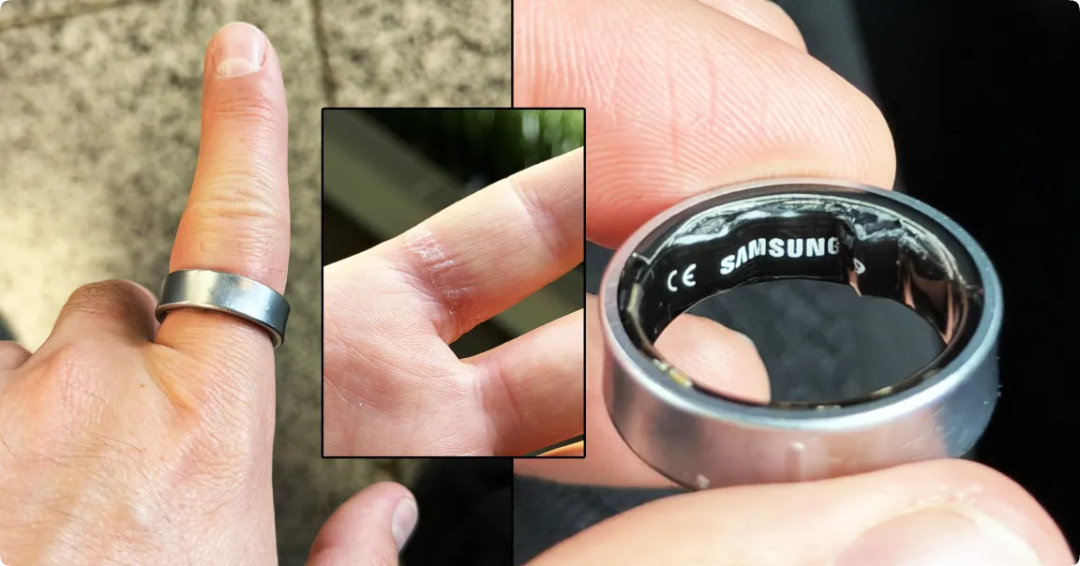
Image|Futurism
Currently, smart rings are still some way from people’s expectations in shape and experience.
Their size is not yet as delicate as traditional jewelry rings; they may misidentify activities—on X, some reviewers mention Oura missing two hours of intense Pilates but recognizing blow-drying hair as exercise.
From a product experience perspective, smart rings are still far from being perfect wearables; but from a product form standpoint, they've already occupied a form that fits AI perfectly.
The ability to be accepted long-term by users is already a rare trait for AI hardware .
This might be Oura’s real significance.
It may not yet prove that smart rings will become the next smartwatch, or that rings have already won the AI hardware war. But it does show the industry that as long as a computing device is quiet, private, and close to the body, users really might be willing to keep it on 24/7.
For AI, which increasingly needs "data about you," this is already an important starting point.
Author|Fang Junming
Editor|Xiao Qinpeng



0
0
Disclaimer: The content of this article solely reflects the author's opinion and does not represent the platform in any capacity. This article is not intended to serve as a reference for making investment decisions.
Understand the market, then trade.
Bitget offers one-stop trading for cryptocurrencies, stocks, and gold.
Trade now!
You may also like
Grayscale Flags $40T U.S. Debt as Catalyst for Bitcoin, ETH, and ZEC Debasement Trade
Coinsprobe•2026/08/29 04:30

Shiba Inu spot outflows increase, SHIB trades at $0.00000532 with pressure building
Cointurk•2026/08/29 03:36
Ondo Finance appoints Allison Parent as Chief Policy Officer, targets tokenized asset regulation
Cointurk•2026/08/29 02:54
What will the Federal Reserve do? Waller gives the answer!
美投investing•2026/08/29 01:14

Crypto prices
More
Bitcoin
BTC
$77,655.71
-2.62%

Ethereum
ETH
$2,440.33
-2.00%

Tether USDt
USDT
$1.0000
-0.00%

BNB
BNB
$690.96
-2.62%

XRP
XRP
$1.39
-2.39%

USDC
USDC
$1.0000
+0.01%

Solana
SOL
$104.06
-2.72%

TRON
TRX
$0.3401
+0.34%

Hyperliquid
HYPE
$81.91
-1.67%

Zcash
ZEC
$799.24
+1.46%
How to buy BTC
Bitget lists BTC – Buy or sell BTC quickly on Bitget!
Trade now
Become a trader now?A welcome pack worth 6200 USDT for new users!
Sign up now