
July Core PCE Released as Expected: What Two Key Signals Did the Fed's Favorite Indicator Reveal?

Huitong Net, August 26—— The US July core PCE monthly rate fully met expectations, maintaining 3.3% year-on-year, indicating that price pressures excluding food and energy did not accelerate significantly, nor did they cool further. The overall PCE slightly exceeded expectations, mainly driven by service spending, while goods spending retreated. After the data was released, the US Dollar Index first dropped then rebounded within about 10 points.
On Wednesday (August 26), at 20:30 Beijing time, the US Department of Commerce’s Bureau of Economic Analysis released the July Personal Consumption Expenditure (PCE) price index and related data. The results showed: July overall PCE price index monthly rate +0.2% (expected +0.1%, previous value -0.1%), core PCE price index monthly rate +0.2% (expected +0.2%, previous value +0.1%); year-on-year, overall PCE +3.7%, core PCE +3.3%. Personal income monthly rate +0.4% (expected +0.2%), personal spending monthly rate +0.2% (expected +0.1%), real consumption spending remained flat. Personal savings rate was reported at 3.0%. The simultaneously released Q2 GDP annualized growth rate was 1.5%, and consumption remained resilient. 
During the Asian and early European sessions of the day, the market overall was in a wait-and-see state, focusing on whether this PCE could confirm the inflation path and clues brought by the simultaneous release of the final Q2 GDP reading. The core PCE, favored by the Federal Reserve, became the focus, with the market previously generally expecting a monthly rate of +0.2%. The overall environment was mainly narrow-range oscillations, and US Treasury yields remained relatively stable before the data.
After the data was released, the US Dollar Index first dipped then rose, fluctuating about 10 points, reaching a high of 98.99. Spot gold slipped $13 from $4,628/ounce to $4,615/ounce, after having risen $10 before the announcement.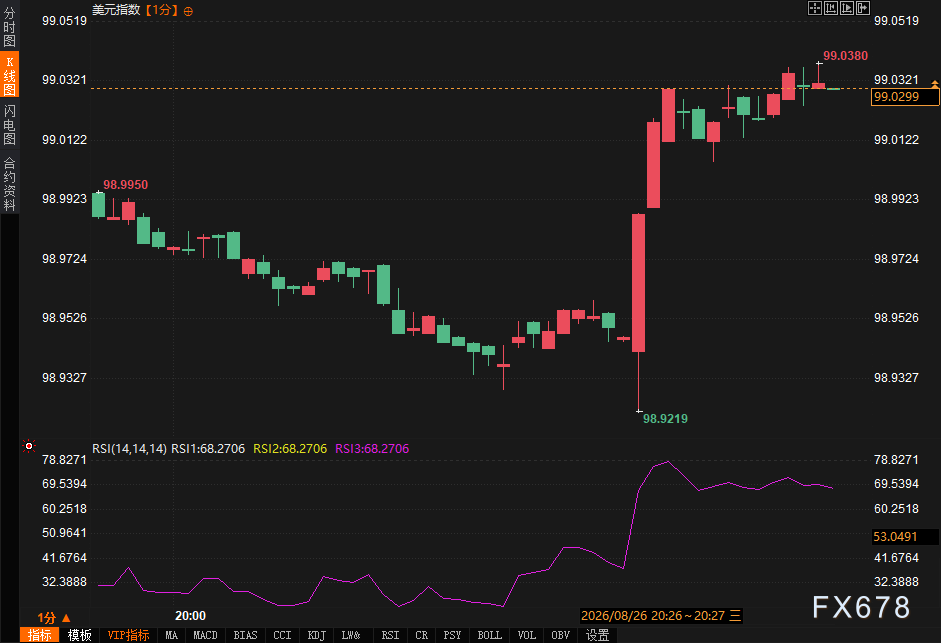
Deep Connectivity Analysis
From a fundamental perspective, the core PCE monthly rate fully met expectations, year-on-year maintained at 3.3%, indicating that price pressures excluding food and energy did not accelerate significantly, nor did they cool further. The overall PCE slightly exceeded expectations, mainly pushed by service spending, while goods spending retreated. The income side was obviously stronger than expected, providing support for consumption, but actual consumption was flat, indicating that part of the nominal spending growth was offset by price factors. Comparing with historical trends, the core PCE monthly rate in June was only +0.1%, this rebound to +0.2% is moderate rather than a large deviation; year-on-year at 3.3%, the same as the previous value, continues the trend of being higher than the Federal Reserve’s 2% target but still relatively stable. The latest quotes show that after the data was released, the US 10-year Treasury yield rose slightly then held steady at 4.635%, with the market reacting cautiously in real time.
Interest rate-sensitive products experienced limited volatility after the data, with no trend breakthroughs, and the logic between the short-term and long-term scenarios remained consistent: in the short term, stability was supported by the expected core data, while in the long term, caution remained due to the sticky year-on-year figures.
The contrast in views is clear. Before the data, many institutions emphasized the baseline scenario of "soft PCE" or "in line with expectations", believing the core numbers would hardly deliver major surprises or shocks. Their focus shifted to subsequent employment and information from the Jackson Hole Central Bank annual conference. Retail investors, however, expressed more concern about inflation stickiness, worrying that any upside surprise might push rate expectations higher. After the release, institutional views quickly shifted to "core meets expectations, overall slightly hot but impact limited", stressing the coexistence of strong income and moderate spending, and that there is no new shock to the policy path; retail discussion became divided, with some focusing on the dollar’s short-term support following the yield’s mild reaction, and others remaining cautious about flat actual consumption. Sentiment shifted from pre-release anxiety to post-release divergence. The deviation in expectations mainly lay in the slight overall PCE beat, but the anchoring effect of the core data was obvious, and the market did not form one-sided pricing.
Trend Outlook
Based on these data, the market displayed low-volatility digestion. The fact that the core PCE met expectations limited the scope for major rate repricing. The 10-year Treasury yield returned to steady after a brief uptick, reflecting the market’s reconfirmation of the inflation path. Focus will now turn to whether real consumption momentum can pick up as income improves, as well as how the stickiness of year-on-year readings affects medium-term pricing. Overall, the event impact is moderate, and the market is likely to continue ranging, awaiting the next round of data to further validate short- and long-term logic consistency.
Frequently Asked Questions
Q: Why is the July core PCE seen as in line with expectations rather than exceeding them?
The core PCE monthly rate landed exactly at the consensus level of +0.2%, and year-on-year stayed unchanged at 3.3%. The market is more sensitive to the core indicator favored by the Federal Reserve, and the slight upside surprise in overall PCE was diluted by the services-goods split, so the immediate reaction was mostly steady.
Q: What does it mean that personal income rose significantly but actual consumption was flat?
Income growth was mainly driven by wages and transfer payments. While nominal spending rose, flat actual spending shows that price factors are still at play. This aligns with the historical pattern of income leading and consumption lagging, providing neutral short-term support for growth expectations.
Q: Why was there a clear difference between institutional and retail views before and after the data release?
Institutions focus more on the anchoring effect of core indicators and the policy path, so the gap between their forecasts and results is small. Retail investors are more easily influenced by aggregate figures and momentary yield swings, with their sentiment shifting from pre-release anxiety to post-result division. This reflects a difference in the pace of information processing.
Q: Why was the shock to US Treasury yields from this PCE so limited?
The core data did not deviate from expectations, limiting the scope for repricing. Yields rose briefly but quickly stabilized at 4.635%, showing that the market views the slight overall heat as a one-off factor, not a change in trend.
Q: In a historical context, what does this data imply for short- and long-term logic?
Compared with the low rebound in June, this is a moderate rise. Short-term support is absorbed steadily, while the long-term view remains observant due to year-on-year numbers still above target. The two have not shown obvious conflict.
Disclaimer: The content of this article solely reflects the author's opinion and does not represent the platform in any capacity. This article is not intended to serve as a reference for making investment decisions.
You may also like
US-Canada Tariff Standoff Continues: Canada Adjusts Countermeasure List, Imposes 50% Tariff on Copper Wire, Charcoal, and Other Goods
Canada has added U.S.-made copper wire and charcoal to its list of products subject to a 50% retaliatory tariff. Certain American goods such as glass containers, printed images, and gypsum bricks have also been included, while fish and seafood products have been removed from the list.
Top Meme Coins to Invest in 2026: Ranked by Risk and Upside Potential in the Upcoming Bull Run
EGRAG CRYPTO highlights bullish engulfing pattern in XRP, points to $0.98 as cycle pivot
SK Hynix (SKHY.US) officially breaks ground on its first HBM advanced packaging plant in the US, investing over $4 billion, with mass production set to begin in 2029
South Korean storage chip giant SK Hynix held a groundbreaking ceremony on Thursday for its advanced storage chip packaging plant in Indiana, USA.

Crypto prices
More


